Our work is entirely funded by private donations – we receive no money from government. Your money will help us continue funding research into vitiligo and supporting people affected by the condition.
Frequently Asked Questions
What are rules for military service entry with vitiligo?
Military service · Patient guide
How do military-service rules for vitiligo differ across countries?
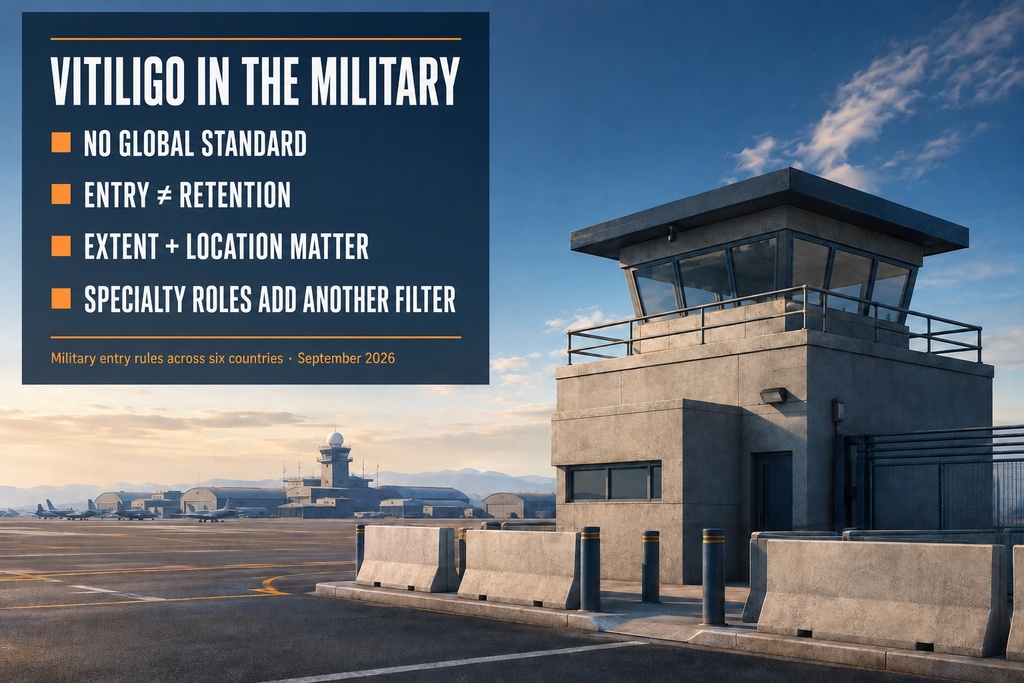
There is no global standard. Every country writes its own entry rules, and most treat people already in uniform differently from new applicants. Some systems distinguish limited or covered vitiligo from widespread disease or involvement of exposed skin. Others do not.
Rules checked September 2026
Read this first
- Accession and retention are usually governed by different rules.
- A rule that bars a recruit may not apply to someone already serving — and vice versa.
- Aviation, diving, submarines, special operations, and similar roles may add another layer of medical scrutiny.
- The recruiting medical officer or service medical board makes the decision in a live case.
At a glance
| Country or system | What the public rule says | Practical effect |
|---|---|---|
| United States | DoDI 6130.03, Volume 1 does not name vitiligo as a disqualifying skin condition. Other medical findings, treatment requirements, functional limitations, or standards for restricted occupations may still affect the decision. | Not barred by name. Not a free pass. |
| United Kingdom | The latest detailed public version of JSP 950 says an applicant with vitiligo and no associated autoimmune disorder may be assessed as fit. The current medical policy is not fully public. | Named and relatively lenient when isolated. |
| Canada | CAF policy uses individualized medical screening, medical categories, and employment limitations tied to basic training and occupational requirements. No public rule names vitiligo as an automatic bar. | Individual review; no published guarantee. |
| Brazil | The conscription exemption list names extensive vitiligo that resists treatment. A court has also rejected exclusion based only on a generic “skin dyschromia” label where the governing notice did not name vitiligo. | Named for extensive disease; contested in practice. |
| India | Standards differ sharply. Some Armed Forces routes may accept minor leukoderma on covered skin, while the separate CAPF system lists vitiligo as a ground for rejection. | The exact force and advertisement decide the first cut. |
| Russia | Regulation No. 565, Article 62 sets numeric thresholds. Widespread vitiligo means three or more patches on different anatomical regions, each at least 10 cm across, or two or more facial patches, each at least 3 cm. | The most numeric public rule. |
Country notes
United States
Accession is governed by Volume 1, updated in February 2026. Isolated vitiligo is not expressly listed as an automatic bar. Retention is covered separately in Volume 2, and specialized occupations may use additional standards.
United Kingdom
The last detailed public wording says isolated vitiligo without another autoimmune disorder may be compatible with entry. Extensive or functionally significant skin disease is treated differently for serving personnel. Confirm the live rule with the recruiting medical authority.
Canada
Applicants receive individualized screening and a medical category. The practical question is whether any resulting employment limitation conflicts with basic training, universality of service, or the requirements of the intended occupation.
Brazil
Decree 703 of December 22, 1992 names extensive, treatment-resistant vitiligo as a basis for definitive exemption. That does not guarantee acceptance of limited disease; it only means the named exemption does not automatically cover it.
India
Do not copy the rule of one force into another. Published Air Force standards may accept minor leukoderma on covered areas and reject exposed-site or extensive involvement. CAPF is a separate Ministry of Home Affairs system. In Karthik Kumar A. v. Union of India, the Delhi High Court upheld rejection under the applicable CAPF guidelines.
Russia
Article 62 is the tape measure. Meeting the widespread-disease threshold leads to limited fitness, peacetime exemption, and placement in the reserve. Smaller or fewer patches fall into a fit-with-restrictions category. In practice, documentation from the state dermatovenerologic dispensary—the KVD—plays the central role; a general-practitioner note is secondary.
The bottom line
One diagnosis can open several different files: fitness to join, fitness to remain, eligibility for a specialized occupation, and possible service connection later. They are related. They are not interchangeable.
This page does not answer questions about care while serving, whether a particular treatment affects deployability, or how veterans’ disability systems rate vitiligo. Those are separate journeys—and separate paperwork.
Educational information only. This is not a binding fitness determination, medical opinion, or legal advice. Military standards change, and full current texts are not always public. Confirm the rule that applies to the country, service, occupation, and date of the decision.
FAQOther Questions
- Can chemicals cause vitiligo?
Certain chemicals can trigger vitiligo, leading to a condition known as chemical-induced vitiligo. While clinically and histologically indistinguishable from other types of viti...
- I have a new job - should I tell colleagues about my vitiligo?
Starting a new job can be both exciting and nerve-wracking, — especially if you’re concerned about stares or questions regarding your skin. Taking a proactive approach can help ...
- Do Antioxidant Supplements Help Vitiligo?
Do Antioxidant Supplements Help Vitiligo? Short answer Maybe a little. But probably not in the way most people hope. Antioxidant supplements may offer modest support, especially...
Though it is not always easy to treat vitiligo, there is much to be gained by clearly understanding the diagnosis, the future implications, treatment options and their outcomes.
Many people deal with vitiligo while remaining in the public eye, maintaining a positive outlook, and having a successful career.
Copyright (C) Bodolóczki JúliaBy taking a little time to fill in the anonymous questionnaire, you can help researchers better understand and fight vitiligo.