New

GPT-Rosalind: Testing Vitiligo Ideas Before They Eat Years of Your Life
Every researcher knows the quiet horror of the “promising idea.”
It starts innocently: a pathway looks interesting, a molecule appears relevant, and a cluster of papers whispers, “There is something here.” Then come months of reading, years of small experiments, grant applications, and eventually the realization that the idea was not wrong exactly — it just was not worth the human caffeine it consumed.
In a field like vitiligo, this is not just a frustration. It is a systemic problem.
In this article
The Math of a Rounding Error
As we documented in The Vitiligo Paradox, vitiligo remains a common disease with rare funding. NIH data shows roughly $0.56 million per year in explicitly vitiligo-titled funding over the last four decades. For a condition affecting millions, that is not a research budget. That is a rounding error wearing a lab coat.
In cancer or diabetes, a weak idea might find enough oxygen to survive for a few years. In vitiligo, the margin for waste is close to zero. A poorly chosen project does not just fail. It can drain years from a young investigator’s career and exhaust the limited pilot funds of small foundations.
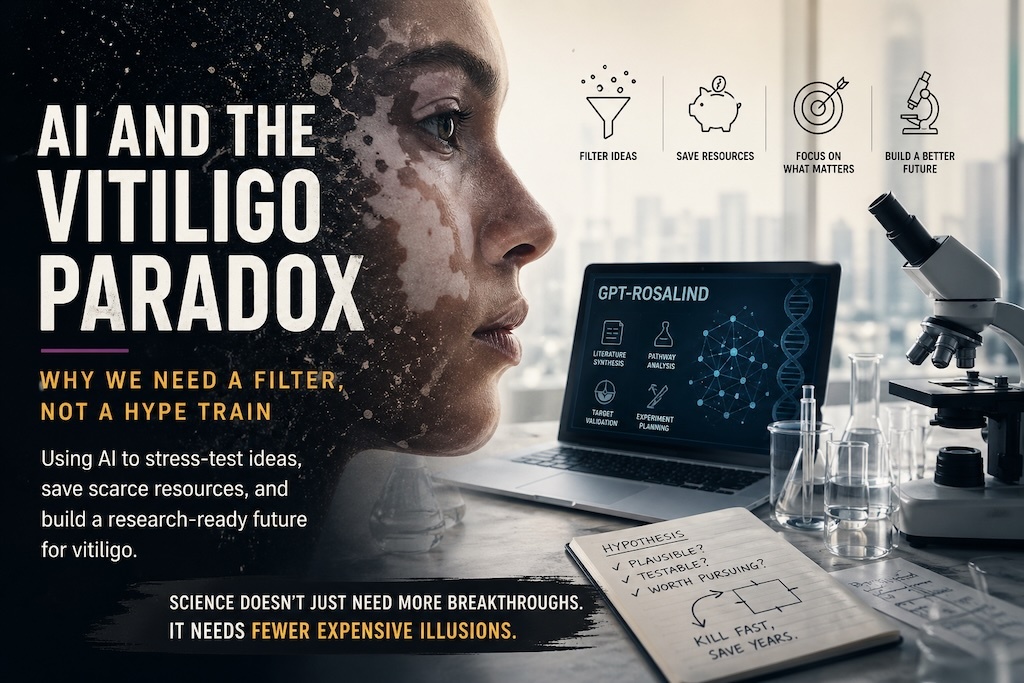
This is why OpenAI’s announcement of GPT-Rosalind matters. Not because it is magic, but because it may become a filter.
GPT-Rosalind: Hypothesis Triage Before the Rabbit Hole
GPT-Rosalind is a frontier reasoning model designed to support research across chemistry, protein engineering, genomics, and other areas of life sciences. In plain English: it is being built to help scientists connect dots faster, stress-test ideas earlier, and avoid wasting years on weak hypotheses.
The shift is simple, but important. The question is no longer only, “Can we test this in the lab?”
It becomes: “Before we spend a single dollar, can we stress-test whether this is biologically plausible — or just statistical noise with a nice haircut?”
For VRF, the goal is not “AI-discovered drugs.” That is the Hollywood version, with a rotating DNA helix and someone dramatically removing glasses. The more useful goal is hypothesis triage.
We need to ask better early questions, like:
- Is this target upstream enough to matter, or is it just a downstream smoke signal?
- Does a mechanism observed in alopecia areata or psoriasis plausibly translate to vitiligo?
- What is the cheapest serious experiment that could falsify this idea?
Good science is not only about building beautiful theories. It is also about killing weak ideas before they become grant proposals.
The Bigger Picture: Compute as a Scientific Instrument
GPT-Rosalind does not exist in a vacuum. We are seeing the rise of AI-native life sciences. Look at LillyPod, Eli Lilly’s AI infrastructure rated at more than 9,000 petaflops of performance.
VRF cannot outspend a pharmaceutical giant. Our piggy bank would need therapy if we tried.
But we can become research-ready.
AI does not run on hope. It runs on data, structure, validation, and good questions. By organizing vitiligo data — registries, biobanks, longitudinal cohorts, imaging standards, treatment histories, and patient-reported outcomes — we make the field easier to study, easier to model, and easier to support.
That is where a patient-focused research foundation can matter.
The Cold Shower: Fast Nonsense Is Still Nonsense
A model that reads papers quickly can still misunderstand them. AI can find biology, or it can create an elegant hallucination with a PubMed accent.
The rule is simple: AI can rank hypotheses, but it cannot replace validation.
Wet-lab work still matters. Clinical expertise still matters. Patient reality still matters. Biostatistics still matters. The human brain, despite its tendency to check email during important meetings, is not obsolete.
The best use of systems like GPT-Rosalind is not to bypass scientists, but to give them better starting points.
Our Move
VRF will not chase every shiny AI announcement like a cat with a laser pointer.
We will focus on the middle layer: structuring the vitiligo field so that when powerful models, research teams, and pharmaceutical partners look at vitiligo, they find an ecosystem ready for action.
Science does not just need more breakthroughs. It needs fewer expensive illusions.
In a field where funding is scarce and unanswered questions are everywhere, that may be one of the most practical uses of AI: not to replace research, but to make scarce research resources smarter.
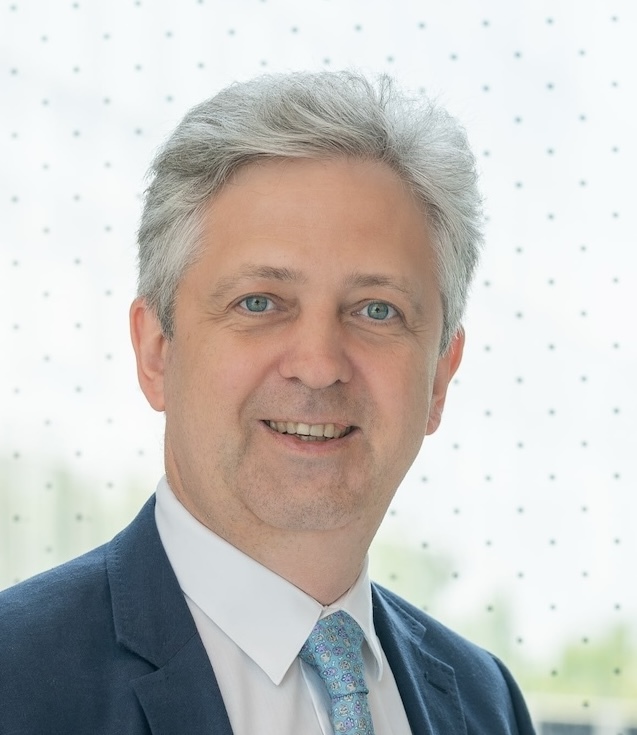
Yan Valle
Prof. h.c., CEO VRF
Suggested Reading
- AI’s Growing Role in Health Advice
- Building a Responsible AI-Powered Ecosystem in Vitiligo
- AI and Vitiligo: The Digital Frontier Gets Real
- AI Shopping for Therapies: How Cognitive Surrender Is Reshaping Pharmaceutical Marketing
Listen to Deep Dive in Vitiligo Podcast
- The State of Vitiligo 2025: A Fast-Moving Field With Slow-Moving Funding (Ep. 57)
- AI for Vitiligo Patients — Beyond the Hype (Ep. 51)
- Can AI Predict Vitiligo Onset, Subtype and Activity? (Ep. 37)
FAQOther Questions
- Which is better for judging vitiligo — Wood’s lamp or dermoscopy?
A recent study out of India compared the two head-to-head. Both tools correlated fairly well with clinical criteria, but dermoscopy had a slight edge: Wood’s lamp: sensitivity 7...
- Is there a link between vitiligo and depression?
Depression and anxiety are often linked with vitiligo, significantly impacting a person’s quality of life. The connection stems from the shared origin of the skin and brain duri...
- Pyrostegia venusta as a folk medicine for vitiligo?
Pyrostegia venusta, also known as “flame vine” or “cipó-de-são-joão,” is a neotropical evergreen vine native to Brazil. It thrives in fields, coastal areas, forest edges, and ro...
Though it is not always easy to treat vitiligo, there is much to be gained by clearly understanding the diagnosis, the future implications, treatment options and their outcomes.
Many people deal with vitiligo while remaining in the public eye, maintaining a positive outlook, and having a successful career.
Copyright (C) Bodolóczki JúliaBy taking a little time to fill in the anonymous questionnaire, you can help researchers better understand and fight vitiligo.