New

The Quiet Case For Older Vitiligo Therapies
Research Update
The Billion-Dollar Molecule Problem
And maybe a healthy one.
Our paper, “Making the Case for Azathioprine, Methotrexate, and Cyclosporine in Active Vitiligo Management”, has successfully passed peer review and has been accepted for publication in Frontiers in Medicine.
For the past few years, vitiligo conversations have largely revolved around shiny new molecules, JAK inhibitors, and the future of precision immunology.
Important progress, absolutely.
But much of the world still lives in a different reality.
Many patients remain in low-resource settings where newer therapies are unavailable, unaffordable, or simply nonexistent outside conference slides and press releases.
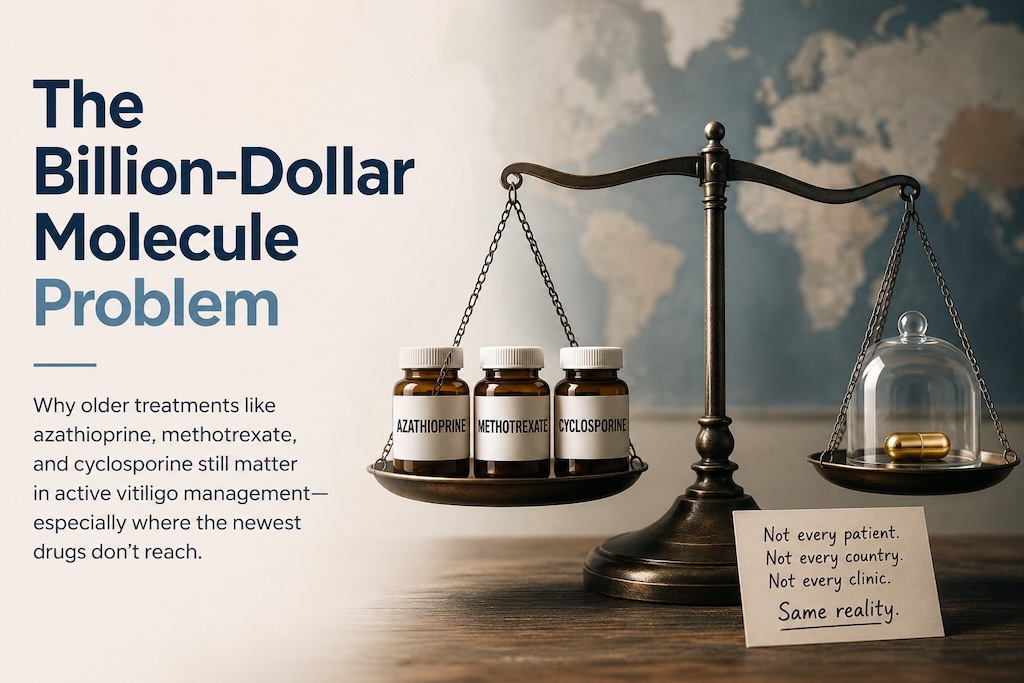
This paper revisits an uncomfortable but necessary question: what do we do for active vitiligo patients today — not in the imagined future, but in real clinics with real constraints? or for those unfit for TCIs or JAKs?
We examine the evidence, limitations, and practical role of older systemic immunomodulators like azathioprine, methotrexate, and cyclosporine — treatments that may not be fashionable, but remain relevant for many clinicians worldwide.
Not every important medical conversation needs to start with a billion-dollar molecule.
Continue reading: Making the Case for Azathioprine, Methotrexate, and Cyclosporine in Active Vitiligo Management
Sometimes it starts with asking whether we’ve quietly abandoned useful tools simply because they stopped being commercially interesting.

Yan Valle
Prof. h.c., CEO, Vitiligo Research Foundation
FAQOther Questions
- What are risks of oral and topical corticosteroids?
Corticosteroid drugs (like hydrocortisone, and others) are often used for treating vitiligo. By mimicing the effects of hormones your body produces naturally in your adrenal gla...
- Which skin conditions can be mistaken for vitiligo?
Vitiligo is a common skin condition with characteristic milky white patches of irregular shape. However, several other skin conditions exhibit similar symptoms that can lead to ...
- Do Antioxidant Supplements Help Vitiligo?
Do Antioxidant Supplements Help Vitiligo? Short answer Maybe a little. But probably not in the way most people hope. Antioxidant supplements may offer modest support, especially...
Though it is not always easy to treat vitiligo, there is much to be gained by clearly understanding the diagnosis, the future implications, treatment options and their outcomes.
Many people deal with vitiligo while remaining in the public eye, maintaining a positive outlook, and having a successful career.
Copyright (C) Bodolóczki JúliaBy taking a little time to fill in the anonymous questionnaire, you can help researchers better understand and fight vitiligo.