Our work is entirely funded by private donations – we receive no money from government. Your money will help us continue funding research into vitiligo and supporting people affected by the condition.
Frequently Asked Questions
Vitiligo and Pregnancy
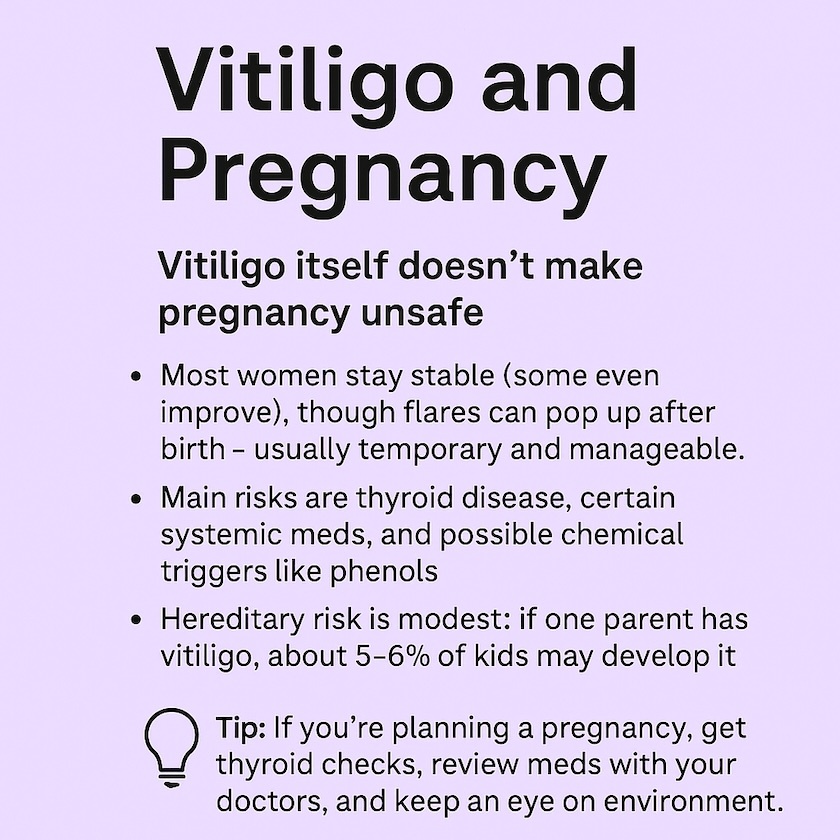
Pregnancy with vitiligo? The good news: vitiligo itself doesn’t make pregnancy unsafe. Most women stay stable (some even improve), though flares can pop up after birth — usually temporary and manageable.
Is pregnancy riskier if I have vitiligo?
- Not in most cases. Studies show a possible increase in miscarriage risk, but risks for preterm birth, pre-eclampsia, or stillbirth are not consistently higher.
Will vitiligo flare during pregnancy?
- Often it stays stable, sometimes it improves. After childbirth, some women notice flare-ups as the immune system resets. These are usually temporary and manageable.
Can vitiligo treatments harm a pregnancy?
- Topical corticosteroids and narrowband UVB are generally safe. Systemic immunosuppressants and biologics require individual assessment and timing adjustments.
What’s the risk of passing vitiligo to my child?
- About 5–6% if one parent is affected, compared to ~1% in the general population. Genetics play a role, but environment and other triggers matter just as much.
Should families worry about environment and chemicals?
- Yes, within reason. Avoid heavy phenol exposure (dyes, glues, disinfectants), and be mindful of “ZIP code effects” where local environments may add risk. Clean lifestyle choices and prenatal care tip the balance toward healthy outcomes.
Read more:
Published on August 22, 2025
FAQOther Questions
- How can I explain vitiligo to my children?
Vitiligo can be confusing for children because it doesn’t resemble an "illness" in the typical sense. Choosing the right way to explain it depends on your child’s age and maturi...
- Which is better for judging vitiligo — Wood’s lamp or dermoscopy?
A recent study out of India compared the two head-to-head. Both tools correlated fairly well with clinical criteria, but dermoscopy had a slight edge: Wood’s lamp: sensitivity 7...
- Which skin conditions can be mistaken for vitiligo?
Vitiligo is a common skin condition with characteristic milky white patches of irregular shape. However, several other skin conditions exhibit similar symptoms that can lead to ...
Though it is not always easy to treat vitiligo, there is much to be gained by clearly understanding the diagnosis, the future implications, treatment options and their outcomes.
Many people deal with vitiligo while remaining in the public eye, maintaining a positive outlook, and having a successful career.
Copyright (C) Bodolóczki JúliaBy taking a little time to fill in the anonymous questionnaire, you can help researchers better understand and fight vitiligo.