New

The Day the Internet Quietly Stopped Being Human
It finally happened. Faster than even the experts anticipated, we crossed a threshold that fundamentally alters the nature of the digital world.
What's inside this story
Cloudflare dropped the numbers and most people just kept scrolling.
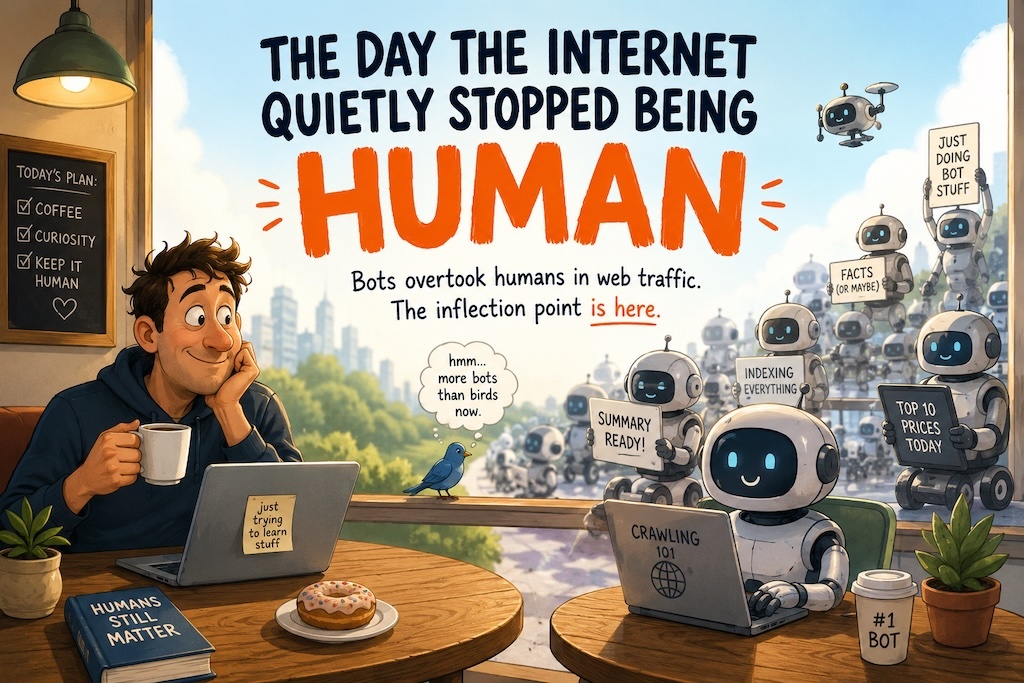
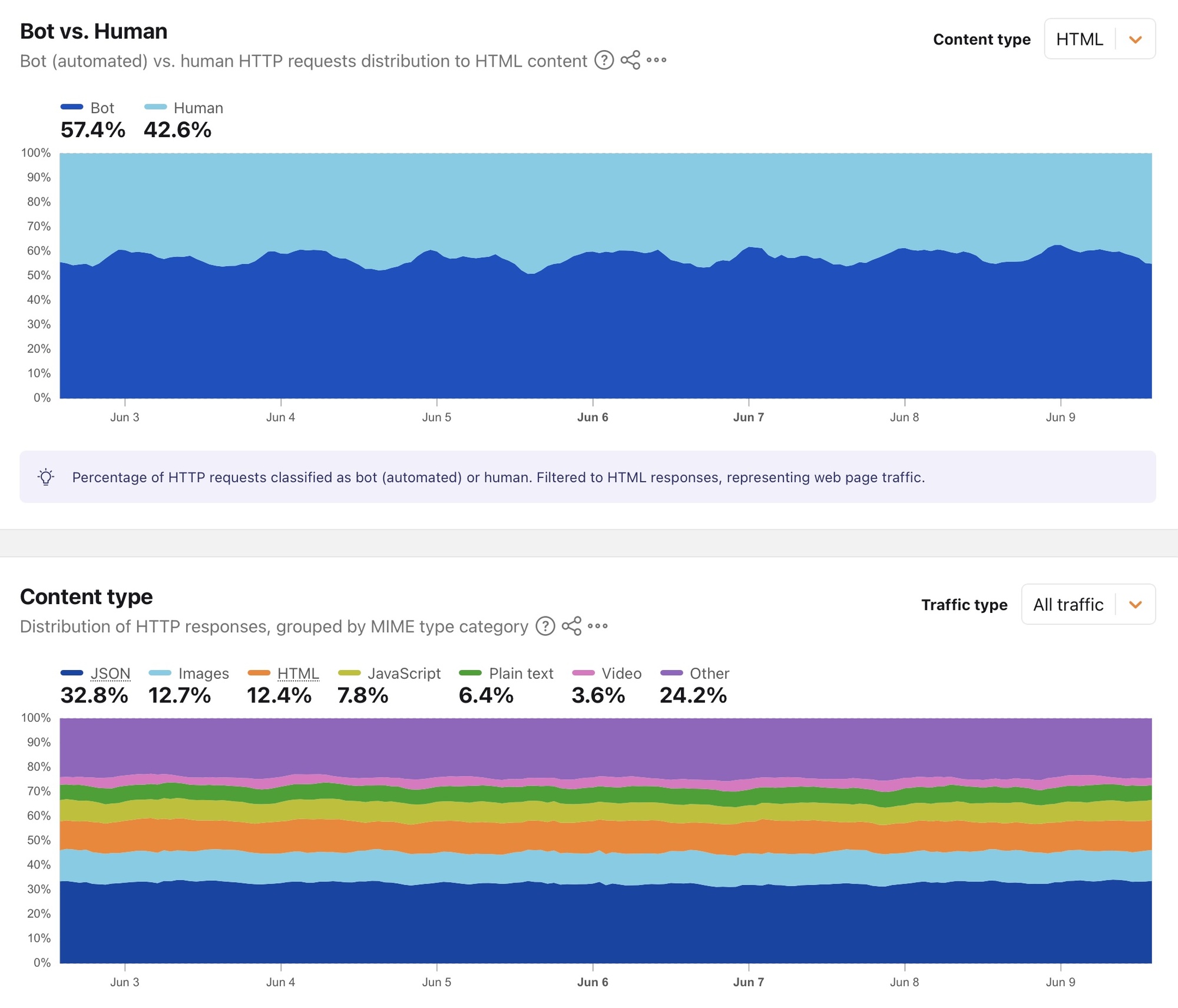
Bots have now overtaken humans in web traffic for the first time. More than 57% of online traffic is generated by automated systems rather than people. Matthew Prince, Cloudflare’s CEO, essentially shrugged and noted that it happened much faster than expected.
I read the report and thought: Well, there it is.
Recognition, Not Surprise
Not shock. Just that heavy click of recognition.
Anyone paying attention saw the freight train coming. The surprise wasn’t the destination — it was how damn fast it arrived.
A year ago we published an article called “We’re Taking Vitiligo to YouTube — Before AI Chatbots Get It Wrong, Forever.” The concern was simple: if we didn’t flood the web with real patient voices, real data, and real human experience, the models would train on whatever happened to be available. Good information, bad information, outdated information, slick marketing dressed up as expertise — it would all end up in the same digital blender and come back to future patients as knowledge.
At the time it sounded like a prediction. Today it reads more like yesterday’s status update.
The Internet Is Changing What It’s For
Because here’s what actually matters: the internet isn’t just getting more bot traffic. It’s changing what it’s for.
For most of its life, the web was a direct, clumsy conversation between curious humans and raw information. You searched. You clicked. You fell down rabbit holes. You read things you disagreed with. You argued in comment sections. Sometimes you changed your mind at two in the morning.
It was inefficient, frustrating, occasionally ridiculous, and profoundly human.
A lot of people don’t search anymore. They ask.
An AI assistant does the crawling, reading, comparing, summarizing, and synthesizing. Then it hands back a polished little package while agentic systems continue grinding through product catalogs, scientific papers, airline prices, competitor websites, and vast chunks of the internet while we sleep.
What used to be your direct relationship with knowledge is increasingly mediated by software that never doubts itself, never gets embarrassed when it is wrong, and never lived with the condition it is explaining.
That small handoff may turn out to be one of the biggest shifts of our lifetime.
Chapters of the Same Story
Over the past year we have been circling the same issue from different directions.
What happens when advertising psychology and behavioral manipulation meet inside a chatbot? What happens when AI becomes a personalized echo chamber? What happens when algorithms quietly edit your information diet before you even realize a choice has been made on your behalf?
At first these looked like separate stories. Increasingly, they look like chapters of the same story. The information ecosystem is reorganizing itself around machine intermediaries. The Cloudflare report simply provides the first clear evidence of how far that transition has already progressed.
And once bots become major consumers of information, they inevitably begin influencing what information gets created in the first place.
Publishers adapt. Researchers adapt. Businesses adapt. Governments adapt. Patient organizations adapt.
We spent decades learning how to educate people. Increasingly, we may have to learn how to educate the algorithms that educate people.
Not because the machines are evil. They are not. But because every additional layer between people and reality has the power to quietly reshape reality.
Why This Matters in Healthcare
This shift hits especially hard in healthcare.
For years patient organizations focused on educating patients directly. Today we also have to think about the systems that increasingly stand between patients and information.
That is one reason we continue investing in podcasts, videos, educational content, patient stories, and AI-guided tools. Not because AI is the enemy. Quite the opposite.
AI is rapidly becoming the first gateway through which many people encounter medical information. If we care about the quality of patient education tomorrow, we need to care about what the machines are learning today.
Who Gets the Last Word?
I am not declaring the “dead internet.” Humanity is not about to be replaced by armies of chatbots arguing with each other in comment sections. But the human layer of the internet is getting crowded out faster than almost anyone predicted.
The tools we built to help us navigate the infosphere are becoming its primary inhabitants. And there is absolutely no stuffing this cat back in the bag.
The machines won the traffic war. Fine. That doesn’t mean they get the last word on reality.
Human experience — stubborn, specific, contradictory, and wonderfully messy — still matters. Real communities still matter. Expertise still matters. Lived experience still matters. Those things do not compress cleanly into tokens.
And that is exactly why they are worth protecting like hell. The inflection point passed while most of us were busy doomscrolling.
The question now isn’t whether the internet changed. It’s whether we recognize the change before the next freight train comes through.

— Yan Valle, CEO VRF
📚 Suggested Reading
When AI Becomes Your Personal Echo Chamber
What happens when artificial intelligence becomes so personalized that it stops challenging your assumptions and starts reinforcing them? A look at the hidden risks of hyper-tailored digital realities.
What Happens When Mad Men Meet Breaking Bad Inside a Chatbot?
Explores the collision between advanced persuasion techniques, behavioral psychology, and AI systems that increasingly shape what we buy, believe, and pay attention to.
Your Future Has Been Edited (And You Didn’t Even Notice)
A deeper look at recommendation engines, algorithmic filtering, and how invisible systems increasingly decide which opportunities, ideas, and narratives reach us.
🎙 Listen to Deep Dive in Vitiligo Podcast
AI for Vitiligo Patients — Beyond the Hype (Ep. 51)
A practical discussion of where AI genuinely helps patients, where it falls short, and what realistic expectations should look like.
AI Now Speaks the Language of Cells (Ep. 40)
How artificial intelligence is transforming biomedical research, drug discovery, and our understanding of human biology.
The Great AI Debate: Do AI Models Truly ‘Get’ It? (Ep. 26)
A thoughtful exploration of what AI systems understand, what they imitate, and where the boundaries between intelligence and prediction really lie.
FAQOther Questions
- What tests for vitiligo should be done?
Before starting vitiligo therapy, several tests may be recommended to ensure an accurate diagnosis and appropriate treatment plan: Physical Examination A thorough physical exami...
- Which therapy has minimal side-effects?
Dead Sea climatotherapy is a unique and highly effective treatment option for vitiligo, offering a top-tier safety profile and natural therapeutic benefits. Its combination of p...
- Which is better for judging vitiligo — Wood’s lamp or dermoscopy?
A recent study out of India compared the two head-to-head. Both tools correlated fairly well with clinical criteria, but dermoscopy had a slight edge: Wood’s lamp: sensitivity 7...
Though it is not always easy to treat vitiligo, there is much to be gained by clearly understanding the diagnosis, the future implications, treatment options and their outcomes.
Many people deal with vitiligo while remaining in the public eye, maintaining a positive outlook, and having a successful career.
Copyright (C) Bodolóczki JúliaBy taking a little time to fill in the anonymous questionnaire, you can help researchers better understand and fight vitiligo.