New

Vitiligo Library Grant Program Update
In some communities, a book may arrive years before a dermatologist. That is exactly why the Vitiligo Library Grant Program still matters.
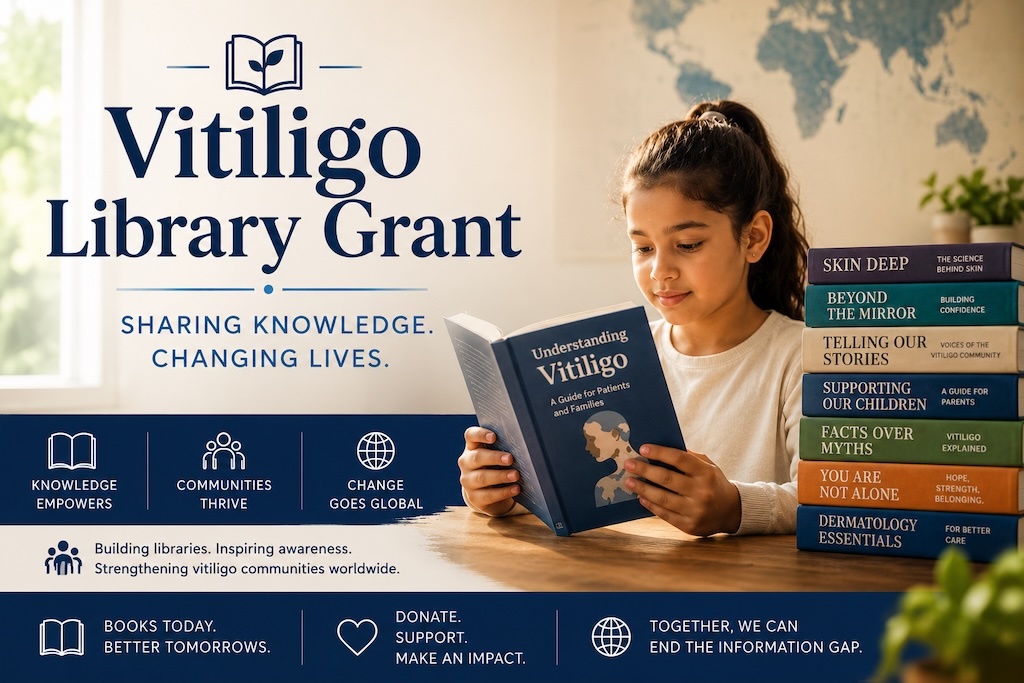
In Brief
📚 Up to $500 in books from VRF and affiliated authors.
💰 Up to $500 in additional funding for educational materials from other publishers.
🌍 Open to nonprofit organizations, vitiligo associations, and patient support groups worldwide.
📅 No application deadline, but proposals submitted before September generally have the best chance of receiving funding.
Contents
The Information Gap: Why a Book Can Arrive Years Before a Dermatologist
For most people reading this, finding information about vitiligo is a matter of seconds.
You can join a support group, listen to a podcast, ask an AI assistant, or skim the latest clinical research from your phone while standing in line for coffee. The coffee may be overpriced, but at least the information is there.
But that is not the reality everywhere.
Most people assume the biggest hurdle in vitiligo care is the lack of treatment. In many parts of the world, the far greater crisis is the lack of information.
In many communities worldwide, reliable resources remain difficult to access. In the absence of facts, myths fill the void. Patients are told the condition is contagious. Parents carry guilt they never earned. Teachers, employers, and even local healthcare workers may be left without the basic knowledge needed to respond with clarity and compassion.
This gap is not just unfortunate. It is a barrier to healthcare.
Before a person can access treatment, they must first understand their diagnosis. Before they can advocate for themselves, they need knowledge. Before a community can dismantle stigma, it needs the truth.
That simple truth is why the Vitiligo Library Grant Program was created.
A Modest Tool with Global Reach
Launched by the Vitiligo Research Foundation in 2019, the Vitiligo Library Grant Program helps build community-based educational infrastructure where it is needed most.
Each year, VRF selects up to three eligible nonprofit organizations to receive educational support for their local communities. The program provides up to $500 worth of curated books from VRF and affiliated medical authors, plus an additional $500 grant to help organizations source diverse literature from independent publishers, advocates, and educators.
That may sound modest. And it is. But modest does not mean small.
A single well-placed library can serve patients, families, schools, clinics, youth groups, and local advocates for years. It becomes a quiet but durable resource in places where reliable information may otherwise be scattered, expensive, or simply unavailable.
What began as a local initiative has gradually crossed borders. Early collaboration with VITFriends helped lay the groundwork, and later efforts supported vulnerable youth and families through the NYC Administration for Children’s Services. Last year, the program reached organizations in Uganda, Kenya, and the Caribbean — each working to challenge myths, reduce stigma, and bring reliable vitiligo education to communities where resources remain limited.
Why Books Still Matter in the Digital Age
People often ask whether paper and ink still matter in an era of smartphones, podcasts, streaming video, and artificial intelligence.
The answer is yes.
A book does not require a login, a subscription, a data plan, or even electricity. It can sit on a clinic shelf for a decade. It can move from a mother to a neighbor, from a teacher to a student, from a local advocate to a newly diagnosed child who needs words for what is happening to their skin.
It travels into places technology has not reliably reached.
In many corners of the world, a single book may be the first accurate explanation of vitiligo a person has ever encountered. It can become a tangible anchor of validation in a community shaped by confusion, silence, or shame.
That is not nostalgia. That is infrastructure.
Beyond Awareness: Building a Framework for Patient Navigation
At VRF, we now see the Library Grant Program through the broader lens of patient navigation.
Awareness matters. Science matters. New treatments matter. But even the best medical advances mean little if patients cannot navigate the distance between diagnosis and action.
That distance can be surprisingly long.
People need to understand what vitiligo is, what it is not, when to seek medical care, how to ask better questions, how to support a child, how to handle stigma, and how to avoid the loud circus of misinformation that surrounds almost every chronic skin condition.
The Library Grant Program is one part of a larger educational ecosystem that includes the Vitiligo Patient Journey Map, Deep Dive in Vitiligo podcast, AI-powered guidance tools, global World Vitiligo Day initiatives, and practical education across languages and regions.
The goal is simple: geography, income, and language should not decide who gets access to trustworthy information.
Knowledge scales beautifully. One book reaches a reader. One reader helps a family. One family can transform an entire community.
Interested in Starting a Vitiligo Library?
Meaningful change often starts small.
A support group finds a meeting space. A local advocate organizes an awareness event. A nonprofit launches its first educational campaign. Then someone asks the obvious question:
“Where can people learn more?”
The Vitiligo Library Grant Program was created to help answer that question.
We welcome applications from registered nonprofit organizations, patient advocacy groups, and vitiligo support communities interested in building or expanding educational resources for the people they serve.
Applications are accepted throughout the year, with no formal deadline. However, groups applying before September generally have a better chance of being considered for the upcoming grant cycle.
Applying is intentionally simple: tell us who you are, who you serve, how the books will be used, and why they would make a difference in your community.
We are especially interested in projects that reach underserved populations, children and families, schools, healthcare facilities, and emerging patient support networks.
If your organization believes that knowledge can reduce stigma, improve health literacy, and strengthen patient support, we would love to hear from you.
How to Apply
To request consideration, simply send us a brief grant proposal describing:
- Your organization or support group
- The community you serve
- How the library resources will be used
- Your educational goals and expected impact
Applications and questions may be sent to info@vrfoundation.org.
What We Expect to See in Your Proposal
Please keep your proposal simple, clear, and practical. We do not need a 40-page strategy document, a motivational manifesto, or a grant proposal written by a committee that has never met a patient.
What we do need is enough information to understand who you are, what you plan to do, and whether the books will actually reach people living with vitiligo.
A strong proposal should include:
- Organization name and status: Tell us whether you are a registered nonprofit organization, patient group, clinic-based support initiative, school program, or vitiligo support community.
- Contact person: Include the name, role, email, phone number, and country of the person responsible for the request.
- Community served: Explain who you work with — patients, children, parents, teachers, healthcare workers, rural communities, or another clearly defined group.
- Current activities: Briefly describe what your group already does for people affected by vitiligo.
- How the books will be used: Tell us where the materials will go and how people will access them — meetings, clinics, schools, workshops, community events, libraries, or support sessions.
- Expected impact: Explain what you hope will change as a result of the grant. For example: better awareness, reduced stigma, parent education, youth support, or improved patient confidence.
- Simple follow-up plan: Let us know how you will report back. A few photos, short testimonials, attendance numbers, or a brief summary of activities is enough.
Please also include any relevant website, social media page, registration document, or public profile that helps us verify your organization and understand your work.
We are not looking for perfect English or polished grant-writing language. We are looking for real organizations doing real work with real people. Clear beats fancy every time.
What We Expect in Return
The Vitiligo Library Grant Program is built on trust, accountability, and a shared commitment to helping people living with vitiligo.
While the grant is modest, we do ask recipients to help us understand the impact of the resources we provide.
Organizations receiving support are expected to:
- Acknowledge the support of the Vitiligo Research Foundation on relevant event materials, social media posts, websites, newsletters, or other public communications whenever appropriate.
- Share photos or brief updates showing how the books and educational materials were used within the community.
- Submit a short report within 60 days after completing the funded activities. This does not need to be complicated. A brief summary, a few photos, attendance numbers, participant feedback, or lessons learned are usually sufficient.
- Maintain communication with VRF if plans change significantly or if challenges arise during implementation.
Our goal is not paperwork. Our goal is learning what works, sharing success stories, and demonstrating to donors that their support is making a meaningful difference in communities around the world.
In short: acknowledge the support, tell us what happened, share a few photos if possible, and help us celebrate the impact together.
Help Us Write the Next Chapter
The Vitiligo Library Grant Program is funded entirely through private donations and community support.
Every contribution helps place trusted educational resources where they can do the most good: in clinics, schools, community centers, patient groups, and local advocacy networks that are often doing big work with very small tools.
Scientific breakthroughs change medicine.
Knowledge changes lives. And sometimes the shortest path between the two is a book.
Support the Vitiligo Library Grant Program
A single book can educate a patient, support a family, and help an entire community challenge stigma.
Your donation helps place trusted educational resources into clinics, schools, support groups, and community organizations around the world.
Donate Today100% of donations support vitiligo education, awareness, and patient navigation initiatives.
Suggested Reading
📚 Vitiligo Books for Kids That Are Worth the Read
A practical guide to children’s books about vitiligo, identity, confidence, and skin difference — for parents, teachers, and anyone trying not to turn bedtime into a dermatology lecture.
Vitiligo Patient Journey Map Explained
A clear introduction to VRF’s Patient Journey Map — a practical framework for helping patients move from confusion to better decisions, one step at a time.
Getting Vitiligo Right in Kids’ Books — Helping a Major Publisher
Why representation needs accuracy, not just good intentions. A behind-the-scenes look at helping children’s publishing treat vitiligo with more care and less cartoon science.
Science-Backed Holiday Health Hacks for Vitiligo
A practical, science-aware guide to stress, food, sleep, sunlight, and holiday chaos — because skin does not take vacations just because the rest of us pretend to.
Listen to Deep Dive in Vitiligo
Prefer listening? These podcast episodes explore the wider world around vitiligo advocacy, education, AI, and global health policy.
The Entire History of World Vitiligo Day — Ep. 61
The story of how World Vitiligo Day grew from scattered advocacy into a global movement connecting patients, doctors, researchers, and communities across continents.
AI for Vitiligo Patients — Beyond the Hype — Ep. 51
A grounded look at what AI can actually do for vitiligo patients today — and where the usual tech-utopia fireworks should probably calm down a little.
WHO Finally Notices the Skin — What It Means and Doesn’t for Vitiligo — Ep. 50
A careful look at global skin health recognition, what it could mean for vitiligo, and why symbolic progress still needs practical follow-through.
FAQOther Questions
- What are the best predictors for therapy response in vitiligo?
A fair question. Also a slightly annoying one, because dermatology loves nuance and patients usually want something more like a weather forecast. Still, a few factors do show up...
- Pyrostegia venusta as a folk medicine for vitiligo?
Pyrostegia venusta, also known as “flame vine” or “cipó-de-são-joão,” is a neotropical evergreen vine native to Brazil. It thrives in fields, coastal areas, forest edges, and ro...
- Which therapy has minimal side-effects?
Dead Sea climatotherapy is a unique and highly effective treatment option for vitiligo, offering a top-tier safety profile and natural therapeutic benefits. Its combination of p...
Though it is not always easy to treat vitiligo, there is much to be gained by clearly understanding the diagnosis, the future implications, treatment options and their outcomes.
Many people deal with vitiligo while remaining in the public eye, maintaining a positive outlook, and having a successful career.
Copyright (C) Bodolóczki JúliaBy taking a little time to fill in the anonymous questionnaire, you can help researchers better understand and fight vitiligo.