
Why Popular “Immune Boosters” May Be Working Against You
Most articles about herbal medicine and vitiligo ask: “Which herbs help?” This one starts somewhere else.
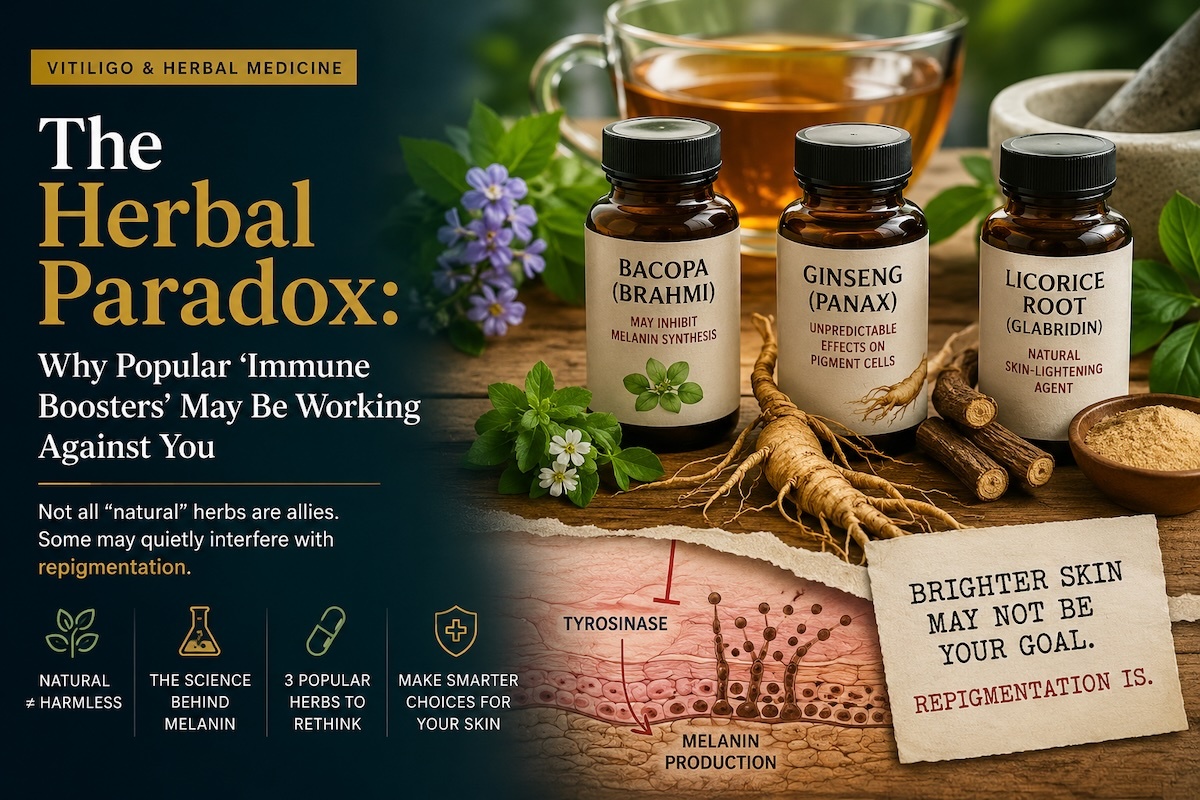
What if some of the most popular herbs are quietly working against repigmentation?
It’s an uncomfortable question because many of these herbs have excellent reputations. They help with stress. They support concentration. They reduce inflammation. They show up in wellness podcasts, health-food stores, and medicine cabinets around the world.
They are also completely natural. Which, as nature repeatedly reminds us, proves absolutely nothing.
The reality is that some herbs may influence the same pigment-producing pathways that vitiligo patients are trying to restore. A supplement can be good for your brain and still raise questions for your melanocytes. It can reduce stress while also affecting melanin production.
That doesn’t make these herbs dangerous. But it does make them more complicated than the marketing brochure suggests.
Contents
Over the past year, we examined the scientific literature behind dozens of herbal remedies promoted for vitiligo. What emerged was a surprisingly different story — one filled with mixed signals, contradictory findings, and a few herbs that appear to be helping the wrong side of the battle.
Let’s start there.
In brief
Some herbs marketed for wellness may also affect melanin production.
This matters because vitiligo treatment often aims to restart pigment production, not slow it down.
The practical lesson is simple: tell your doctor about supplements, teas, powders, extracts, and “natural” skincare products. Your melanocytes do not care what the label says. They respond to chemistry.
The Mechanism: Shifting Into Reverse
To bring color back to vitiligo-affected skin, pigment cells — melanocytes — rely heavily on a key enzyme called tyrosinase. This enzyme helps drive melanin production.
The cosmetic industry actively seeks out plant compounds that block tyrosinase because they can act as “skin brighteners,” helping fade dark spots, melasma, or uneven pigmentation.
That may be useful if the goal is to reduce excess pigment. But if you are trying to recover lost pigment, a strong tyrosinase inhibitor deserves caution. It may be working in the opposite direction of vitiligo therapy.
So if a supplement, serum, tea, or extract is marketed to “even skin tone,” “brighten complexion,” or “fade spots,” it is worth asking a simple question:
Is this helping pigment return — or quietly telling pigment production to slow down?
Three Herbs Helping the Wrong Side of the Battle
🌿 Ginseng: The Unpredictability Trap
Ginseng is often treated as a holy grail for daily energy, resilience, and cellular health.
At first glance, it sounds like a reasonable candidate for vitiligo support. It has antioxidant and anti-inflammatory properties, and early theories suggested it might help protect melanocytes from oxidative stress.
But ginseng is not one clean molecule. It is a chemically messy cocktail of ginsenosides, and some of these compounds appear to have anti-melanogenic effects. In plain English: they may reduce pigment production.
That does not prove ginseng worsens vitiligo in real life. We do not yet have the kind of human clinical data needed to say that.
But it does create an obvious caution flag.
For patients actively trying to repigment, ginseng may be less like a reliable ally and more like a supplement with unclear loyalties. A bit of a Trojan Horse, but with better packaging.
🌿 Bacopa Monnieri: The Cognitive Lightener
Bacopa monnieri, also known as Brahmi, is widely celebrated for memory, focus, and calming the mind.
For people with vitiligo, the logic sounds tempting. Stress can aggravate vitiligo. Bacopa may help with stress. Therefore, Bacopa might help vitiligo.
Sadly, biology does not always follow the wellness-store syllogism. Experimental models suggest Bacopa can suppress melanin synthesis and inhibit tyrosinase. That means a supplement taken for the brain may, at least in theory, send the wrong message to pigment-producing cells.
Again, this does not mean every person with vitiligo must avoid Bacopa forever. But it does mean Bacopa should not be casually promoted as a vitiligo-friendly herb without better evidence.
🌿 Licorice Root: The Cosmetic Whitener
Licorice root is another complicated case. It is often praised for its anti-inflammatory effects and appears in teas, supplements, skincare products, and “soothing” formulas. But licorice extract also contains glabridin, a compound widely studied for its skin-lightening effects.
In cosmetic science, that is a feature. In vitiligo repigmentation, it may be a bug.
Used topically, concentrated licorice extract may counteract the pigment-building goals of treatments such as phototherapy. Taken systemically, the picture is less clear, but the same basic caution applies: if a compound is famous for reducing pigmentation, vitiligo patients should not treat it as harmless background noise.
Navigating the Cabinet Safely
This is not an anti-herb argument.
Some botanicals deserve serious attention. Ginkgo biloba and Polypodium leucotomos, for example, have more meaningful scientific support as conservative adjuncts when used alongside dermatological treatment.
But the key word is adjuncts.
Herbs do not replace phototherapy, topical therapies, medical supervision, or long-term disease management. They sit in the supporting cast — useful sometimes, distracting at other times, and occasionally auditioning for the wrong movie.
The takeaway is simple: always disclose your supplements. Many patients forget to mention herbal teas, adaptogens, powders, capsules, or “natural” skin products because they do not think of them as real medicine.
But your melanocytes are not reading the label. They are responding to chemistry.
And when it comes to vitiligo, chemistry matters more than the word “natural.”
– by Yan Valle, Prof. h.c., CEO VRF
🎙️ Listen to the Companion Podcast
Herbs That Secretly Bleach Your Skin
In this episode of Deep Dive in Vitiligo, we look at the supplement aisle from the opposite direction. Not “which herbs help,” but which herbs may quietly interfere with repigmentation.
From Bacopa and ginseng to skin-brightening botanicals hiding inside teas, powders, capsules, and skincare formulas, this episode asks a practical question: could something “healthy” still be bad news for your pigment cells?
📚 Suggested Reading
A Comprehensive Guide to Herbal Approaches in Vitiligo Therapy
A broader look at herbal medicine in vitiligo, including which botanicals have some scientific support, which remain speculative, and why “natural” still needs evidence.
Bacopa (Brahmi) and Vitiligo? Another Popular Herb That May Not Help
Bacopa is widely used for memory and focus, but experimental pigmentation data raise an awkward question for vitiligo patients trying to restore melanin.
Ginseng for Vitiligo? Hold Your Horses
Ginseng has antioxidant appeal, but its chemistry is complicated. Some components may support pigmentation, while others may push in the opposite direction.
🎙️ Listen to Deep Dive in Vitiligo
Sucralose, Your Gut, and Vitiligo — The Sweet Lie We Don’t Want to Hear (Ep. 55)
A look at artificial sweeteners, gut health, inflammation, and why “zero sugar” does not always mean zero biological consequences.
Vitiligo and Vitamins. Hope or Hype? (Ep. 30)
Vitamins are often the first thing patients try. This episode separates reasonable support from wishful thinking with a polite but firm scalpel.
The Vitiligo Diet: Can What You Eat Heal Your Skin? (Ep. 5)
Diet matters, but not in the magical way the internet often promises. This episode explores food, inflammation, oxidative stress, and practical expectations.
A final note
This article is for educational purposes only and is not medical advice. If you have vitiligo and use herbal supplements, teas, powders, tinctures, or “brightening” skincare products, discuss them with a qualified healthcare professional — especially if you are actively undergoing treatment.