
Protecting Your Skin in an Age of Confusing Science
Every summer, the advice arrives like clockwork: wear sunscreen, use SPF 30 or higher, reapply every two hours, and avoid getting burned. Simple enough. Then science came along, as science does, and made the story more interesting.
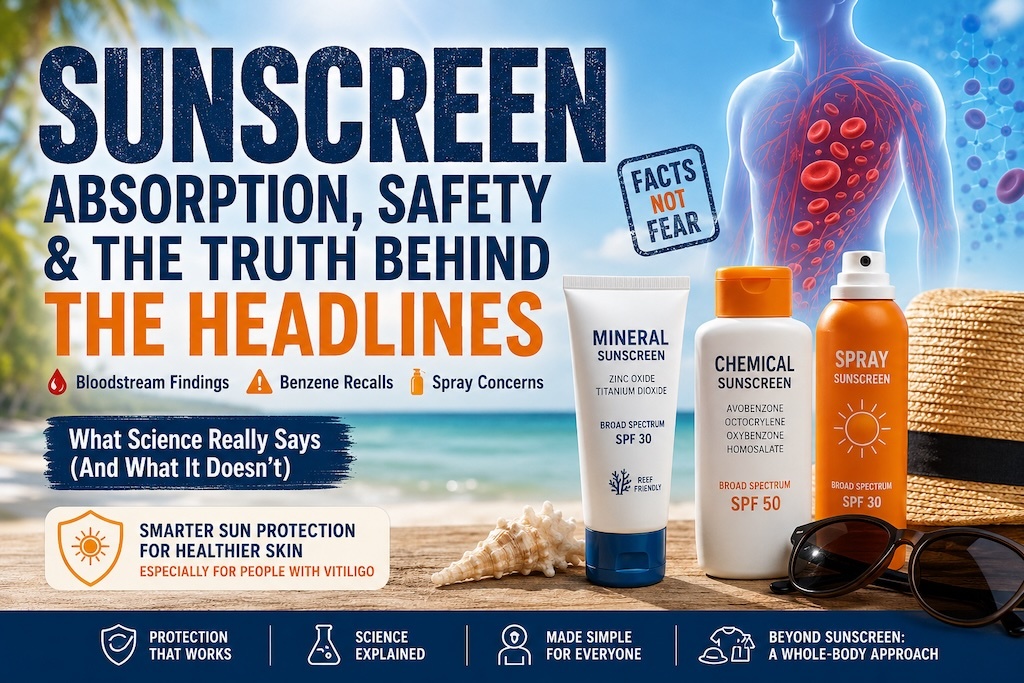
🎙️ Prefer listening to reading? This companion episode of Deep Dive in Vitiligo podcast explores many of the same themes discussed in this article.
In Brief
Sunscreen remains an important tool for preventing sunburn, photoaging, and skin cancer risk. But the story has become more complicated. Some chemical sunscreen ingredients can enter the bloodstream, although this does not prove they are harmful in humans. Several recalls involved benzene contamination, especially in aerosol products, but benzene is not an intentional sunscreen ingredient.
For most people, the practical answer is not to stop using sunscreen. It is to use it more intelligently: choose broad-spectrum SPF 30 or higher, apply enough, reapply often, consider mineral formulas if preferred, avoid questionable sprays, and combine sunscreen with hats, shade, and UPF clothing.
Whats Inside This Story
- Why sunscreen became a public health success story
- The SPF illusion
- Chemical vs. mineral sunscreens
- The bloodstream surprise
- Should we be worried?
- The benzene scare
- Why spray sunscreens deserve extra skepticism
- Expiration dates matter
- The environmental debate
- What makes sunscreen different for people with vitiligo?
- The consumer action plan
- Frequently asked questions
For decades, the message was refreshingly simple: too much ultraviolet radiation damages your skin, accelerates aging, and increases the risk of skin cancer. Sunscreen helps reduce that risk. End of story.
Then science complicated things.
Over the last few years, researchers discovered something that surprised even many dermatologists. Some sunscreen ingredients do not simply sit on the surface of the skin. They can be absorbed into the bloodstream, sometimes at levels high enough to trigger additional safety testing requirements from regulators. Around the same time, headlines exploded with news of sunscreen recalls involving benzene, a known carcinogen.
Suddenly, consumers found themselves in a strange position. The very product designed to help prevent cancer was being linked, at least in news headlines, to possible health concerns of its own.
So what is actually going on?
As usual, the truth sits somewhere between the reassuring simplicity of sunscreen advertisements and the panic of social media influencers warning that every bottle in your beach bag is poisoning you. Reality is annoying like that. It refuses to behave like a slogan.
Why Sunscreen Became a Public Health Success Story
Before discussing controversies, it is worth remembering why sunscreen became important in the first place.
Sunlight feels wonderful. Human beings evolved under it. A little sun helps regulate mood, sleep cycles, and vitamin D production. It also gives us that pleasant illusion that life is under control, which is nice, even if usually false.
The problem is dose.
Modern life has changed the equation. We live longer, travel more, spend sudden bursts of time in intense sun, and often treat a tan as a sign of health. That creates a lot of cumulative ultraviolet exposure, especially for skin that is not adapted to high-intensity sun.
Scientists have known for decades that ultraviolet radiation damages DNA inside skin cells. Over time, that damage accumulates. Wrinkles appear. Pigmentation changes develop. Skin loses elasticity. More importantly, the risk of skin cancers rises significantly.
Sunscreen was developed to interrupt that process, and by most measures it has succeeded. Used correctly, it reduces sunburn and helps lower long-term UV damage. For people with vitiligo, the benefits can be especially important because depigmented skin lacks melanin, the pigment that provides some natural protection against UV radiation.
That does not mean sunscreen is perfect. It means it solves one problem while raising a few questions of its own. Welcome to adulthood.
The SPF Illusion
Here is where things get tricky. Many people treat sunscreen as a magical shield rather than one tool among many.
SPF 30 sounds good. SPF 50 sounds better. SPF 100 sounds almost invincible. Unfortunately, biology does not work like a superhero movie.
SPF measures protection mainly against UVB radiation, the part of ultraviolet light strongly associated with sunburn. SPF 30 blocks about 97 percent of UVB rays. SPF 50 blocks around 98 percent. SPF 100 reaches roughly 99 percent. Those extra numbers sound impressive, but the real-world difference is smaller than most people imagine.
The bigger problem is psychological. People using very high-SPF products may stay in the sun longer because they feel protected. Ironically, that can lead to more total UV exposure, not less. The danger is not always choosing the wrong sunscreen. It is believing sunscreen gives you permission to ignore every other rule of sun protection.
This is the SPF illusion. A higher number on the bottle can make people behave as if the sun has signed a non-aggression treaty. It has not.
For daily life, broad-spectrum SPF 30 or higher is usually a sensible baseline. For prolonged outdoor exposure, sweating, swimming, or travel to high-UV environments, higher SPF may offer a useful margin. But no SPF works well if you apply too little, miss half your skin, or forget to reapply.
Chemical vs. Mineral Sunscreens
Broadly speaking, modern sunscreens fall into two camps.
Chemical sunscreens rely on ingredients such as avobenzone, octocrylene, oxybenzone, homosalate, and octisalate. These compounds absorb UV radiation and convert it into tiny amounts of heat before the radiation can damage skin cells. Their main advantage is cosmetic elegance. They tend to be lightweight, transparent, and easy to wear daily.
Mineral sunscreens use zinc oxide, titanium dioxide, or both. Instead of soaking into the skin cells, they sit on top like a physical barrier, absorbing, scattering, and reflecting sunlight before it can penetrate deeper. Historically, they had one major drawback: they often left users looking like they had been dusted with powdered sugar. Thankfully, modern formulations have improved dramatically, and many now blend surprisingly well into a wide variety of skin tones.
For years, the choice between chemical and mineral sunscreens came down mostly to personal preference. Do you want something invisible and light? Chemical formulas often win. Do you have sensitive skin or prefer a simpler active ingredient profile? Mineral formulas may be the better choice.
Then the U.S. Food and Drug Administration published a series of studies that changed the conversation.
| Feature | Chemical Sunscreens | Mineral Sunscreens |
|---|---|---|
| Common active ingredients | Avobenzone, octocrylene, oxybenzone, homosalate, octisalate | Zinc oxide, titanium dioxide |
| Feel on skin | Often lighter and more transparent | May feel thicker, though newer formulas are much improved |
| Bloodstream absorption | Demonstrated for several common filters | Generally much lower systemic absorption concern |
| Sensitive skin | May irritate some users | Often preferred for sensitive skin |
| White cast | Usually minimal | Possible, but tinted formulas help |
The Bloodstream Surprise
For years, regulators assumed sunscreen ingredients largely stayed on the skin surface. That assumption was challenged when FDA researchers studied what happens after people apply common sunscreen products under realistic conditions.
The findings were clear. Several commonly used chemical sunscreen filters entered the bloodstream after just one day of use. Some exceeded the FDA threshold of 0.5 nanograms per milliliter, a level that triggers the need for additional toxicology testing.
The headlines were immediate and predictable.
"Sunscreen chemicals found in bloodstream."
The implication was obvious: danger. The reality was more nuanced.
What the FDA actually concluded was not that these ingredients were harmful. Rather, the agency concluded that additional safety testing was warranted. In regulatory language, that distinction matters. Absorption and toxicity are not the same thing.
Every day we absorb compounds from food, medications, cosmetics, air, water, and countless other sources. The fact that a substance enters the bloodstream does not automatically make it dangerous. What matters is what happens next.
Still, the findings raised legitimate questions. If these compounds circulate throughout the body, could they potentially affect hormone systems, fertility, pregnancy, or long-term health? Researchers are still trying to answer those questions.
Some laboratory and animal studies suggest that certain sunscreen ingredients, particularly oxybenzone, may have endocrine-disrupting properties under specific experimental conditions. However, translating laboratory findings into meaningful human health outcomes is notoriously difficult. To date, there is no convincing evidence that normal sunscreen use causes cancer, infertility, thyroid disease, or major hormonal disorders in humans.
That may sound unsatisfying, but it reflects the current state of the science. Absorption is real. Harm remains unproven. The established dangers of excessive UV exposure are still far better documented than any theoretical risks associated with sunscreen absorption.
So Should We Be Worried?
Probably less than the internet would like us to be.
One of the oddities of modern health reporting is that uncertainty often sounds scarier than certainty. When scientists say, "We're still studying this," many people hear, "Disaster is imminent."
But uncertainty is simply how science works.
Twenty years ago, researchers assumed sunscreen ingredients largely stayed on the skin. Better technology revealed that some do not. That discovery did not prove danger. It proved that we now have better tools for asking questions.
In many ways, this is exactly what we want regulators and scientists to do: identify assumptions, test them, and update recommendations when new information appears. The real danger would be pretending questions do not exist.
The Benzene Scare
If sunscreen absorption created confusion, the benzene recalls created outright panic.
Beginning in 2021, multiple sunscreen products were voluntarily recalled after testing revealed contamination with benzene, a known human carcinogen linked to leukemia and other blood cancers. Consumers understandably reacted with horror. If sunscreen is supposed to protect health, why is a carcinogen showing up inside the bottle?
The answer is important because it often gets lost in the headlines.
Benzene is not a sunscreen ingredient. No reputable manufacturer intentionally adds it to sunscreen. The contamination was largely traced to manufacturing problems, particularly involving aerosol sprays and their propellants.
In other words, the issue was not the sunscreen filters themselves. It was the machinery and chemicals used to package and deliver the product.
Think of it this way. If bottled water becomes contaminated during production, that does not mean water itself is dangerous. It means something went wrong in the manufacturing process.
The recalls revealed weaknesses in quality control, not evidence that sunscreen ingredients themselves were carcinogenic. Still, the episode taught many consumers a practical lesson: fewer moving parts often mean fewer opportunities for things to go wrong.
Expiration Dates Matter
Sunscreen does not last forever.
FDA regulations require sunscreens to remain stable for at least three years, unless a specific expiration date appears on the packaging. In the real world, however, sunscreen rarely enjoys ideal laboratory conditions. Heat, sunlight, beach bags, car glove compartments, open caps, and general human neglect all take their toll.
If your sunscreen is past its expiration date—or has been rolling around in a hot beach bag since last summer—the UV filters may have broken down. If the smell, texture, or color has changed noticeably, it is time to replace it.
Skin cancer prevention is not the place to practice extreme thrift.
The Environmental Debate
The sunscreen story does not stop with human biology. It extends into the oceans.
Researchers have found that certain chemical UV filters, particularly oxybenzone and octinoxate, may contribute to coral reef damage under some conditions. This concern has prompted restrictions or bans in several environmentally sensitive regions, including Hawaii and other coastal destinations.
The environmental story is complicated. Coral reefs face enormous pressures from warming oceans, pollution, habitat destruction, and overfishing. Sunscreen is only one piece of a much larger puzzle. Still, many consumers increasingly view mineral sunscreens as a reasonable compromise that may reduce both environmental concerns and personal exposure to chemical filters.
Whether that matters to you depends on your priorities. But it is one more reason why sunscreen selection has become more complicated than simply grabbing the highest SPF bottle from a pharmacy shelf.
The Rise of Better Mineral Sunscreens
One reason mineral sunscreens are gaining popularity has little to do with toxicology. They simply got better.
Older formulations often felt thick, greasy, chalky, and stubborn. Modern formulations are far more sophisticated. Many now use micronized zinc oxide that spreads more evenly and feels less like applying drywall compound to your face.
Tinted formulations containing iron oxides have also become increasingly popular, especially among people who dislike the traditional white cast associated with zinc-based products.
For individuals with darker skin tones, these formulations can be particularly helpful. They reduce the grayish appearance sometimes associated with older mineral sunscreens while offering additional protection against visible light, which may contribute to certain pigmentation disorders.
In short, choosing a mineral sunscreen in 2026 is a very different experience than choosing one in 2006.
What Makes Sunscreen Different for People with Vitiligo?
Vitiligo changes the sun protection conversation because depigmented patches have less natural melanin protection. That means they can burn more easily and sometimes more severely than surrounding skin.
Sunburn is not merely uncomfortable. In some people with vitiligo, skin injury can trigger new patches through the Koebner phenomenon, where trauma to the skin may provoke additional areas of depigmentation. Not everyone experiences this phenomenon, but it remains one more reason to avoid unnecessary burns.
At the same time, sunlight itself is not the enemy. Controlled ultraviolet light is routinely used as a treatment for vitiligo, particularly narrowband UVB phototherapy. The difference is control. Medical phototherapy uses carefully measured doses. Random sun exposure does not.
The beach is wonderful. It is not, however, a calibrated dermatology device.
For everyday life, people with vitiligo should protect depigmented areas carefully, avoid burns, consider UPF clothing, and choose sunscreens they can tolerate and will actually use consistently.
The best sunscreen is not necessarily the one with the most impressive marketing campaign. It is the one you apply correctly and repeatedly.
Definitions
SPF: Sun Protection Factor. Primarily measures protection against UVB radiation.
UVA: Longer-wave ultraviolet radiation associated with aging, pigmentation changes, and deeper skin damage.
UVB: Shorter-wave ultraviolet radiation strongly associated with sunburn.
Broad-spectrum: Protection against both UVA and UVB radiation.
Mineral sunscreen: A sunscreen using zinc oxide and/or titanium dioxide.
Chemical sunscreen: A sunscreen using organic UV filters such as avobenzone, octocrylene, oxybenzone, homosalate, or octisalate.
UPF: Ultraviolet Protection Factor, used to rate sun-protective clothing.
The Consumer Action Plan
So what should an ordinary person do with all this information?
- First, keep using sun protection. The risks of excessive UV exposure are real and well documented. Sunburn is not a badge of honor. It is DNA damage with a tan line.
- Second, choose a broad-spectrum SPF 30 or higher sunscreen. Higher SPF may provide a useful margin of protection, but it does not compensate for poor application.
- Third, use enough sunscreen. Most people apply far less than they should. A symbolic smear does not count.
- Fourth, reapply every two hours during outdoor exposure, and sooner after swimming or heavy sweating.
- Fifth, consider mineral sunscreens if you have sensitive skin, are concerned about systemic absorption, or simply prefer a shorter ingredient list.
- Sixth, think beyond sunscreen. Hats, shade, sunglasses, and UPF clothing remain among the most effective sun-protection tools ever invented.
A shirt may be the least exciting skincare product on Earth, but it has several advantages. It never expires. It does not need reapplication. It cannot be washed off by sweat. And it never enters your bloodstream.
That is not an argument against sunscreen. It is an argument for using multiple layers of protection instead of expecting one product to do everything.
Frequently Asked Questions
Do sunscreen ingredients enter the bloodstream?
Some chemical sunscreen ingredients do. FDA studies found measurable blood levels of several common filters after sunscreen use. This does not prove these ingredients are harmful, but it does justify additional safety research.
Are chemical sunscreens dangerous?
Current evidence does not demonstrate serious harm from normal sunscreen use in humans. The concern is that some ingredients are absorbed into the body, and researchers are still studying the long-term significance of that finding.
Are mineral sunscreens safer?
Mineral sunscreens are often preferred by people with sensitive skin or concerns about chemical exposure. They are not perfect, but they offer a reasonable alternative for many consumers.
Should people with vitiligo wear sunscreen?
Yes. Depigmented skin has less natural protection against ultraviolet radiation and can burn more easily. Sunscreen, UPF clothing, hats, and shade can all help reduce unnecessary skin injury.
Is SPF 100 much better than SPF 30?
Not as much as most people think. SPF 30 blocks about 97 percent of UVB radiation, while SPF 100 blocks about 99 percent. Proper application and reapplication matter more than chasing the highest number available.
Are spray sunscreens safe?
They can work, but people often apply them poorly. Lotions and creams generally provide more reliable coverage and avoid concerns associated with aerosol delivery systems.
Can sunscreen expire?
Absolutely. Expired or poorly stored sunscreen may not provide the protection listed on the label. When in doubt, replace it.
The Bottom Line
Should you worry about sunscreen? Probably not.
Should you stop using it? Almost certainly not.
Should you pay more attention to what you buy, how you apply it, and what role it plays in your overall sun protection strategy? Absolutely.
The lesson from the past few years is not that sunscreen is bad. It is that sunscreen is not magic. It is a useful tool, but it works best alongside hats, shade, clothing, and a healthy respect for the sun itself.
A final question is worth considering. If a sunscreen ingredient enters your bloodstream, should we automatically assume it is dangerous?
Or does that simply mean science is doing exactly what we want science to do—asking better questions than it asked twenty years ago?
After all, the healthiest relationship with sunlight is neither fear nor recklessness. It is understanding.
And understanding, unlike sunscreen, never needs to be reapplied.
Suggested Reading
Red Wine and Vitiligo
Can a glass of red wine actually be beneficial? A look at genetics, antioxidants, and what the latest research really says.
Why Coffee Works Better Than Capsules: The Antioxidant Puzzle in Vitiligo
The surprising reason why food often beats supplements when it comes to antioxidant biology.
Deodorants and Vitiligo: Separating Myth from Reality
A practical guide to fragrances, irritants, and what actually deserves your attention.
Smoking, Vaping, and Vitiligo: The “Protective” Paradox
One of the strangest findings in vitiligo epidemiology—and why nobody should start smoking because of it.
Listen to Deep Dive in Vitiligo Podcast
Red Wine and Vitiligo
Exploring genetics, antioxidants, and what moderation really means.
How Antidepressants Shape Your Body and What It Means for Vitiligo
A fascinating look at medications, metabolism, and unintended consequences.
Landscape of Hand Vitiligo
Why the hands are uniquely challenging and what new research reveals.
References
- Matta MK et al. JAMA. 2019. Effect of Sunscreen Application Under Maximal Use Conditions on Plasma Concentration of Sunscreen Active Ingredients.
- Matta MK et al. JAMA. 2020. Effect of Sunscreen Application on Plasma Concentration of Sunscreen Active Ingredients.
- U.S. Food and Drug Administration. Sunscreen: How to Help Protect Your Skin from the Sun.
- American Academy of Dermatology. Shade, Clothing, and Sunscreen Guidance.
- FDA Benzene Contamination Guidance and Recall Notices.
Disclaimer: This article is for education only and does not replace medical advice from your dermatologist.