New

Why Berries, Coffee and Wine Work Better Than Antioxidant Capsules
This post is a follow-up to our recent article on red wine and vitiligo. We received many thoughtful questions from readers, mostly circling around the same puzzle: if antioxidant-rich foods may help, why don’t antioxidant pills do the same job?
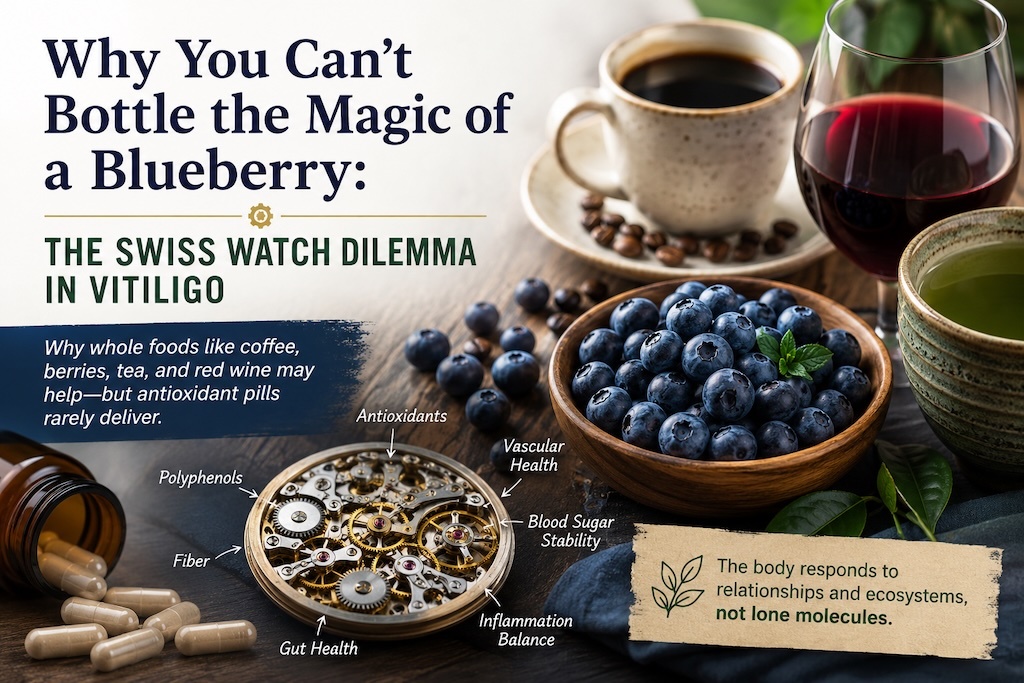
Why You Can’t Bottle the Magic of a Blueberry: The Swiss Watch Dilemma in Vitiligo
In Brief
Whole antioxidant-rich foods like coffee, blueberries, tea, and moderate red wine often show protective signals in vitiligo research. Isolated antioxidant supplements? They rarely deliver measurable benefits on their own. The difference isn’t potency — it’s context.
Why? Biology runs on complex systems, not single molecules. Whole foods arrive as complete biological systems — with fiber, timing, metabolism, gut effects, blood vessel effects, and hundreds of interacting compounds working together. A capsule usually brings one lonely molecule and asks it to perform miracles without the orchestra.
🎙️ Prefer listening to reading? This episode explores many of the same themes discussed in this article.
You sit down with black coffee, a handful of blueberries, green tea, or maybe a glass of red wine with dinner. Something in these ordinary rituals seems to help the body handle oxidative stress — the kind of stress that quietly batters melanocytes in vitiligo.
Science keeps circling back to the same observation. Diets rich in plant compounds and polyphenols often correlate with healthier inflammatory balance overall. Coffee repeatedly shows protective signals in vitiligo studies. Tea does too. Moderate red wine sometimes appears in the same conversation. Mediterranean-style eating patterns keep showing up across autoimmune and inflammatory research like that one annoyingly correct relative nobody wanted to listen to twenty years ago.
Meanwhile, the supplement aisle looks like a biochemical circus: vitamin C megadoses, resveratrol capsules, “super antioxidant complexes,” and berry extracts harvested somewhere high in the Himalayas by spiritually enlightened marketing departments. Every bottle promises “cellular defense” in fonts usually reserved for monster trucks and pre-workout powder.
But when scientists actually test isolated antioxidant supplements in vitiligo, the result is usually underwhelming. Some studies show mild improvement. A few show modest help when antioxidants are combined with Narrowband UVB phototherapy. But the dramatic “oxidative stress solved” effect everybody expected never really showed up.
Which raises a deeply uncomfortable possibility: maybe we’ve been trying to yank one gear out of a Swiss watch and expecting it to keep perfect time.
The Original Logic Made Perfect Sense
The original theory honestly sounded reasonable. Vitiligo involves oxidative stress. Oxidative stress damages melanocytes. Antioxidants reduce oxidative stress. Therefore, antioxidants should help vitiligo. Done.
Medicine loves these kinds of clean stories because sometimes they work beautifully. Bacteria causing infection? Kill bacteria. Insulin deficiency? Replace insulin. High cholesterol? Lower cholesterol. Simple mechanism, clear intervention, predictable result.
But oxidative biology turned out to be far messier than researchers hoped. Antioxidants do not operate like tiny firefighters running around your bloodstream spraying free radicals with little molecular hoses.
Your body is already packed with antioxidant systems: enzymes, repair pathways, mitochondrial signaling, inflammatory cascades, hormones, gut bacteria, sleep cycles, stress responses, blood vessel regulation, immune surveillance, and cellular recycling systems. The whole thing behaves less like a machine with replaceable parts and more like an ecosystem.
More rainforest than Lego set. And rainforest ecosystems do not respond particularly well to simplistic engineering.
Nature Doesn’t Sell Isolates
A blueberry is not “an antioxidant.” It is a densely packed biochemical neighborhood: anthocyanins, quercetin, polyphenols, fiber, minerals, plant-defense molecules, pigments, organic acids, sugars, water, structure, timing — and most importantly, interaction.
Vitamin C helps recycle vitamin E. Polyphenols regenerate one another. Some compounds absorb quickly, others slowly. Some influence gut bacteria. Some stabilize blood vessels. Some affect inflammatory signaling. Some may influence gene expression temporarily. And fiber prevents stupid spikes.
That part matters more than people realize. Whole food creates a gradual biological conversation. A capsule often creates a synthetic shout.
☕️ Coffee is an even better example. People still think coffee is mostly caffeine, which is a bit like saying a symphony is mostly violins. Coffee contains more than a thousand bioactive compounds — chlorogenic acids, melanoidins, flavonoids, diterpenes, polyphenols, and compounds influencing liver enzymes, insulin sensitivity, inflammation, blood vessels, nervous system signaling, and the microbiome.
In other words, coffee behaves less like a single ingredient and more like a biochemical jazz band. Trying to isolate one “hero molecule” from coffee and expecting identical results is a little like removing the saxophone player from Miles Davis and wondering why the concert suddenly feels disappointing.
Then we concentrate that isolated compound fifty-fold, put it into a shiny capsule, and expect biology to applaud. Instead, the body often responds with something closer to: “Interesting. What exactly would you like me to do with this?” Or worse: “Congratulations. You have invented expensive urine.”
The Genetics Twist Makes the Story Even Stranger
Modern genetics made the story more interesting. Recent Mendelian randomization studies found that genetically predicted intake of coffee, tea, and moderate red wine was associated with lower vitiligo risk. That sentence sounds like something written by a committee trying to punish normal readers, so let’s translate it.
Nutrition studies have a gigantic problem: people who eat or drink certain things often live differently overall. Coffee drinkers may sleep differently, work differently, exercise differently, smoke differently, eat differently, or have different income and healthcare access. Wine drinkers may live differently from people drinking soda or hard liquor.
Scientists call this “lifestyle confounding.” In plain English, it means researchers constantly struggle to separate the effect of the food itself from the effect of the kind of person who consumes it.
Mendelian randomization tries to partially bypass that mess by using naturally occurring genetic variants linked to certain tendencies, such as drinking more coffee. Since your genes are assigned before adult lifestyle choices fully enter the picture, this approach acts a bit like a built-in randomized experiment from birth.
It is not perfect. Nothing in nutrition science is. But it helps reduce some of the hidden noise that makes dietary research so maddeningly contradictory.
And here’s the remarkable part. When researchers looked at genetically predicted intake of coffee, tea, and red wine, they found protective signals. But when they examined genetically predicted circulating levels of isolated antioxidants like vitamin C, vitamin E, selenium, zinc, and carotenoids, they found no meaningful protective effect.
That is the Swiss watch dilemma in scientific form. The body appears to respond to complex biological patterns — whole dietary ecosystems — rather than isolated molecules floating through the bloodstream alone.
The Broader Diet Story Keeps Saying the Same Thing
The same pattern keeps appearing elsewhere too. Large population studies suggest that stronger dietary patterns — Mediterranean-style eating, high-fiber foods, lower liquid sugar intake — are associated with better long-term health, even in people carrying unfavorable genetic risk.
For vitiligo, this does not mean diet guarantees repigmentation. Let’s not turn broccoli into a dermatologist. That would be unfair to both. The more honest point is quieter than that: you may be able to shape the metabolic neighborhood surrounding your melanocytes.
Better fiber intake, less inflammatory chaos, lower sugar spikes, better vascular health, more stable sleep, a calmer gut environment, and more resilient metabolic signaling may all matter. Not as instant pigment magic. More as background maintenance for a system that is already under stress.
Genes may load the gun. Daily patterns decide how often it fires.
Vitiligo Makes the Problem Impossible to Ignore
Vitiligo is not simply “the immune system attacking pigment.” That is part of the story, and a major part. But probably not the whole story.
Research increasingly points toward overlapping failures involving oxidative stress, immune dysregulation, fragile melanocytes, altered skin resilience, vascular issues, nervous system signaling, and possibly the microbiome. Which means simplistic solutions were probably doomed from the beginning.
The body is not merely asking, “Do you have enough vitamin E?” It may be asking, “How stable is the entire environment surrounding the melanocyte?” That is a much harder question, and unfortunately much less marketable.
“Take this miracle antioxidant capsule” fits beautifully on a label. “Improve systemic biological resilience across multiple interacting networks over years” does not.
Oxidation Is Not Actually the Villain
There is another twist here. Oxidation itself is not inherently bad. Exercise creates oxidative stress. Sunlight creates oxidative stress. Immune cells use oxidative bursts to destroy pathogens. Life partially runs on controlled oxidative reactions.
The goal is not eliminating oxidation entirely. The goal is balance. This helps explain why megadose antioxidant trials across medicine — not just vitiligo — have so often produced disappointing or inconsistent results.
Biology does not always want “more.” Quite often it wants “appropriate.” Very rude of biology, honestly.
The Practical Take: Eat the Damn Food
None of this means supplements are useless. Certain antioxidant combinations may still help some people, especially alongside phototherapy or in individuals with documented deficiencies. Vitamin D matters in some patients. B12 matters in some patients. Iron, folate, zinc — all can matter in the right context.
But “specific deficiency” is not the same thing as “everybody needs a bottle of antioxidant fireworks.” The broader lesson is becoming difficult to ignore: human biology appears to respond better to patterns than isolated hacks.
Dark berries, good coffee, green tea, olive oil, colorful vegetables, legumes, whole grains, movement, sleep, reasonable stress management, and maybe the occasional glass of red wine if it fits your life and health profile. Not because these things are magical. Mostly because this is closer to the biological environment humans evolved inside before modern culture convinced us every complex problem should come with one active ingredient and a subscription plan.
The supplement industry loves single gears because single gears are profitable. Reality says the watch works better intact.
This isn’t hippie “natural is always better” nonsense. Cyanide is natural. So are poisonous mushrooms and people who give unsolicited advice at dinner parties. This is simply pattern recognition from decades of watching what consistently moves outcomes in complex chronic diseases.
The body rewards context. It punishes oversimplification.
Eat the damn food: prioritize coffee, berries, tea, and colorful plants over bottles. Skip the hype. That's what I do, anyways.
– Yan Valle
Prof. h.c., CEO VRF
A Small Safety Note
This article is not medical advice and does not recommend alcohol as a treatment for vitiligo. Alcohol can worsen sleep, anxiety, liver health, metabolic health, and inflammation in some people. If you do not drink, there is no medical reason to start. The bigger point here is about whole dietary patterns, not turning red wine into a prescription with mood lighting.
Suggested Reading
Red Wine and Vitiligo: Helpful, Harmful, or Just Humans Looking for Good News?
The post that started this follow-up. A closer look at red wine, oxidative stress, polyphenols, moderation, and humanity’s eternal search for scientifically approved excuses.
Your Genes Are Not Your Destiny: Diet Quality Means More Than Longevity Genes
Why daily food patterns appear capable of influencing long-term health more than many people realize — even when genetics are less than cooperative.
High-Dose Vitamin D for Vitiligo: Pro et Contra
A balanced discussion of vitamin D, immune signaling, deficiency, and why “more” is not automatically smarter in biology.
Listen to Deep Dive in Vitiligo
Red Wine, Black Coffee, and Why Your Antioxidant Pills Are Ghosting You (Ep. 69)
We explore recent genetic studies showing why antioxidant-rich dietary rituals — like drinking coffee, tea, or a moderate glass of wine — show protective signals against vitiligo, while isolated supplement capsules often fall flat.
Why You’re Sleepy After Lunch and What It Means For Vitiligo (Ep. 46)
A practical episode on blood sugar, meal timing, post-lunch crashes, metabolic rhythm, and what those sleepy signals may be trying to tell you.
Vitiligo and Vitamins. Hope or Hype? (Ep. 30)
What vitamins can and cannot do, where deficiency matters, and where supplement marketing starts waving jazz hands.
Bottom Line
Antioxidant-rich foods may help because they arrive as part of a biological system. Antioxidant pills often fail because they remove the molecule from the system and expect it to perform alone. The gear matters. But the watch only works when the mechanism stays intact.
FAQOther Questions
- Is vitiligo contagious?
Vitiligo is not contagious. This means it cannot be spread from person to person through physical contact, sharing personal items, or any other means of transmission. Vitiligo i...
- What's the status with official recognition of World Vitiligo Day?
In 2016, the United Nations marked World Vitiligo Day in its International Calendar of Disability Events. However, it was removed in 2019 when the calendar was streamlined to 'M...
- Polypodium leucotomos as an adjunct treatment for vitiligo?
The tropical fern Polypodium leucotomos (also known as Polypodium aureum) and its relative Polypodium decumanumhave shown potential benefits for managing vitiligo and other auto...
Though it is not always easy to treat vitiligo, there is much to be gained by clearly understanding the diagnosis, the future implications, treatment options and their outcomes.
Many people deal with vitiligo while remaining in the public eye, maintaining a positive outlook, and having a successful career.
Copyright (C) Bodolóczki JúliaBy taking a little time to fill in the anonymous questionnaire, you can help researchers better understand and fight vitiligo.