Our work is entirely funded by private donations – we receive no money from government. Your money will help us continue funding research into vitiligo and supporting people affected by the condition.
Podcast
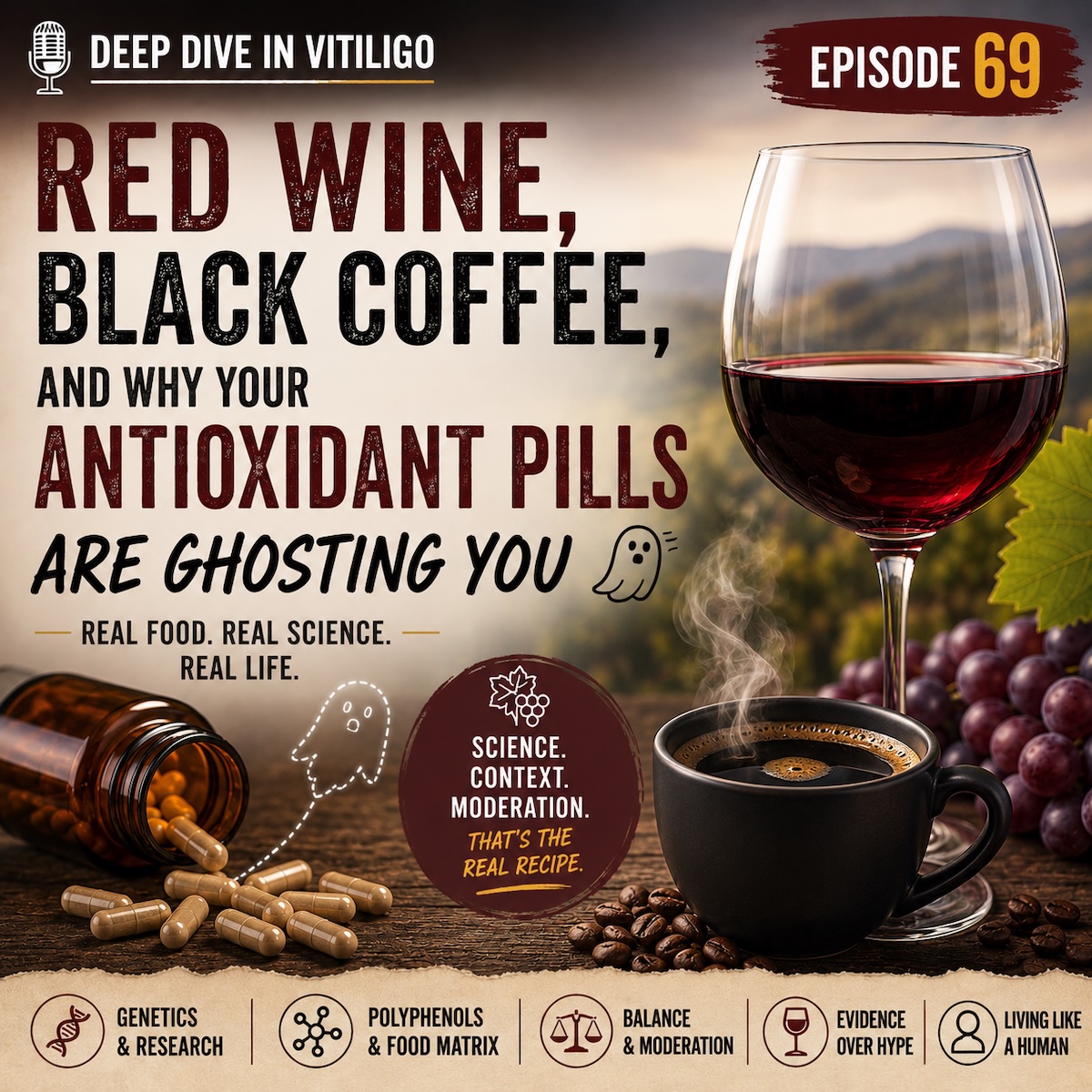
Red Wine, Black Coffee, and Why Your Antioxidant Pills Are Ghosting You (Ep. 69)
We’ve all seen the headlines: red wine might reduce vitiligo risk. Coffee keeps showing up as protective in the data. Berries, tea, and the usual Mediterranean suspects all look suspiciously useful.
Sounds like good news — until you remember the supplement aisle packed with “super antioxidant” bottles that somehow never quite deliver.
In this episode, we cut through the noise. Genetic studies hint at real signals from whole-food polyphenols and the messy, living matrix that comes with them — not lonely molecules trapped in capsules. We talk oxidative stress, why biology prefers a Swiss watch over a single gear, moderation (yes, even with wine), and why Prof. Torello Lotti’s famous final slide with a glass of Chianti still hits different.
No miracle cures. No wellness hype. Just the practical, slightly inconvenient truth about food, context, and living like a human instead of a biochemistry experiment.
Pour yourself something real — or don’t — and join the conversation.
📚 Prefer reading to listening? Two companion articles expand on many of the themes discussed in this episode:
- Red Wine and Vitiligo: Helpful, Harmful, or Just Humans Looking for Good News?
- Why Berries, Coffee and Wine Work Better Than Antioxidant Capsules
🎙️ Listen to Deep Dive in Vitiligo
You can also listen to Deep Dive in Vitiligo on your favorite podcast platform:
🍎 Apple Podcasts
🟢 Spotify
📦 Amazon Music
❤️ iHeart Radio
🎧 Player FM
🎙️ Podchaser
🎤 Podbean
Pick your platform, hit subscribe, and we'll meet you there.
FAQOther Questions
- Who is prone to vitiligo?
Vitiligo can affect anyone, regardless of gender, age, or race. Vitiligo prevalence is between 0.76% and 1.11% of the U.S. population, including around 40% of those with the con...
- What is vitiligo?
Vitiligo (pronounced vit-ill-EYE-go) is a generally unpredictable skin disease that causes a gradual loss of skin color and overlying hair on different parts of the body. Contr...
- Does vitiligo increase the risk of skin cancer?
No, it does not. Despite common misconceptions, people with vitiligo are actually at a lower risk of developing skin cancer—including both nonmelanoma skin cancer (NMSC) and mal...
Though it is not always easy to treat vitiligo, there is much to be gained by clearly understanding the diagnosis, the future implications, treatment options and their outcomes.
Many people deal with vitiligo while remaining in the public eye, maintaining a positive outlook, and having a successful career.
Copyright (C) Bodolóczki JúliaBy taking a little time to fill in the anonymous questionnaire, you can help researchers better understand and fight vitiligo.