
Vitiligo and Your Nails: What the Research Actually Shows
In Brief
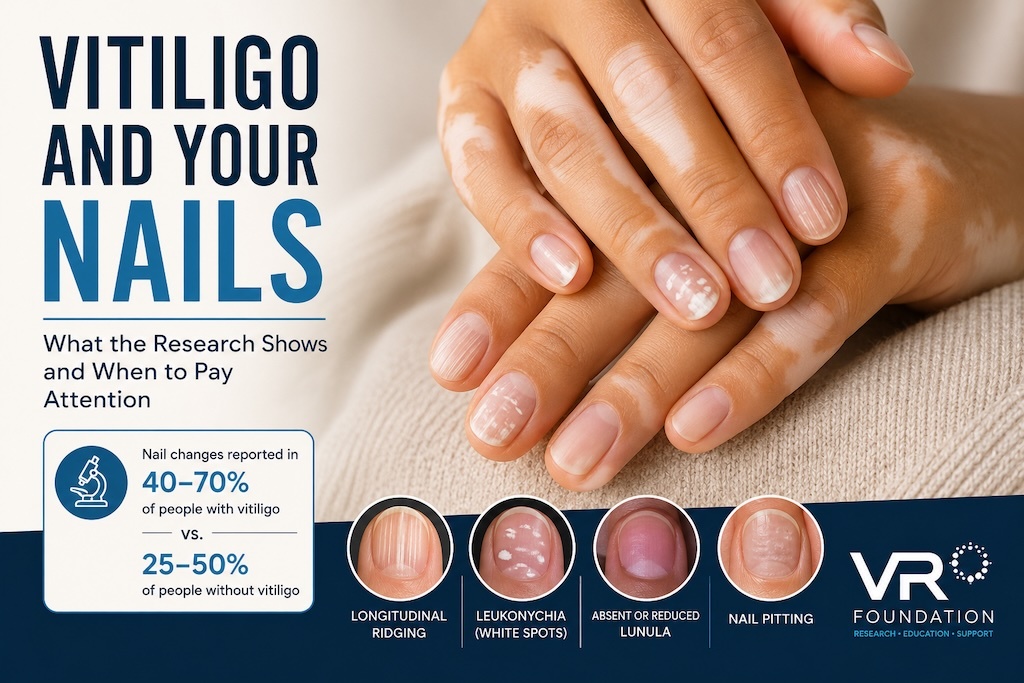
Nail changes appear to be more common in people with vitiligo than in people without vitiligo.
The most frequently reported findings include vertical nail ridges, white spots or lines, and a missing or faint lunula — the pale half-moon at the base of the nail.
These changes do not automatically mean vitiligo is getting worse. They also do not diagnose vitiligo by themselves. But they may offer one more clue that vitiligo is not just “skin deep.”
🎙️ Prefer listening to reading? This companion podcast episode explores many of the same themes discussed in this article.
Why Nails Matter in Vitiligo
Vitiligo is best known for what it does to the skin: the immune system targets melanocytes, the pigment-producing cells that give skin its color.
But melanocytes are not only found in the skin. They are also present in the hair follicles, mucous membranes, and parts of the nail unit, especially the nail matrix — the small but very busy tissue that produces the nail plate.
That matters because several studies have found that nail abnormalities are more common in people with vitiligo than in people without the condition. Depending on the study, nail changes have been reported in roughly 40% to nearly 80% of vitiligo patients, compared with lower rates in control groups.
So yes, there is a real connection. No, it does not mean every ridge or white spot is a vitiligo emergency. Nails are dramatic little things. They react to trauma, aging, manicures, illness, nutrition, psoriasis, thyroid disease, fungal infection, and everyday life. In other words, nails are not exactly calm witnesses.
Common Nail Changes Reported in Vitiligo
The nail findings most often described in vitiligo studies include:
- Longitudinal ridging — vertical lines running from the base to the tip of the nail.
- Leukonychia — white spots, streaks, or lines in the nail plate.
- Absent or reduced lunula — the pale half-moon at the base of the nail may be faint or missing.
- Nail pitting — small dents or depressions in the nail surface.
- Nail thinning or fragility.
- Onycholysis — separation of the nail plate from the nail bed.
- Trachyonychia, sometimes called twenty-nail dystrophy — a rough, sandpaper-like change involving many nails, reported rarely.
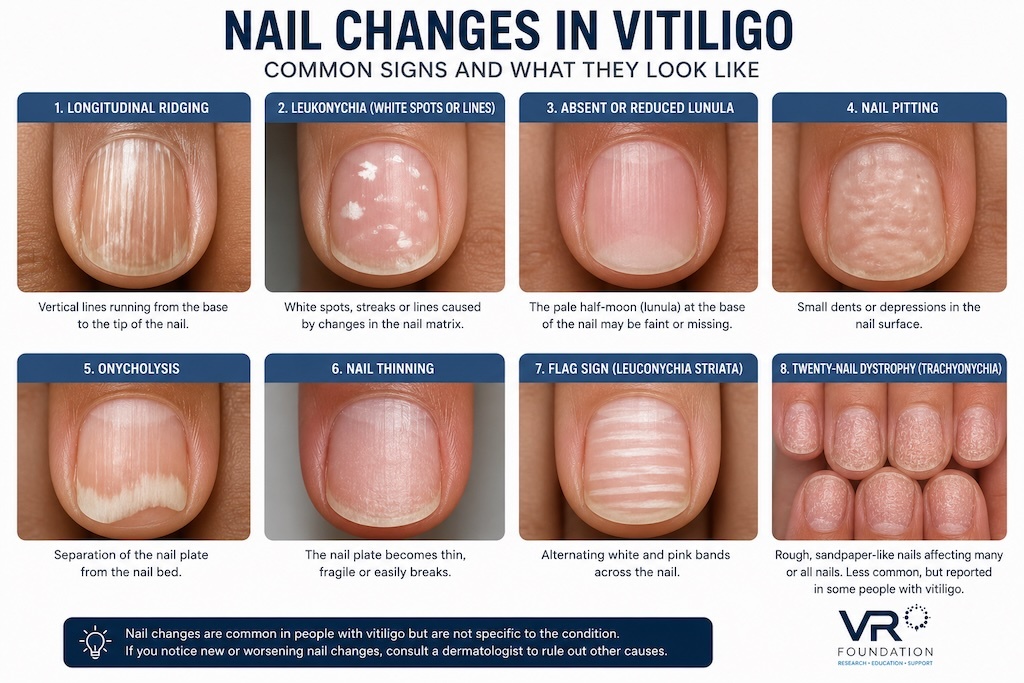
Among these, longitudinal ridging and leukonychia are the most frequently reported. One study of 100 patients with vitiligo found nail abnormalities in 78% of patients, with longitudinal ridging in 42% and leukonychia in 16%.
What Is Leukonychia?
Leukonychia simply means white discoloration in the nail. It may appear as small dots, horizontal lines, vertical streaks, or larger pale areas.
And no, those tiny white marks are usually not proof that you are “low in calcium.” That old myth deserves a comfortable retirement.
White nail changes can come from minor trauma, manicures, fungal infection, inflammatory skin disease, or changes in the nail matrix. In vitiligo, researchers suspect they may reflect altered melanocyte function or immune activity around the nail unit.
Why Might Vitiligo Affect Nails?
There are a few likely explanations.
First, vitiligo is an immune-mediated disease. The same immune activity that damages melanocytes in the skin may also affect melanocytes or surrounding structures in the nail matrix.
Second, vitiligo often travels with other autoimmune conditions. Thyroid disease, alopecia areata, and some inflammatory skin conditions occur more often in people with vitiligo. Nail changes may sometimes reflect those overlapping issues rather than vitiligo alone.
Third, the Koebner phenomenon may play a role. This is when skin changes appear after trauma, friction, pressure, or injury. Nails and cuticles take a lot of abuse: typing, cleaning, picking, biting, gel removal, acrylics, gardening, dishwashing, and the occasional heroic attempt to open packaging designed by someone with no soul.
What Nail Changes Do Not Mean
This part is important.
- Nail ridges do not automatically mean your vitiligo is active.
- White spots do not usually mean calcium deficiency.
- Nail changes alone cannot diagnose vitiligo.
- Most nail changes are not dangerous.
- A single abnormal nail is often more likely to be trauma, fungus, or irritation than vitiligo.
Think of nail changes as a clue, not a verdict.
When Should You See a Dermatologist?
It is worth checking with a dermatologist if you notice:
- rapid nail changes across several nails;
- pain, swelling, bleeding, or pus around the nail;
- thickened, yellow, crumbly, or lifting nails;
- new nail changes together with spreading vitiligo patches;
- nail pitting with scalp flaking, joint pain, or a personal/family history of psoriasis;
- hair loss, fatigue, unexplained weight change, or other symptoms that may suggest thyroid or autoimmune issues.
Your doctor may check for fungal infection, psoriasis, eczema, thyroid disease, nutritional deficiencies, medication effects, or simple mechanical trauma. Boring explanations are common. Medicine, annoyingly, is often less cinematic than the internet would like.
Practical Nail Care for People With Vitiligo
You do not need a luxury nail ritual. You need a boring, consistent one. Boring often wins.
- Keep nails short enough to avoid repeated trauma.
- Use a simple moisturizer or cuticle oil regularly.
- Avoid cutting or aggressively pushing back the cuticles.
- Be careful with gel polish, acrylic nails, and harsh removal methods.
- Wear gloves for cleaning, gardening, or frequent wet work.
- Do not pick at lifting or damaged nails.
- Take photos every few weeks if changes are spreading or unclear.
Nutrition matters too, but supplements are not magic nail fertilizer. Protein, iron, zinc, vitamin D, and biotin all play roles in nail health, but taking extra supplements only helps if there is a real deficiency. If you suspect one, test first. Guessing is how bathroom cabinets become small museums of abandoned pills.
What About Phototherapy?
Phototherapy is commonly used for vitiligo, especially narrowband UVB. Most patients do not need special nail-related precautions beyond normal care, but the skin around the nails can be sensitive, especially if there are active patches on the hands or fingers.
If you are using home phototherapy, follow your prescribed protocol carefully. Do not improvise dose increases. Your skin is not a toaster setting.
What Newer Research Adds: Splinter Hemorrhages and Disease Activity
Older vitiligo nail studies focused mostly on visible changes such as vertical ridges, white spots, and absent lunula. Newer clinical and dermoscopic research gives us a sharper look at the nail unit.
Dermoscopy is a simple tool dermatologists use to examine the skin and nails under magnification. Think of it as a dermatologist’s polite little microscope — less dramatic than a lab machine, but very good at spotting details the naked eye may miss.
A recent study in JAAD International looked at clinical and dermoscopic nail findings in people with vitiligo. One of the more interesting observations was the presence of splinter hemorrhages — tiny reddish-brown or dark longitudinal lines under the nail that can look like fine splinters.
These marks are not specific to vitiligo. They can also appear after trauma, infection, psoriasis, vascular issues, and other conditions. But their appearance in vitiligo research is useful because it reminds us that the nail unit may reflect subtle inflammation or microvascular changes, not just pigment loss.
The same study also reported a link between absent or reduced lunula — the pale half-moon at the base of the nail — and active vitiligo. This does not mean a missing lunula proves disease activity. Many healthy people have faint or invisible lunulae. But in the right clinical context, it may be one more small clue.
Updating the Checklist
Based on older studies and newer dermoscopic findings, the nail changes reported in vitiligo may include:
- Splinter hemorrhages — tiny reddish-brown or dark lines under the nail plate.
- Longitudinal ridging — vertical lines running from the cuticle to the tip.
- Leukonychia — white spots, streaks, or patches in the nail.
- Absent or reduced lunula — a faint or missing half-moon at the nail base.
- Nail pitting — small dents or depressions in the nail surface.
- Nail thinning or fragility — nails that become thinner, weaker, or easier to break.
- Onycholysis — lifting or separation of the nail plate from the nail bed.
The takeaway is simple: you do not need to inspect your fingernails with a magnifying glass every morning. That way lies madness, and possibly very boring breakfast conversations.
But nails can sometimes act as a small biological paper trail. They may show signs of inflammation, trauma, pigment changes, or overlapping conditions. In vitiligo, that makes them worth noticing — not worshipping.
Real-World Case Study: The Case of the Changing Toenail
One rare but memorable case report published in the British Journal of Dermatology showed just how closely the nail matrix and skin can speak the same biological language.
Dermatologists described a child with vitiligo who developed a dark pigmented band on one toenail. Over time, the band changed into two different shades, creating a trichrome pattern — dark pigment, lighter pigment, and depigmented areas appearing side by side.
This is rare. Most people with vitiligo will never see anything like it. But the case is useful because the nail changes appeared during an active phase of the child’s vitiligo and later shifted as the condition evolved.
In plain English: the tissue growing the nail seemed to be affected by the same pigment-related immune activity affecting the skin.
That does not mean every nail change is vitiligo. A changing pigmented nail band should always be checked by a dermatologist, especially if it is widening, irregular, new in adulthood, or affecting only one nail. Most causes are benign, especially in children, but this is not the place for heroic self-diagnosis.
The bigger lesson is more grounded: nails are not separate from the rest of the body. They are connected to the same immune, vascular, and pigment systems involved in vitiligo. Sometimes they quietly show us what is happening elsewhere.
Recent clinical and dermoscopic research has renewed interest in nail involvement in vitiligo. Dermoscopy is a handheld magnifying tool used by dermatologists to see details not always visible to the naked eye.
The Bigger Picture
Vitiligo is not merely a cosmetic skin condition. It is an immune-mediated disorder with effects that may extend beyond visible patches.
Nail changes are one small part of that story. They are usually mild. They are not always caused by vitiligo. But they can help patients and clinicians notice patterns, rule out other conditions, and understand the body as a connected system rather than a collection of unrelated parts.
In short: pay attention, but do not panic. Your nails may be giving you useful information. They are not issuing a royal decree.
Bottom Line
Nail changes are more common in people with vitiligo, especially vertical ridging, white spots or lines, and absent lunula. Most are not dangerous and do not prove that vitiligo is worsening.
If nail changes are sudden, painful, spreading, or associated with other symptoms, see a dermatologist. Otherwise, gentle nail care, documentation, and a little common sense go a long way.
References
- Topal IO, Gungor S, Kocaturk OE, Duman H, Durmuscan M. Nail abnormalities in patients with vitiligo. Anais Brasileiros de Dermatologia. 2016;91(4):442-445. Read study
- Anbar T, Abdel-Rahman AT, Moftah NH, Al-Khayyat MA. Clinical study of nail changes in vitiligo. Journal of Cosmetic Dermatology. 2013;12(1):67-72. PubMed
- Lajevardi V, Ghiasi M, Falahati AA, Goodarzi A. Evaluation of nail characteristics in patients with vitiligo. Iranian Journal of Dermatology. 2017;20(3):69-74. PDF
- Ali SO, et al. Nail vitiligo: Clinical and dermatoscopic features. JAAD International. 2025;18:48-49. doi:10.1016/j.jdin.2024.06.002. PubMed
- Grover C, et al. Nail changes associated with pigmentary disorders. Pigment International. 2021. Read article
Suggested Reading
Smoking, Vaping, and Vitiligo: the “Protective” Paradox
Why some data around smoking and vitiligo looks strange at first glance — and why “protective” does not mean “recommended.” Biology, as usual, refuses to behave politely.
Vitiligo’s White Armour: A Shield Against Mortality & Diseases?
A deeper look at the surprising research suggesting that vitiligo may be linked with certain protective biological patterns, not just risk.
Surprising Link Between Exercise and Vitiligo Management
Exercise is not a vitiligo cure. But it may help regulate inflammation, stress, metabolism, and immune balance — all the boring-but-important stuff your body actually cares about.
Listen to Deep Dive in Vitiligo
Splinters, Ridges & Half-Moons: The Secret Life of Vitiligo Nails (Ep. 70)
We unpack the latest studies, explain what these findings may mean for patients, and discuss when nail changes deserve a closer look — and when they’re probably just part of being human.
Landscape of Hand Vitiligo (Ep. 48)
Why is hand vitiligo so stubborn? This episode explores one of the most visible and treatment-resistant forms of the condition and what patients can realistically expect.
Let's Talk Vitiligo and Beauty During Pregnancy (Ep. 33)
Pregnancy raises plenty of questions about skincare, cosmetics, treatments, and self-image. This conversation tackles them with practical advice and a healthy dose of common sense.