Our work is entirely funded by private donations – we receive no money from government. Your money will help us continue funding research into vitiligo and supporting people affected by the condition.
Podcast
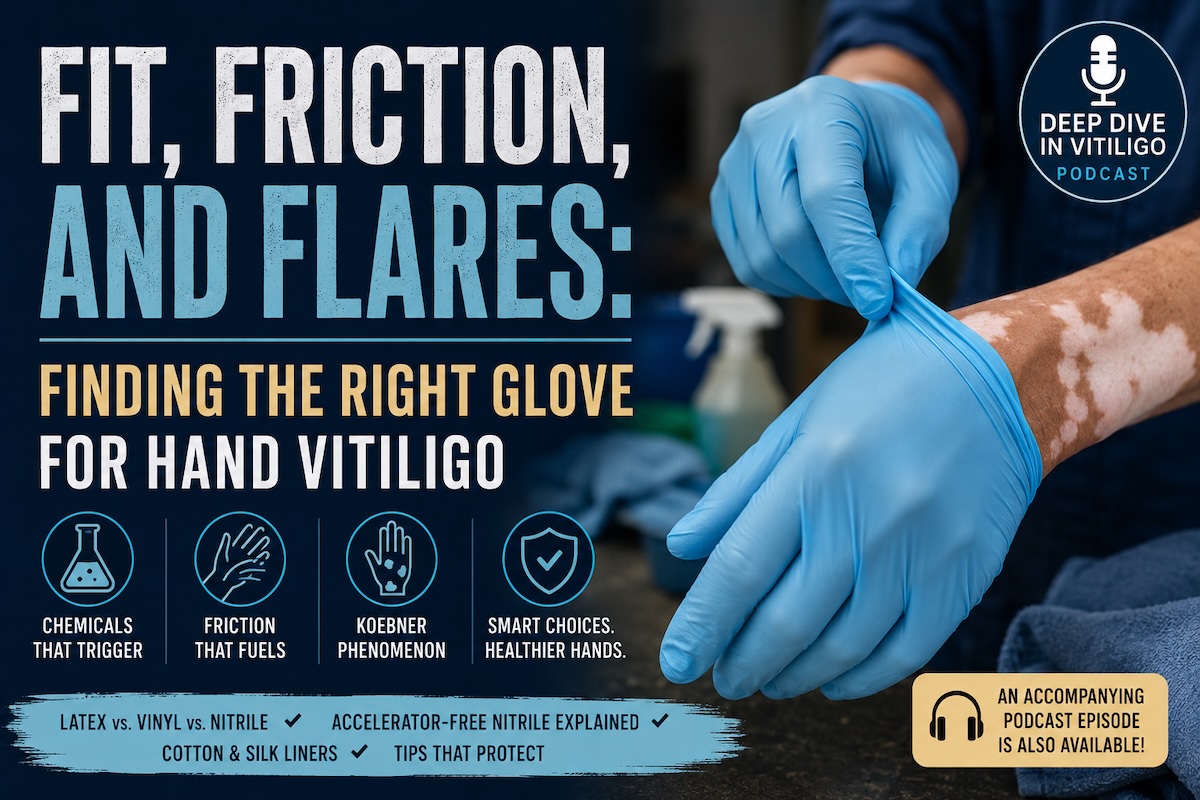
Fit, Friction, and Flares: Finding the Right Glove for Hand Vitiligo (Ep. 74)
Most people think gloves are simple: put them on, protect your hands, move on with life.
Unfortunately, your skin didn’t get that memo.
In this episode of Deep Dive in Vitiligo, we explore the surprisingly complicated world of work gloves, hand dermatitis, chemical leukoderma, and the Koebner phenomenon. Why do some gloves trigger itching, cracking, or irritation? Why can friction matter almost as much as chemicals? And why are many dermatologists quietly steering patients toward accelerator-free nitrile gloves?
We compare latex, vinyl, and nitrile options, discuss cotton and silk liners, tackle the rise of biodegradable “eco-friendly” gloves, and explain how a simple choice at the hardware store or workplace can affect long-term hand health.
No fear-mongering. No glove industry conspiracies. Just practical advice to help your hands do their job without becoming part of the problem.
Because the best glove is supposed to protect your skin — not give it a new hobby.
📚 Prefer reading to listening? The companion article expands on many of the themes discussed in this episode.
🎙️ Listen to Deep Dive in Vitiligo
You can also listen to Deep Dive in Vitiligo on your favorite podcast platform:
🍎 Apple Podcasts
🟢 Spotify
📦 Amazon Music
❤️ iHeart Radio
🎧 Player FM
🎙️ Podchaser
🎤 Podbean
Pick your platform, hit subscribe, and we'll meet you there.
FAQOther Questions
- Will it spread?
Vitiligo is famously unpredictable, but it doesn't move at random. By looking at thousands of cases, researchers have identified specific patterns of how the condition behaves. ...
- Safety of clinical trials. Can my child leave it for any reason?
Pediatric vitiligo trials · Safety and choice Who watches your child, what may need to pause and what happens if your family changes its mind. Two studies discussed here are eva...
- Are there any famous people with vitiligo?
Many celebrities have dealt with vitiligo while remaining in the public eye, maintaining a positive outlook, and having a successful career. Here are a few courageous famous peo...
Though it is not always easy to treat vitiligo, there is much to be gained by clearly understanding the diagnosis, the future implications, treatment options and their outcomes.
Many people deal with vitiligo while remaining in the public eye, maintaining a positive outlook, and having a successful career.
Copyright (C) Bodolóczki JúliaBy taking a little time to fill in the anonymous questionnaire, you can help researchers better understand and fight vitiligo.