New

Tattoo Ink and Vitiligo: A Cautionary Case of Systemic Reaction to Red Ink
Tattoo case report: red ink triggered erythroderma, alopecia universalis, anhidrosis and vitiligo in a man with autoimmune risk — and what this means for people with vitiligo.
- When body art triggers a cascade of autoimmune conditions
- The patient’s journey: from self-expression to medical crisis
- A perfect storm of complications
- The likely culprit: red tattoo ink
- Treatment challenges and the role of modern immunotherapy
- Why this matters for people with vitiligo
- What else has been reported?
- Practical implications and prevention
- The bigger picture: tattoos are not just cosmetic
- A final word for the vitiligo community
- References
When body art triggers a cascade of autoimmune conditions
Tattoos are now completely mainstream. Roughly one in four young adults has at least one. For most people, it is just decoration and self-expression.
But for dermatologists, another side of the story is becoming hard to ignore: tattoo ink can trigger serious immune reactions. Not just itchy patches or local rashes, but full-blown autoimmune disease.
A recent case from Poland shows how far this can go.
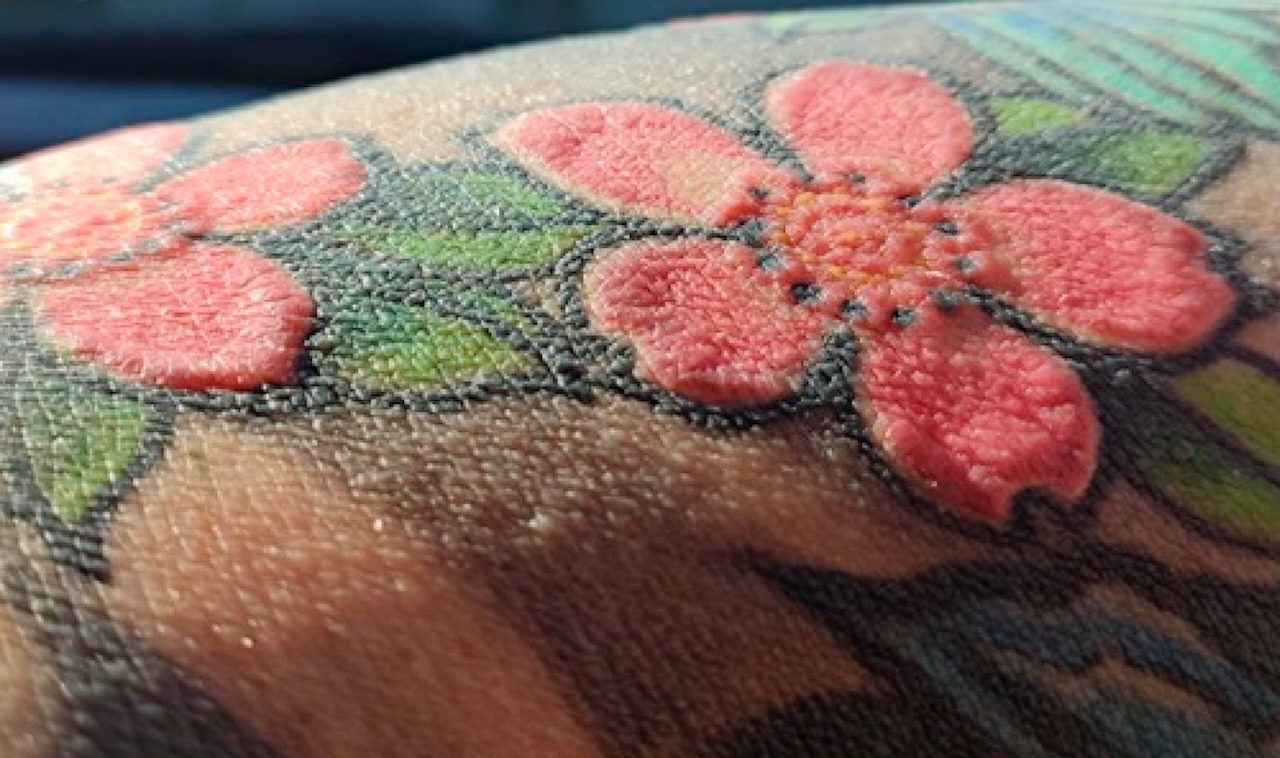
Image: Initial stage of skin changes within the red ink tattoo
Copyright: Mateuszczyk MK, Łyko M, Bieniek A, et al
The patient’s journey: from self-expression to medical crisis
In late 2020, a 36-year-old man got a tattoo on his right forearm. Nothing unusual, except for one detail: the design included red pigment.
Four months later, the problems started. He developed intense itching (8–10 out of 10), severe peeling, and a raised, bumpy rash on a red background at the tattoo site. Over the following months, this localized reaction escalated into:
- Erythroderma – red, inflamed skin covering more than 90 percent of his body.
- Alopecia universalis – total loss of hair on the scalp and body.
- Anhidrosis – complete loss of sweating.
By early 2021, his skin was bright red and inflamed, he had no hair anywhere on his body, and he had stopped sweating entirely. Without sweat, he could not safely exercise, work in heat, or even tolerate warm rooms.
Then came one more twist: after surgeons removed the tattooed skin, he developed vitiligo, with large depigmented patches spreading over much of his body.
This one tattoo had essentially flipped several autoimmune switches at once.
A perfect storm of complications
What makes this case so unusual is the combination of four major complications in a single patient.
Erythroderma
A severe, widespread inflammation of the skin. He required multiple hospitalizations and tried many treatments, including oral corticosteroids, cyclosporine, methotrexate, and acitretin. None gave lasting relief.
Alopecia universalis
Complete loss of hair on the scalp and body. This eventually improved under immunosuppressive treatment, but it was a clear sign of massive immune system disruption.
Anhidrosis
The most disabling feature: he completely lost the ability to sweat. Skin biopsies showed destruction and scarring of the eccrine (sweat) glands. This appears to be permanent. Despite aggressive therapy, sweating never returned, and he remains dependent on external cooling to avoid overheating.
Vitiligo
Depigmented patches appeared months after the first symptoms. Treatment was able to stop further spread, but about 30 percent of his body remained depigmented and has not repigmented.
One tattoo, four serious and long-lasting outcomes.
The likely culprit: red tattoo ink
Allergy testing (patch testing) showed hypersensitivity to several substances often found in tattoo inks:
- Potassium dichromate
- Formaldehyde
- Fragrance additives
Red tattoo ink has long been the problem child of tattoo colors. Before 2022, the European Union had no strict regulation on tattoo pigment composition. Red inks often contained mercury, cadmium, arsenic and other toxic or carcinogenic ingredients. Even now, with tighter rules, red inks can still contain allergenic compounds.
In this patient, the red ink likely acted as a powerful trigger on top of an already primed immune system. He had a history of Hashimoto’s thyroiditis, an autoimmune thyroid disease, and elevated ANA titers suggesting a general autoimmune tendency.
So you have: susceptible immune system plus strong allergen plus skin trauma – a perfect setup for systemic trouble.
Treatment challenges and the role of modern immunotherapy
Managing this case was anything but straightforward.
Over several years, the medical team cycled through many treatments and procedures:
- Seven surgical procedures to remove tattooed areas.
- Multiple systemic immunosuppressants.
- High-dose intravenous corticosteroids.
- Eventually, a JAK inhibitor (baricitinib).
A simplified treatment timeline looks like this:
- Cyclosporine helped stop vitiligo progression and restored most hair growth within six months.
- High-dose intravenous corticosteroids brought temporary improvement but did not restore sweating.
- Complete removal of all remaining red tattoo pigment was essential. Areas where pigment remained kept reactivating months later.
- Baricitinib, a JAK inhibitor, further accelerated hair regrowth and stabilized vitiligo, but neither repigmentation nor sweating came back.
In other words, modern immunotherapy helped control the fire, but could not undo all the structural damage.
Why this matters for people with vitiligo
This case is especially relevant for the vitiligo community for several reasons.
Shared autoimmune pathways
Vitiligo appeared after the tattoo reaction. That suggests the tattoo-induced inflammation helped push the immune system to attack melanocytes as well. We already know that roughly one in four people with one autoimmune disease will develop another; this case is a vivid example.
The Koebner phenomenon
Vitiligo often appears in areas of skin injury or friction, a pattern called the Koebner response. A tattoo is, by definition, controlled trauma plus foreign material injected into the skin. For someone with an excitable immune system, that can be enough to start or amplify vitiligo.
Risk in predisposed individuals
People with autoimmune conditions such as Hashimoto’s, lupus, vitiligo, or type 1 diabetes, or a strong family history, are at higher risk for over-reactive immune responses. Tattoo ink gives the immune system something new to attack, in a very visible place.
The missed warning signs
This patient already had subclinical markers of autoimmunity, including elevated ANA. In an ideal world, that would be part of informed consent: your immune system is already active and a tattoo may carry extra risk for you.
What else has been reported?
The exact combination in this case – erythroderma, alopecia universalis, anhidrosis and vitiligo after red tattoo ink – appears to be unique so far.
But related problems have been documented:
- Generalized lichenoid reactions: widespread skin inflammation spreading well beyond the tattoo site, sometimes requiring systemic steroids.
- Tattoo-induced alopecia: a reported case where alopecia areata developed in association with a reaction to red tattoo pigment and improved after treating the inflammation.
- Vitiligo at tattoo sites: classic Koebner phenomenon, with vitiligo appearing in or around tattoos, or spreading from them.
- Systemic autoimmune diseases triggered after tattooing: cases of sarcoidosis, lupus-like reactions, myositis, and other systemic inflammatory disorders have been reported after tattooing.
What sets this Polish case apart is its severity, duration, and the permanent loss of sweat glands – a structural, not just functional, injury.
Practical implications and prevention
This case raises practical questions for three groups: people considering tattoos, healthcare providers, and regulators.
For people considering tattoos
Especially if you have vitiligo, another autoimmune disease, or a strong family history:
- Talk to your dermatologist before getting a tattoo.
- Know that red ink carries the highest documented risk of allergic and inflammatory reactions.
- Understand that patch testing with ink is imperfect. Allergens can form only after the pigment sits in the dermis and binds to proteins, a process called haptenization.
- Be clear that serious systemic reactions are rare, but possible, and sometimes life-altering.
For healthcare providers
- Take a full autoimmune and family history when patients ask about tattoos.
- In high-risk individuals, consider patch testing with the exact ink proposed, while acknowledging its limits.
- Be alert to symptoms appearing months after tattooing, not just in the first few weeks.
- Remember that incomplete removal of sensitizing pigment can allow reactions to flare again.
- Recognize that JAK inhibitors and other advanced immunotherapies may have a role in severe tattoo-related reactions, though data are still limited.
For society and regulation
- Strong regulation of tattoo pigment composition is essential. The EU’s 2022 REACH rules are a step, but not the end of the story.
- Licensing and proper training for tattoo artists should include basic understanding of risks, especially with red ink.
- Public education campaigns should treat tattoos as a medical procedure with possible complications, not just body art.
The bigger picture: tattoos are not just cosmetic
This case underlines a simple point: tattoos are not like eyeliner or nail polish. They introduce foreign chemicals directly into the dermis, where they stay for life.
For most people, the immune system shrugs and moves on. For others, especially those with underlying immune dysregulation, that foreign material becomes a long-term trigger.
In this patient, the most devastating outcome was not vitiligo or hair loss – both of which partially improved – but permanent anhidrosis. He cannot sweat. That means:
- No normal exercise.
- No safe work in warm environments.
- Continuous risk of overheating.
That is not a cosmetic complication. That is a disability.
A final word for the vitiligo community
If you have vitiligo, another autoimmune condition, or a strong family history, it does not mean tattoos are absolutely forbidden. But it does mean the decision deserves real thought.
Ask yourself:
- Have I discussed this with a dermatologist who knows my history?
- Do I understand that red ink is higher risk?
- Am I comfortable with a small but real chance of serious complications?
In the case described here, the patient is still on baricitinib. His vitiligo has stabilized. His hair has grown back. But his sweating has not returned, and likely never will.
That is the kind of trade-off no one expects when they walk into a tattoo studio.
Suggested Reading
References
Mateuszczyk MK, Łyko M, Bieniek A, et al. Erythroderma, alopecia, anhidrosis, and vitiligo as complications of a red ink tattoo – a case report. Clin Pract. 2025;15:224.
Sources
- Inflammatory Reactions to Red Tattoo Inks (PubMed)
- Repigmentation of vitiligo with 5-fluorouracil tattooing in combination with topical ruxolitinib (PubMed)
- Avoiding laser therapy for tattoos exhibiting allergic reactions (ScienceDirect)
- Tattoos: risks and complications, clinical and histopathological: ScienceDirect
- Inflammatory Reactions to Red Tattoo Inks: Three cases highlighting: Sultan Qaboos University Medical Journal
FAQOther Questions
- Red Wine and Vitiligo
Recent research has explored whether moderate red wine consumption might influence vitiligo risk, especially through genetic studies and large population data. What the Genetic ...
- Awareness Days Similar to World Vitiligo Day
World Vitiligo Day, celebrated annually on June 25 since 2012, is a significant event dedicated to raising awareness about vitiligo and supporting those affected by the conditio...
- How smoking affects vitiligo?
Smoking is a common habit linked to numerous health risks, affecting multiple body systems and increasing various disease risks, including respiratory and cardiovascular issues....
Though it is not always easy to treat vitiligo, there is much to be gained by clearly understanding the diagnosis, the future implications, treatment options and their outcomes.
Many people deal with vitiligo while remaining in the public eye, maintaining a positive outlook, and having a successful career.
Copyright (C) Bodolóczki JúliaBy taking a little time to fill in the anonymous questionnaire, you can help researchers better understand and fight vitiligo.