New

The Vitiligo Corporate Trench Map
How Vitiligo Became a Serious Therapeutic Category
Opinion and Analysis
By Yan Valle, CEO, Vitiligo Research Foundation
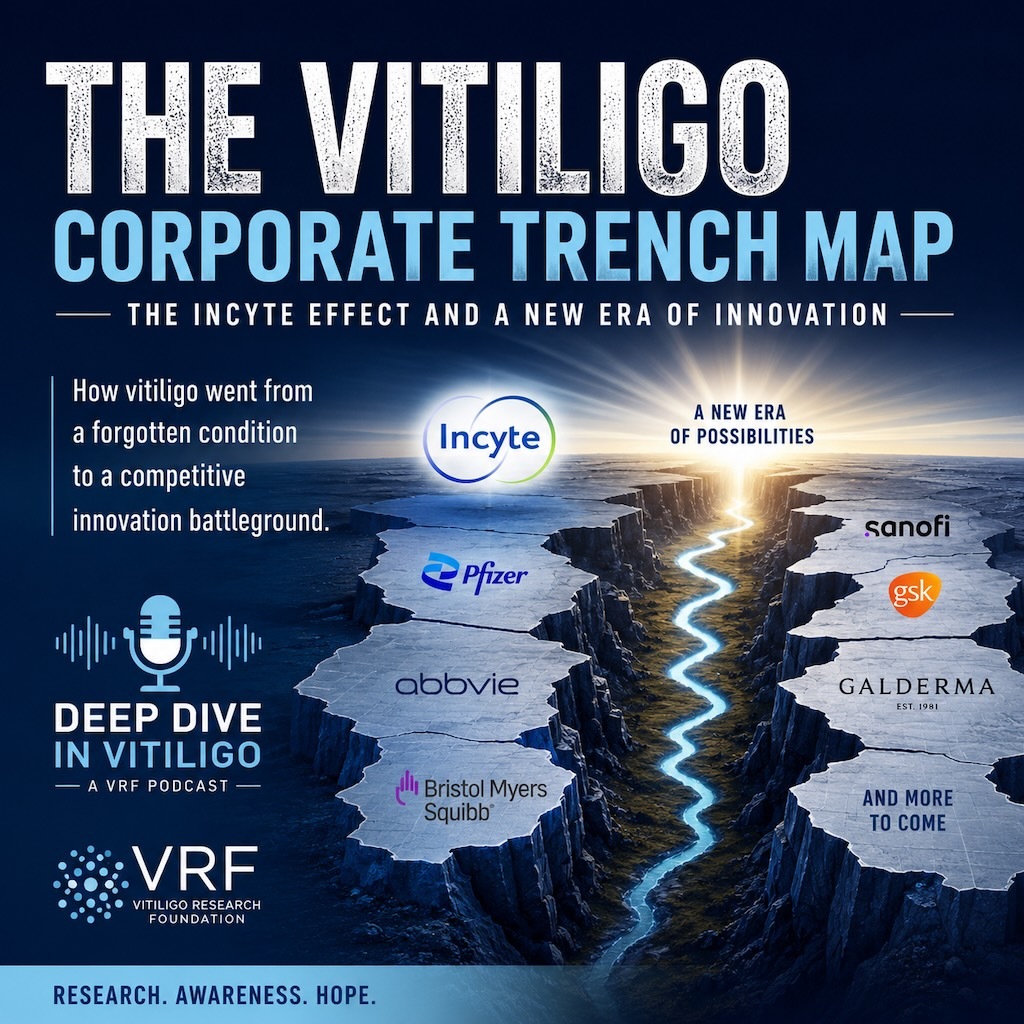
Vitiligo did not become a serious therapeutic category because of any single breakthrough or organization. It happened because patients became visible, advocates became organized, scientists became stubborn, and industry finally gained the confidence to invest alongside them. This is the messy map of how that happened.
What's Inside This Story
A venture capitalist, a biotech analyst, and a slightly cynical patient advocate walked into a bar. The venture capitalist ordered a premium scotch and launched into a passionate monologue about untapped patient populations. The biotech analyst pulled up a spreadsheet, muttered something about compound annual growth rates, and promptly spilled a fancy cocktail all over it. The patient advocate sighed, ordered a Diet Coke, and asked whether any of this money was actually going to stop a vitiligo patch from spreading before the decade ended.
For most of modern medical history, that joke would have made little sense because nobody was walking into the bar to talk about vitiligo. Patients cared. Dermatologists cared. A few researchers cared. Much of pharma saw a modest market, unclear biology, messy endpoints, and a condition still dismissed as cosmetic.
That view had consequences. Research funding lagged. Trials were rare. Investment stayed thin. Patients were offered corticosteroids, phototherapy, tacrolimus, and hope, then told to live with it.
Then, somewhere between the clinic, the lab, and the boardroom, the math changed. Not overnight. Not through one miracle breakthrough. And certainly not because pharma woke up one morning humming humanitarian folk songs.
It changed because patients refused to stay invisible, researchers kept pushing, advocates built pressure, entrepreneurs spotted gaps, and companies increasingly committed resources to a disease they could no longer ignore.
If the Jackson–Thomas–Harlow Effect explains how vitiligo became visible, this Vitiligo Corporate Trench Map explains how it became investable.
That story is where things get interesting.
The Disease Nobody Wanted
It is easy to forget how recently vitiligo sat near the bottom of the pharmaceutical priority list.
Today, conference halls buzz with discussions about JAK inhibitors, IL-15 blockade, immune memory, treatment sequencing, and billion-dollar market forecasts. Major pharmaceutical companies compete. Investors listen. Analysts project growth well into the next decade.
None of that would have sounded remotely believable fifteen years ago.
Back then, vitiligo occupied a strange blind spot. It affected millions worldwide, yet remained largely invisible to the machinery that drives modern drug development. Too common to be rare, not attractive enough to chase. Researchers struggled for funding. Trials stayed small. Treatment plans barely changed from one decade to the next.
Patients often heard the same discouraging advice:
Learn to live with it.
The irony, of course, is that millions already were.
What the field lacked was not patients. It lacked proof — proof that meaningful repigmentation was achievable, that regulators would approve dedicated treatments, that insurers might provide coverage, and that sustained investment could accelerate progress.
The first companies willing to test those assumptions were taking real risks.
Clinuvel: The Pioneer Who Hit the Wall
Long before JAK inhibitors dominated the conversation, Clinuvel was out on a different path.
Their drug, afamelanotide (Scenesse), was designed to stimulate melanocytes and encourage pigment production. Straightforward logic: if vitiligo destroys pigment, push harder on making more.
They were ahead of their time — investing when bigger players wouldn't touch it, running trials in a niche everyone ignored, exploring pigment rebuilding instead of pure immune suppression.
But biology humbles elegant theories. The challenge wasn't creating pigment. It was creating pigment patients experienced as improvement. Because Scenesse stimulates melanin broadly, normal skin darkened too. In lighter phenotypes, especially with phototherapy, contrast sometimes got uglier before it got better — a psychological gut punch for people already raw about their reflection.
A dermatologist might chart repigmentation. A patient might see their condition suddenly more obvious.
Clinuvel never became the defining success story. Pioneers rarely do. Their real role was proving serious money would chase vitiligo before the spreadsheets looked good.
But pioneers don't just vanish when they hit a wall; they recalibrate. Clinuvel didn't abandon the field. Instead, they doubled down on the clinical nuance, pushing Scenesse into advanced trials specifically as a combination therapy alongside targeted narrowband ultraviolet B (NB-UVB) phototherapy.
Sometimes the first expedition doesn't discover the city. It simply proves the city exists.
The Incyte Effect
If Clinuvel proved someone could explore the territory back in 2011, Incyte helped demonstrate what a mature therapeutic category could look like.
When Incyte initiated its first dedicated vitiligo trials in 2018, the industry was still skeptical. The approval of Opzelura (ruxolitinib cream) in 2022 was a genuine watershed — first FDA-approved treatment specifically for repigmentation in non-segmental vitiligo. Sales climbed into hundreds of millions. Ex-US approvals and launches followed.
More importantly, the rest of the industry started paying attention.
Approvals rewrite behavioral gravity. Researchers, investors, executives, and competitors all gained confidence. The market effectively validated what patients had been screaming for decades: this isn't a cosmetic quirk. It's a bone-fide autoimmune disease with serious commercial legs.
Pipeline activity accelerated. Investment increased. Companies that had previously ignored the field suddenly began paying attention.
But Incyte went past the molecule. They engaged deeply in patient and doctor education, opened their doors for unscripted lab tours, supported public service announcements, helped organize high-impact advocacy summits. Through the launch of the Vitiligo Ingenuity Awards, they began backing grassroots solutions for the community directly.
When COVID-19 hit, they skipped the standard pharma playbook. Instead of supporting a traditional, tightly controlled awareness campaign, they backed World Vitiligo Day as a decentralized global network. Leadership rotated by country. Local organizers ran local shows. The digital reach blew right past traditional boundaries.
For a pharmaceutical industry accustomed to rigid, centralized opeational protocols, this was a visionary move. It allowed a fractured global community to tune to the exact same wavelength at least once a year. The broader effect is hard to argue: Incyte helped solidify vitiligo community and pull it from the margins of dermatology toward the mainstream.
The Giants Nobody Could Ignore
One of the reasons vitiligo became commercially interesting was not just Wall Street spreadsheets, – it was geography.
The industry's center of gravity may have been North America and Europe, but the disease itself was speaking loudly from elsewhere.
India, in particular, became impossible to ignore.
With one of the world's largest vitiligo populations and decades of accumulated dermatology experience, India quietly became one of the field's most important proving grounds. Long before pharmaceutical analysts were discussing market forecasts, Indian physicians were already managing vast numbers of patients and refining treatment approaches in real-world settings.
In many ways, India provided something every therapeutic field eventually needs:
Scale.
A disease that affects millions is difficult to dismiss forever.
China contributed something different.
While Western discussions often focused on individual therapies, Chinese researchers and companies increasingly approached vitiligo through the lens of population-scale medicine. Large hospital networks, digital health platforms, artificial intelligence initiatives, and growing biotechnology investment created an environment where patient recruitment, data collection, and clinical development could occur at remarkable speed.
The future of vitiligo innovation may still be written partly in Boston, New York, and Basel. But increasingly, some of the most important chapters are also being written in Chandigarh, Mumbai, Shanghai, Beijing, and Guangzhou.
The Bulldozers Arrive
Once a market is proven, the heavy machinery rolls in.
AbbVie advanced upadacitinib (Rinvoq), an oral JAK1 inhibitor already familiar to physicians treating other autoimmune diseases. Pfizer expanded development of ritlecitinib (Litfulo) into vitiligo after success in alopecia areata. Other major players began evaluating where they might fit into a field that suddenly looked far more attractive than it had just a few years earlier.
The strategic shift was important. Topical therapy treats individual patches. Systemic therapies aim to influence immune activity throughout the body.
For patients with extensive body involvement, that distinction changes the conversation entirely. The question is no longer whether repigmentation is possible. The question becomes how aggressively the underlying autoimmune process should be managed.
These companies aren't simply introducing new drugs. They're helping redefine how vitiligo is viewed.
A disease once managed primarily with corticosteroid creams and ultraviolet light is increasingly discussed in the same language as psoriasis, alopecia areata, and other systemic autoimmune disorders.
That shift carries enormous implications for research funding, physician education, insurance coverage, and future innovation.
The Rebels Tag Along
Every therapeutic field eventually develops a second wave.
The first wave proves treatment is possible. The second wave asks whether existing treatments are good enough.
That's where today's pipeline rebels enter the story.
One of the most intriguing developments in recent years involves IL-15 and tissue-resident memory T cells. These cells are increasingly viewed as the local hard drives of disease activity, preserving the immune memory that allows vitiligo to return long after successful repigmentation.
Current therapies often suppress the immune response. But suppression is not the same as elimination.
Incyte's acquisition of Villaris Therapeutics highlighted growing interest in this area. Additional efforts involving anti-IL-15 programs suggest that significant capital is now being directed toward the biology of relapse itself.
The goal is no longer simply controlling vitiligo. The goal is no longer a lifetime of daily applications.
It is a therapeutic reset.
Elsewhere, smaller biotechnology companies continue exploring cellular therapies, regenerative approaches, stress-response pathways, next-generation immune modulation, and other ideas that may or may not survive contact with reality.
Many will fail. That is the nature of innovation. But every failed experiment expands the map.
The Post-Opzelura Acceleration
Look at the landscape now and it's almost unrecognizable from a decade ago.
Dozens of programs. Big Pharma mixing with biotechs. Sophisticated endpoints. Investment levels that once seemed absurd.
The disease didn't get more common. The biology didn’t suddenly change. What changed was the confidence that scientific progress could translate into real treatments.
Once one company demonstrated that regulators would approve a dedicated therapy, physicians would prescribe it, patients would seek it, and investors would fund it, the entire field accelerated.
The result was not a straight line. It was a stampede.
Vitiligo's Telegraph Road
I keep thinking of Dire Straits' Telegraph Road – among my all-time favorite songs – here.
Then came the churches, then came the schools
Then came the lawyers, and then came the rules
Then came the trains and the trucks with their loads
And the dirty old track was the telegraph road...
That is almost exactly what happens when a neglected disease becomes a market.
First come the patients and doctors. Then come the researchers. Then come the companies, investors, regulators, advocacy summits, patient platforms, insurance, fashion, books, movies and everything else necessary for a community to thrive.
But once the road is built, everyone uses it — the healers, the builders, the merchants, and yes, the occasional snake-oil salesman with a slick landing page.
As a lifelong Dire Straits fan, I have to admit this may be the first time I've heard Mark Knopfler accidentally explain the evolution of a dermatology market.
What Comes Next
Looking back, the modern history of vitiligo can be divided into three distinct eras.
The Era of Visibility
Patients, advocates, and public figures fought to make the world acknowledge the condition. Michael Jackson made people notice. Lee Thomas made the condition human. Winnie Harlow challenged assumptions about beauty and possibility.
The Era of Validation
Researchers mapped the biology. Pharmaceutical companies built the pipeline. Investment transformed possibility into products.
The Era of Navigation
Patients suddenly face an abundance of choices that barely existed a decade ago. The challenge is no longer finding treatment. It is understanding which treatment makes sense, for whom, when, and at what cost.
For decades, patients lacked visibility and treatments. Today they increasingly have both.
The challenge is no longer finding hope. It is finding the proper direction in the informational fog.
The next bottleneck may not be scientific discovery. It may be helping people find their way through a rapidly growing therapeutic ecosystem.
The cavalry has finally arrived.
Now somebody needs to hand out maps.
This wasn't clean or inevitable. It was scarred patients, loud advocates, stubborn scientists, and companies willing to bet when the bar conversation still sounded like a bad joke.
Orphan no more. Vitiligo had finally become a disease the world was willing to take seriously.
The map is still being drawn. Some dirty roads will turn out to be dead ends. Some promised shortcuts will lead nowhere. Some of today's most exciting ideas will quietly disappear. That's how exploration works.
But for the first time in a very long time, vitiligo patients are no longer standing at the edge of a blank page. The road is finally built. Traffic is picking up. And that alone is worth raising a glass to.
Recommended Reading
If this article sparked your interest, these pieces help complete the picture.
📌 Vitiligo Drug Pipeline Analysis – January 2026
The technical companion to this article. A detailed look at the companies, drugs, mechanisms, acquisitions, successes, failures, and emerging therapies shaping the future of vitiligo treatment.
The Jackson, Thomas, Harlow Effect on Vitiligo
How three public figures helped transform vitiligo from a little-known skin condition into a global conversation about visibility, representation, and identity.
The Real Price Tag of Treating Vitiligo: What You Need to Know
Drug approvals are exciting. Paying for them is another story. A practical look at the economics of modern vitiligo care.
Vitiligo Patient Journey Map
The next chapter after visibility and validation. A framework designed to help patients navigate an increasingly complex landscape of treatments, decisions, and outcomes.
Listen to Deep Dive in Vitiligo Podcast
Prefer listening to reading? These episodes explore many of the same themes discussed in this article.
🎙️ The Vitiligo Corporate Trench Map (Ep. 61)
We explore the "Incyte effect" and forces reshaping the vitiligo landscape in mid-2026 — from pharmaceutical giants and emerging biotech companies to AI-powered research, teledermatology, and the growing role of India and China in global innovation.
🎙️ The Jackson-Thomas-Harlow Effect On Vitiligo (Ep. 60)
A sharp look at medicine, media, and why human faces often change minds faster than facts. The Jackson-Thomas-Harlow Effect describes how visibility, storytelling, and cultural representation can reshape public acceptance of vitiligo.
🎙️ AI for Vitiligo Patients — Beyond the Hype (Ep. 51)
Separating practical AI tools from science-fiction marketing and understanding what artificial intelligence can actually do for patients today.
🎙️ WHO Finally Notices the Skin — What It Means (and Doesn't) for Vitiligo (Ep. 50)
A closer look at WHO's growing attention to skin diseases and what it may — and may not — mean for the future of vitiligo care.
The Next Breakthrough May Not Be Another Drug
It may be helping patients understand the choices now appearing in front of them — with science, honesty, and a decent map.
© Vitiligo Research Foundation • Written by Yan Valle, CEO VRF, polished with ChatGPT — one more small sign that even advocacy has entered its cyborg era.
FAQOther Questions
- Is it possible to stop the progression of vitiligo?
While it's not always possible to quickly stop vitiligo progression, there are some treatments that can help slow or halt the spread of the condition in many cases: Corticostero...
- Are there any famous people with vitiligo?
Many celebrities have dealt with vitiligo while remaining in the public eye, maintaining a positive outlook, and having a successful career. Here are a few courageous famous peo...
- What are risks of oral and topical corticosteroids?
Corticosteroid drugs (like hydrocortisone, and others) are often used for treating vitiligo. By mimicing the effects of hormones your body produces naturally in your adrenal gla...
Though it is not always easy to treat vitiligo, there is much to be gained by clearly understanding the diagnosis, the future implications, treatment options and their outcomes.
Many people deal with vitiligo while remaining in the public eye, maintaining a positive outlook, and having a successful career.
Copyright (C) Bodolóczki JúliaBy taking a little time to fill in the anonymous questionnaire, you can help researchers better understand and fight vitiligo.