New

Vitiligo Study For Children Ages 2–11 in USA and Canada
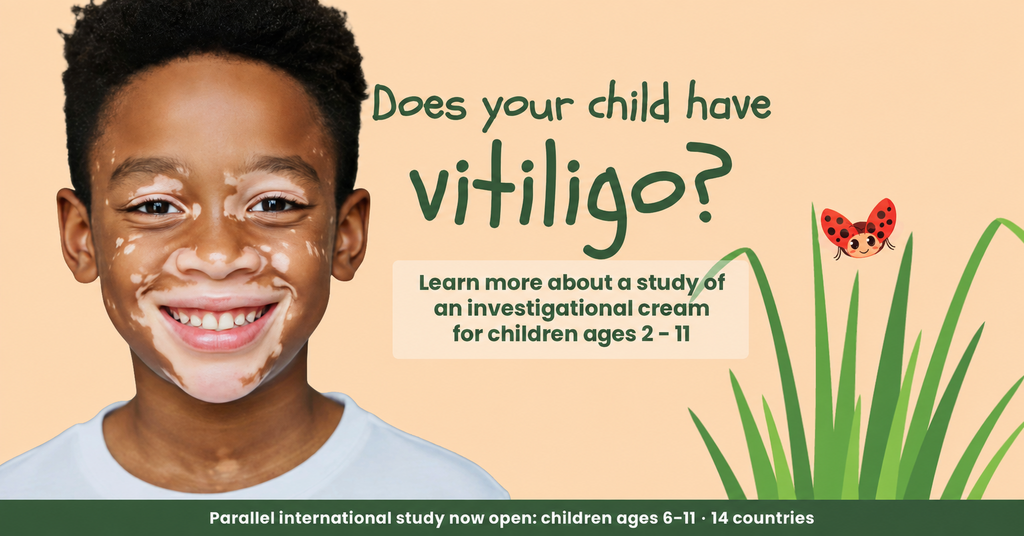
Clinical trial · Children ages 2–11 · United States and Canada
TRuE-ViP study is testing ruxolitinib cream in children ages 2–11 with vitiligo in the United States and Canada. Its use in children this age is investigational — researchers are still finding out how well it works and how safe it is.
Here is what a parent needs to know before adding a clinical trial to the family calendar.
Two studies, one active ingredient: what is the difference?
Two studies are testing ruxolitinib cream in children with nonsegmental vitiligo. They study the same active ingredient, but they are separate trials with different age ranges, locations and study designs.
For children ages 2–11 at selected sites in the United States and Canada.
For children ages 6–11 at sites across Argentina and 13 European countries.
Is there a study site near you?
TRuE ViP lists 69 trial sites in the United States and 19 – in Canada.
Look up participating locations on the World Vitiligo Map.
Find locations on the map →Why study the cream in younger children?
Ruxolitinib cream — marketed as Opzelura in the United States and Canada for nonsegmental vitiligo from age 12 — has not been established for this younger age group. This study is designed to evaluate its efficacy and safety in children ages 2–11.
A younger child is not a pocket-sized teenager. Researchers need real evidence from this age group. The answer is not known yet — that is why the trial exists.
Who may qualify?
- Children ages 2 to 11 at the study start
- A diagnosis of nonsegmental vitiligo, its most common form
- Vitiligo sized from a few spots up to 10% of the body
Detailed criteria may include other health and treatment requirements. Contact the study team for details.
Ready to check the basics?
Answer a few initial questions and choose your country. A participating study site will confirm whether screening makes sense.
Check eligibility →Quick answers for parents
The questions mothers ask first
You do not need to decode a research protocol over breakfast. Start with the question sitting at the top of your list.
FAQ 1 · The basics
Why does age matter — and which study may apply?
Learn why children are studied in separate age groups, how a trial differs from regular treatment and why location matters when choosing between these two studies.
Read the basics →FAQ 2 · Taking part
What does joining actually look like?
Cream in the morning. Cream at night. Scheduled visits, photographs and blood tests. For the first 24 weeks, your child may receive ruxolitinib cream or a look-alike cream without the active medicine.
See what joining involves →FAQ 3 · Safety and choice
Who watches my child — and can we leave?
See who monitors safety, why other vitiligo treatments may need to pause and what happens if the trial no longer feels right for your child or your family.
Read about safety and leaving →Interested in this vitiligo study?
Visit the official TRuE-ViP website for the full study details, current locations, and to check the basic eligibility criteria.
Visit the TRuE-ViP study website →Recruitment status and site availability can change. The research team will confirm eligibility and explain the study before enrollment.
Suggested Reading
A few short guides for families comparing trial options, treatment development and the wider patient journey.
Parallel study
Vitiligo Study For Children Ages 6–11, International
The companion guide to the international ruxolitinib cream study, including participating countries, eligibility and what families can expect.
Clinical trials
Clinical Trials: An Important Step in Drug Development
How treatments move from the laboratory into human studies—and what each phase is meant to learn.
Patient journey
Vitiligo Patient Journey Map
Diagnosis, treatment, setbacks and daily life, mapped like a subway system.
🎙 Listen to Deep Dive in Vitiligo
Start with the two-study explainer in English or Spanish. For the bigger picture, Episode 25 explains how clinical trials work.
Podcast · Ep. 75 · English
Two Pediatric Vitiligo Trials: Same Cream, Different Continents (Ep. 75)
Why two Phase 3 trials are testing the same ruxolitinib cream in different age groups and regions—and how families can tell which study applies to them.
Podcast · Ep. 75 · Español
Dos ensayos de ruxolitinib en niños con vitiligo: misma crema, distinto mapa (Ep. 75)
Una guía clara sobre los dos ensayos pediátricos de ruxolitinib: qué comparten, en qué se diferencian y cuál corresponde según la edad y el país.
Podcast · Ep. 25
Inside Vitiligo Clinical Trials: Why, What and How? (Ep. 25)
A practical conversation about how trials work and what participation can mean.
FAQOther Questions
- Which is better for judging vitiligo — Wood’s lamp or dermoscopy?
A recent study out of India compared the two head-to-head. Both tools correlated fairly well with clinical criteria, but dermoscopy had a slight edge: Wood’s lamp: sensitivity 7...
- What causes vitiligo?
The exact cause is a complex puzzle, but we know the foundation: It is pre-wired in your genes. Think of your genetics as a loaded spring, just waiting for a specific "trigger" ...
- What is vitiligo?
Vitiligo (pronounced vit-ill-EYE-go) is a generally unpredictable skin disease that causes a gradual loss of skin color and overlying hair on different parts of the body. Contr...
Though it is not always easy to treat vitiligo, there is much to be gained by clearly understanding the diagnosis, the future implications, treatment options and their outcomes.
Many people deal with vitiligo while remaining in the public eye, maintaining a positive outlook, and having a successful career.
Copyright (C) Bodolóczki JúliaBy taking a little time to fill in the anonymous questionnaire, you can help researchers better understand and fight vitiligo.