Our work is entirely funded by private donations – we receive no money from government. Your money will help us continue funding research into vitiligo and supporting people affected by the condition.
Podcast
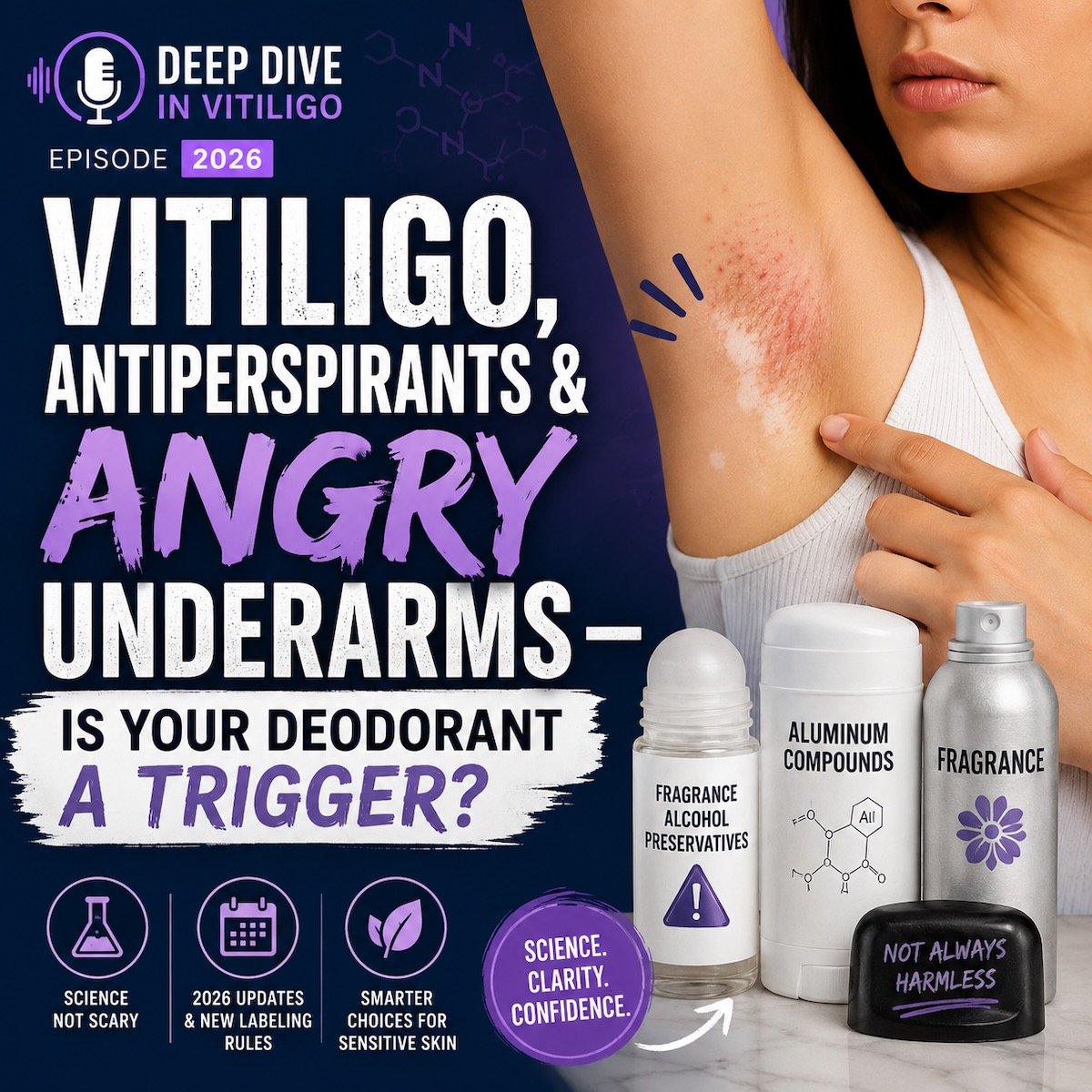
Vitiligo, Antiperspirants & Angry Underarms — Is Your Deodorant a Trigger? (Ep. 67)
Could your deodorant be making vitiligo worse?
It’s a question that lands in our inbox surprisingly often — and one that turns out to be more complicated than a simple yes or no.
In this episode of Deep Dive in Vitiligo, we explore the science behind deodorants, antiperspirants, fragrance allergies, chemical leukoderma, and why underarm skin may deserve more attention than most of us give it.
There’s no solid evidence that ordinary deodorants or antiperspirants cause vitiligo. If your deodorant works, feels invisible, and causes no problems, carry on. But if it burns, itches, triggers eczema, or seems connected to new patches, your skin may be trying to tell you something.
Tune in for the latest 2026 regulatory updates, including expanded EU fragrance labeling, the truth about the “whole-body deodorant” trend, and a practical routine to help keep your underarms calm. You’ll get a dead-simple testing protocol, the red-flag signs to stop yesterday, and a practical routine that respects real skin instead of wellness theater.
📚 Prefer reading to listening? The full companion article expands on many of the themes discussed in this episode.
🎙️ Listen to Deep Dive in Vitiligo
You can also listen to Deep Dive in Vitiligo on your favorite podcast platform:
🍎 Apple Podcasts
🟢 Spotify
📦 Amazon Music
❤️ iHeart Radio
🎧 Player FM
🎙️ Podchaser
🎤 Podbean
Pick your platform, hit subscribe, and we'll meet you there.
FAQOther Questions
- What's the status with official recognition of World Vitiligo Day?
In 2016, the United Nations marked World Vitiligo Day in its International Calendar of Disability Events. However, it was removed in 2019 when the calendar was streamlined to 'M...
- I have vitiligo: will my children have vitiligo, too?
If you have vitiligo, it’s natural to worry about your children. While there is a genetic component, vitiligo is not a straightforward hereditary disease like eye color or heigh...
- Which diseases most commonly accompany vitiligo?
Vitiligo is rarely an isolated event. Because it involves an overactive immune system, it often coexists with other autoimmune disorders. According to extensive 10-year clinical...
Though it is not always easy to treat vitiligo, there is much to be gained by clearly understanding the diagnosis, the future implications, treatment options and their outcomes.
Many people deal with vitiligo while remaining in the public eye, maintaining a positive outlook, and having a successful career.
Copyright (C) Bodolóczki JúliaBy taking a little time to fill in the anonymous questionnaire, you can help researchers better understand and fight vitiligo.