
A follow-up to our original story on the rediscovery of the National Vitiligo Control Act — and what its ideas look like fifty years later.
The bill failed. The idea did not. The battle continues.
In Brief
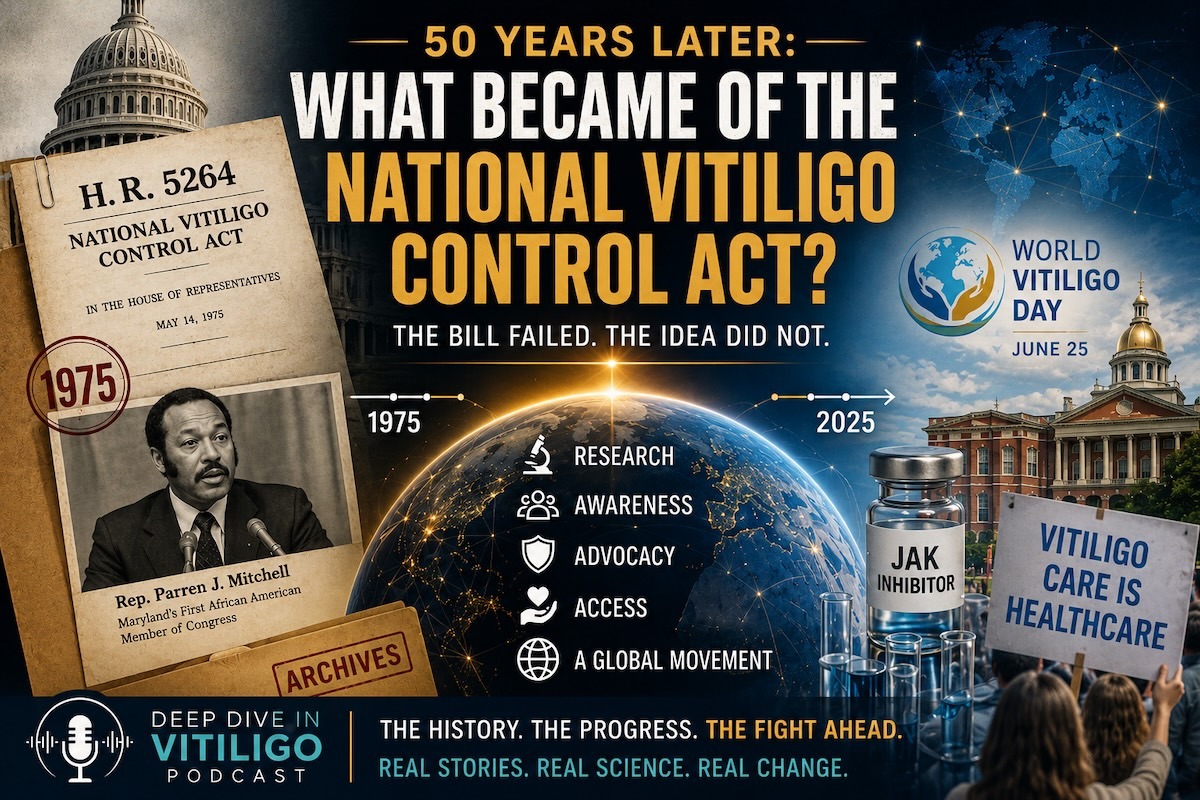
In 1975, Congressman Parren J. Mitchell introduced the National Vitiligo Control Act, one of the earliest known U.S. legislative efforts to address vitiligo through research, education, and public awareness.
The bill never became law. Decades later, Yan Valle, CEO of the Vitiligo Research Foundation, rediscovered the original congressional records while investigating the early history of vitiligo advocacy in the United States.
Fifty years later, many of the Act’s goals have slowly become reality — not through one federal mandate, but through research, World Vitiligo Day, patient advocacy, policy battles, and a global movement that refused to stay quiet.
In 1975, Congressman Parren J. Mitchell introduced the National Vitiligo Control Act — one of the earliest known legislative efforts to address vitiligo in the United States.
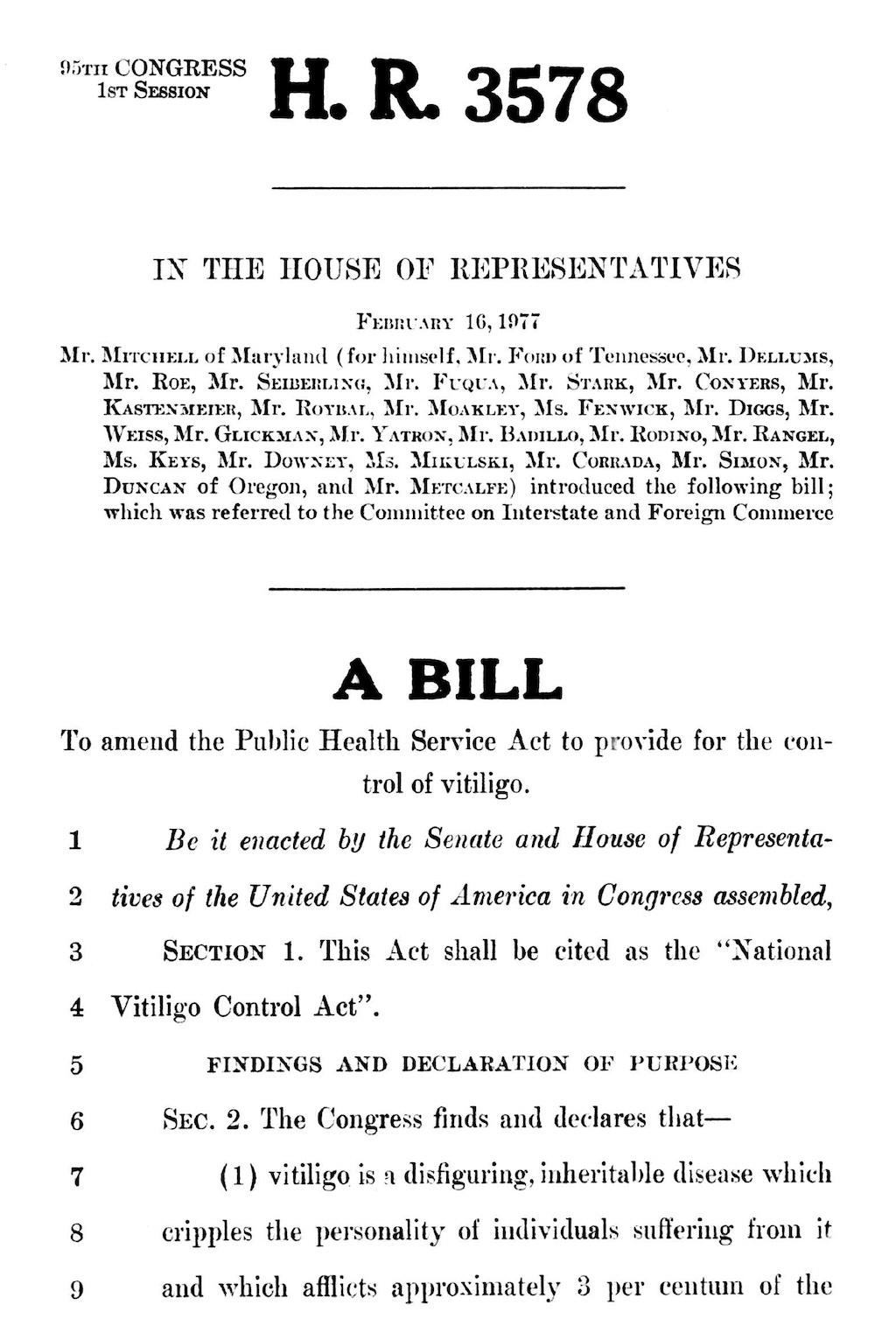
The bill never became law.
When the story of the Act was first unearthed from the Library of Congress archives after nearly four decades of silence, the focus was on its remarkable rediscovery. It resonated because it revealed a hidden truth: long before social media, celebrity advocates, or World Vitiligo Day, a few visionary lawmakers already recognized that vitiligo deserved a coordinated national response.
Now, half a century after that bill was first stamped, shelved, and nearly forgotten, a better question emerges:
What became of its ideas?
The answer is surprising. Many of the Act’s original goals have become reality — just not through the legislative halls of Congress. Instead, they were carried forward by patients, physicians, researchers, and advocates who kept pushing long after the paperwork disappeared.
Research Finally Arrived
In 1975, vitiligo research occupied a tiny, underfunded corner of dermatology. The biological mechanisms behind depigmentation were still poorly understood, and treatments were often treated as an afterthought.
Today, the scientific landscape looks very different. Researchers now investigate autoimmune signaling pathways, genetic risk factors, oxidative stress, tissue-resident memory T cells, and targeted therapies designed specifically for vitiligo.
Most importantly, some of this science has translated into clinical reality. The regulatory approval of targeted treatments, including topical JAK inhibitors, marked a major milestone. For the first time, patients gained access to a therapy developed directly from modern understanding of vitiligo biology, rather than a treatment borrowed from the sidelines of dermatology.
The research ecosystem envisioned by the 1975 Act took decades to emerge. It did not arrive neatly. Science rarely does. But it has largely arrived.
Awareness Went Global
The original legislation called for public education to reduce myths and stigma surrounding vitiligo.
That mission was ultimately advanced not by a national government campaign, but by patients themselves.
World Vitiligo Day, observed annually on June 25, now reaches millions of people across dozens of countries. Public figures, athletes, models, actors, doctors, parents, and everyday patients openly discuss their experiences. Social media did what government pamphlets probably never could: it made vitiligo visible, personal, and impossible to ignore.
The condition is still misunderstood in many places. Stigma has not packed its bags and left the building. If only.
But compared with the isolated world of 1975, the cultural shift is enormous.
World Vitiligo Day Became the Public Face
If the National Vitiligo Control Act was one of the movement’s earliest legislative expressions, World Vitiligo Day became its global public face.
What began as a grassroots awareness campaign eventually grew into an international observance connecting patients, physicians, researchers, policymakers, and support organizations.
It created a platform for education, advocacy, research updates, media attention, and policy discussion. In other words, many of the goals imagined in the 1975 Act found a modern home — not in one government office, but in a worldwide network.
The Insurance Battle Moved to State Houses
Not every goal of the National Vitiligo Control Act has been achieved. Access to care remains one of the movement’s most frustrating problems.
In the United States, many patients still face insurance policies that classify vitiligo treatment as cosmetic, even when the condition affects quality of life, mental health, employment, social confidence, and daily functioning.
In recent years, patient-led advocacy has shifted from awareness alone to healthcare policy reform. Massachusetts Bill H.1115 became one example of this modern battleground, continuing the push for insurance coverage of vitiligo care, including phototherapy and related services.
The fight is not finished. Insurance systems rarely wake up one morning and say, “You know what, let’s be reasonable today.” They usually need pressure, evidence, and a few very persistent humans knocking on the door.
But the debate has changed. It is no longer simply about whether vitiligo matters. It is about whether healthcare systems are willing to treat it accordingly.
The Movement Outgrew National Borders
Perhaps the greatest surprise to the original authors of the 1975 Act would be the borderless nature of today’s vitiligo community.
The National Vitiligo Control Act imagined an American response to an American problem. What emerged was a global movement.
Patient organizations now work across North America, Europe, Asia, Africa, Latin America, and Australia. International conferences connect clinicians and researchers from dozens of countries. Clinical trials span continents. Online support groups make it possible for someone newly diagnosed in one country to learn from a patient advocate on the other side of the planet.
In Europe, patient-led networks such as the Vitiligo International Patient Organizations Committee, alongside national groups in countries including France, Germany, and the United Kingdom, have brought patient voices into conversations with regulators, health ministries, and health technology assessment bodies.
As advanced therapies enter the market, advocates are increasingly asked to explain not only the biology of vitiligo, but its psychological, social, and economic impact.
That matters. Access decisions are rarely made by science alone. They are made by systems. And systems need evidence, pressure, and human stories before they move.
The Real Lesson of a Failed Bill
The National Vitiligo Control Act failed. There is no way around that historical fact.
Yet fifty years later, it is difficult to read the bill without recognizing how many of its ambitions survived.
- Research expanded.
- Public awareness grew.
- Professional education improved.
- Patient organizations emerged.
- The conversation became global.
The work remains unfinished. Access to care is uneven. Stigma persists. Millions of people still struggle to obtain diagnosis, treatment, and support.
But the world looks very different from the one that existed in 1975. Perhaps that is the real lesson of the National Vitiligo Control Act.
Laws can fail. Committees can forget. Documents can disappear into archives. Yet sometimes an idea survives long enough for history to catch up.
Fifty years later, that appears to be exactly what happened.
Suggested Reading
From Lost to Found: 50 Years of the National Vitiligo Act
The original historical account of how the National Vitiligo Control Act was rediscovered — and why this forgotten bill still matters.
Vitiligo Coverage: The Battle for H.1115 Isn't Over Yet
A closer look at the ongoing fight for insurance coverage and why the “cosmetic” label still causes real harm.
The Power of Advocacy: 2026 Leaders Summit
How patient leaders are shaping the next phase of vitiligo advocacy, policy, education, and global cooperation.
Listen to Deep Dive in Vitiligo
50 Years Later: What Became of the National Vitiligo Control Act? (Ep. 64)
In this episode, we travel back nearly 50 years to explore one of the most forgotten chapters in vitiligo history: the National Vitiligo Control Act.
The Entire History Of the World Vitiligo Day (Ep. 61)
The remarkable grassroots story behind World Vitiligo Day, from early advocacy to global movement.
WHO Finally Notices the Skin — What It Means (and Doesn’t) for Vitiligo (Ep. 50)
A practical discussion of what global recognition of skin disease means for vitiligo patients — and what it does not magically solve.
