
How 300,000 Michael Jackson Fans Accidentally Built One of the Largest Vitiligo Awareness Campaigns in History
Data Archaeology / World Vitiligo Day
A forensic dive into the strange collision of fandom, stigma, and early internet activism.
Brief Summary
Between 2012 and 2016, the World Vitiligo Day (WVD) petition collected 516,096 signatures. More than 300,000 contained explicit references to Michael Jackson, making this one of the largest examples of celebrity-linked health advocacy in dermatology history. The archive is messy, emotional, and full of early internet fingerprints — but it also reveals how fandom, stigma, and grassroots mobilization helped bring vitiligo into global public conversation.
What’s Inside This Story
In 2012 the Vitiligo Research Foundation (VRF) launched a modest online petition asking the United Nations to recognize 25 June as World Vitiligo Day. The date was chosen in memory of Michael Jackson, whose own struggle with vitiligo had become public knowledge years earlier. What started as a modest medical advocacy effort eventually exploded.
From the complete archive of 516,096 signatures, a careful analysis by Grok AI shows that more than 300,000 entries contained explicit references to Michael Jackson. We later grouped these under the collective label “MJ fans.” This single cohort represents roughly 58% of the entire petition.
Their support helped push the WVD petition toward it's goal of 500,000 signatures, landing briefly at the UN Calendar.
The numbers alone are startling. The story they tell is even more so.
The Campaign That Wasn’t Supposed to Happen
The first MJ-linked signature arrived on 12 April 2012 from Tanzania. For the rest of that year and most of 2013 the petition grew slowly and organically. Then, in December 2013, something changed. A massive, coordinated wave of signatures flooded the site 25June.org. By the time activity tapered off in 2016, the MJ-fan cohort had reached 300,262 records.
This was not a conventional awareness campaign. It was something rawer: an early-2010s proto-digital advocacy swarm.
First and Foremost: The Geography of the Wave
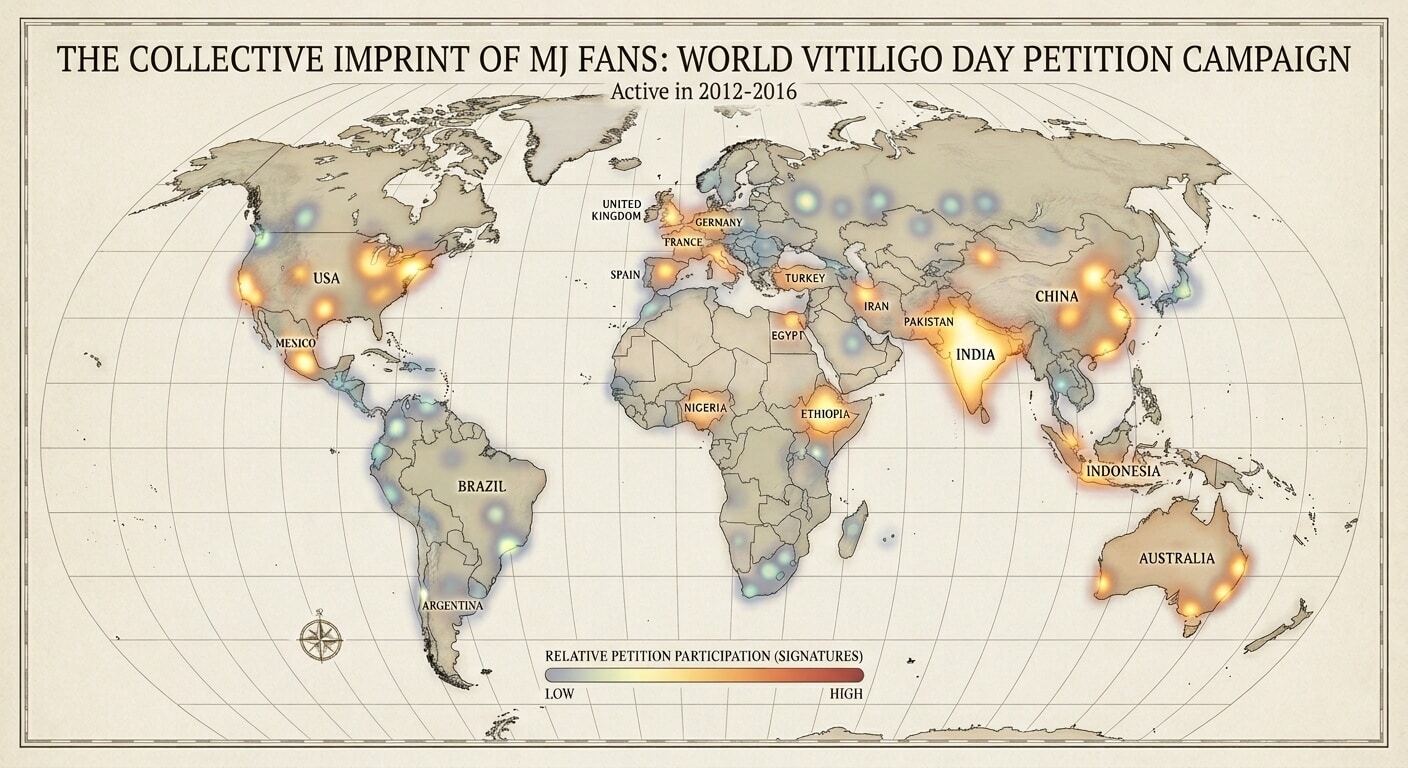
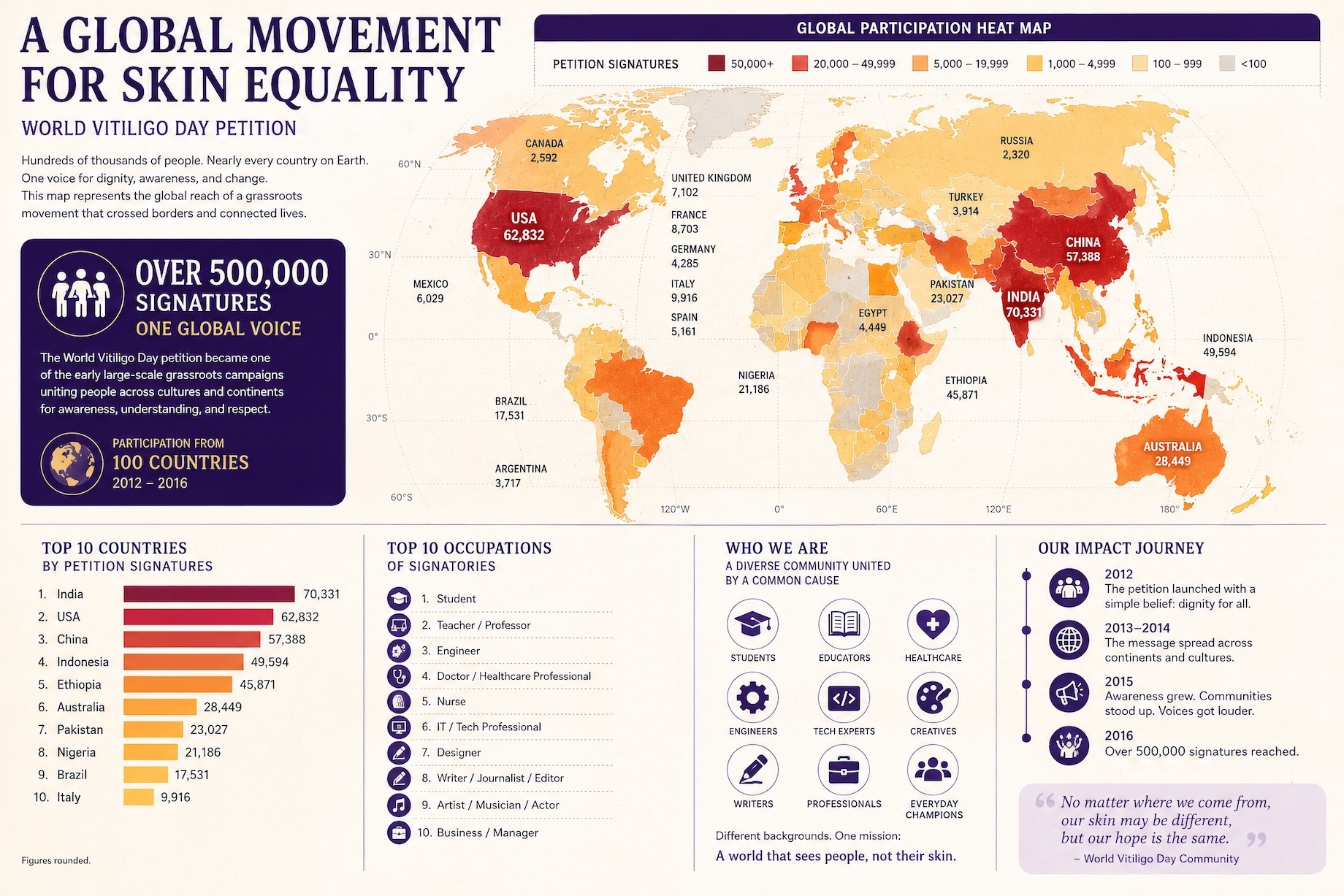
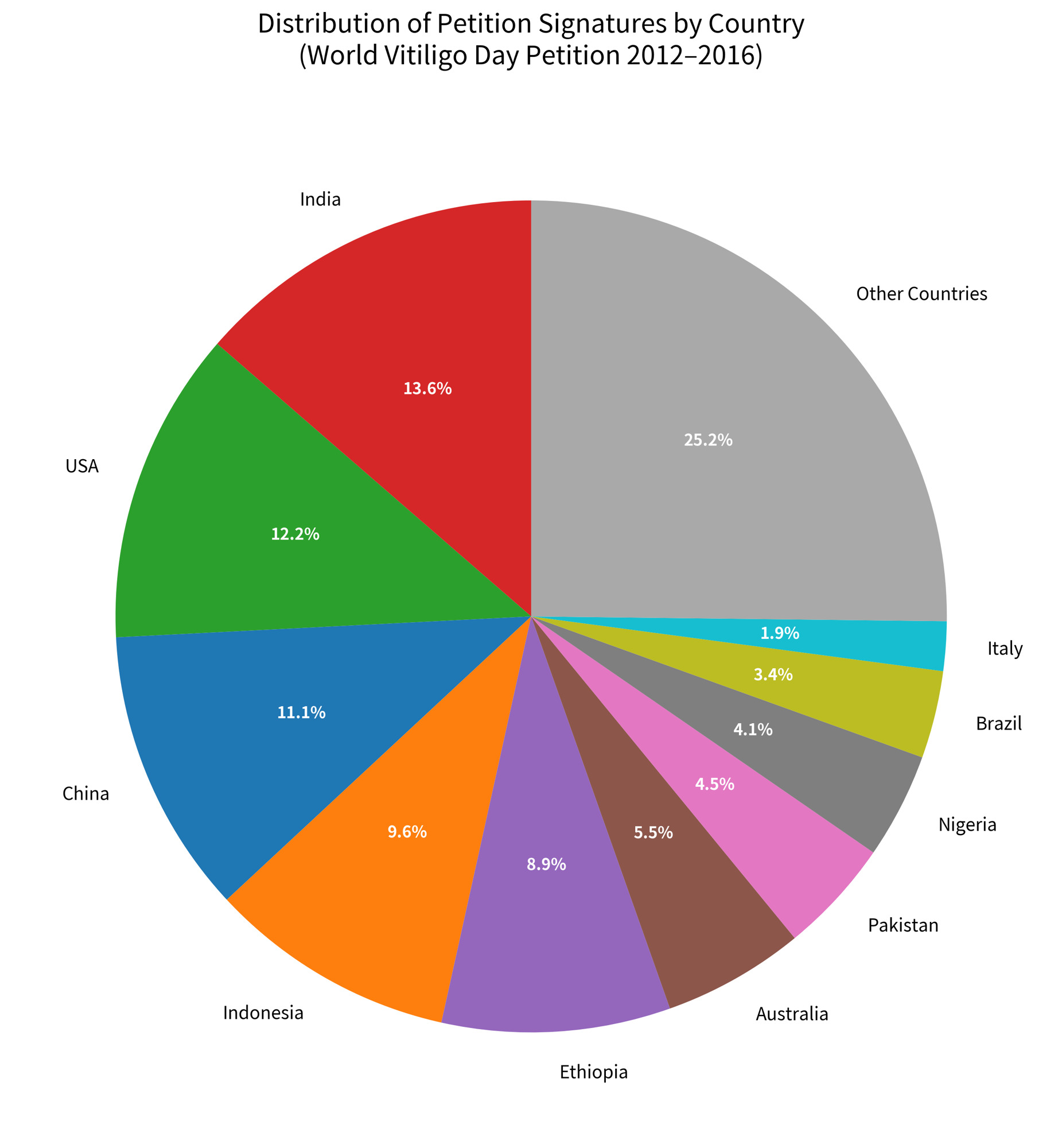
The campaign touched 202 countries. The earliest signatures came from Tanzania, Italy, Canada, the United Kingdom, and a handful of other nations in mid-2012. But the real engines of the explosion were elsewhere.
Top 10 countries by MJ-fan volume
| Rank | Country | MJ Fans |
|---|---|---|
| 1 | India | 38,912 |
| 2 | USA | 31,346 |
| 3 | Indonesia | 28,561 |
| 4 | China | 26,956 |
| 5 | Ethiopia | 26,571 |
| 6 | Australia | 16,093 |
| 7 | Pakistan | 13,227 |
| 8 | Nigeria | ~12,000 |
| 9 | Brazil | ~10,000 |
| 10 | Italy | 5,449 |
These ten nations alone account for more than 60% of the entire MJ-fan cohort.
Professional Snapshot
After normalizing the occupation field, the top-reported professions among MJ fans cluster around Student, Teacher/Professor, Engineer, Doctor/Healthcare Professional, Nurse, IT/Tech, Designer, and Writer/Journalist.
A note on the data: Because many fan-driven submissions used casual definitions for their jobs, these occupational categories should be interpreted directionally rather than as precise demographics. It is messier and noisier than formal research data, but its emotional rawness captures the cultural and social reality of the condition in a way that small, structured studies often cannot.
Messaging Analysis: The Language of the Campaign
The December 2013 wave was characterized by highly consistent, almost templated messaging. Yet beneath the repetition, Jackson was not discussed primarily as a pop icon or celebrity. He was invoked as first living, then posthumous proof — proof that vitiligo is a genuine medical condition, proof that visible skin differences can trigger devastating psychological and social consequences, and proof that even fame, wealth, and medical confirmation do not shield someone from misunderstanding and ridicule.
Evidence from the 300,262 MJ-fan comments
While the top 10 most frequent phrases — the repetitive campaign templates like “michael jackson is my idol,” “MJ forever,” and “king of pop” — dominate the raw count, the more substantive, non-template comments repeatedly return to three core themes:
- Proof that vitiligo is real — “MJ had it,” “he suffered from the same thing,” “not made up,” “not contagious.”
- Proof of psychological devastation — “he covered it because of ridicule,” “made him unhappy,” “depression,” “isolation,” “public ridicule.”
- Proof that misunderstanding persists — “even after medical confirmation,” “still faced stigma,” “people didn’t believe him.”
“we need help,together we can get rid of it,Lets look at Michael Jackson fought at all the best he can to cover the affected area on his skin because the disease always made him unhappy,his humanity wasn't free of life,He gone and left us behind with the same suffering,I need recognition and support on this issue.”
— John Lyimo, Tanzania, 12 April 2012
Hundreds of other comments echo this exact framing: MJ as the ultimate case study that validates the lived reality of vitiligo patients worldwide.
What People Actually Wrote
The comments themselves were often emotional, personal, and surprisingly thoughtful. Many participants connected Jackson’s vitiligo directly to themes of stigma, ridicule, isolation, race, public misunderstanding, and media cruelty.
Several recurring themes appeared repeatedly:
- “Michael Jackson made me aware of vitiligo.”
- “People mocked him because they did not understand vitiligo.” Many expressed retrospective guilt about the ridicule he faced in the 1980s and 1990s.
- “Vitiligo awareness should prevent others from suffering similarly.”
The Most Detailed Comment
One of the longest comments in the archive came from a supporter in the Czech Republic:
“Michael Jackson is INNOCENT! ... Michael Jackson had VITILIGO! ... I love Michael Jackson with all my heart ... He healed the world ... I still learn from him how to live right, love and sing.”
The comment continued for multiple paragraphs, combining grief, devotion, spirituality, defense against accusations, admiration for Jackson’s family, and reflections on vitiligo. Objectively speaking, it reads less like a petition comment and more like a public emotional testimony. And that is precisely what makes the WVD archive interesting. This was not merely a database of signatures. It was an emotional repository.
The Most Thoughtful Comments Were Often Not from Patients
One unexpected finding was that some of the most nuanced comments came not from people explicitly identifying as patients, but from supporters, educators, and fans. A Canadian respondent wrote: “Michael Jackson suffered alone almost his whole life, in fear of people seeing him without make-up, and of being accused of hating his own race.”
Another commenter connected vitiligo awareness to childhood education and anti-bullying work. Several comments referenced broader social prejudice rather than pigmentation alone.
In retrospect, this may explain part of World Vitiligo Day’s unusual growth trajectory. The movement was never solely medical. It was cultural.
The Strange Historical Timing
The petition years roughly overlap with the rise of Facebook-driven activism, peak posthumous Michael Jackson cultural attention, the transition from forums to social-media organizing, and the early globalization of patient-led digital movements.
The WVD archive still contains thousands of legacy @facebook.com email addresses — digital fossils from an internet era when Facebook briefly tried to replace email itself. Much of this mobilization happened during Facebook’s peak organic-reach era, when fan groups could still move enormous volumes of people without paid promotion, algorithms, or institutional infrastructure.
Importantly, VRF did not run any significant paid advertising campaigns, large-scale Facebook promotion, influencer partnerships, or coordinated media outreach capable of producing numbers on this scale. There was no sophisticated growth strategy behind the surge, no agency, no targeting dashboards, no viral marketing blueprint. The true ignition point remains unknown.
Somewhere in late 2013, the petition appears to have crossed an invisible threshold inside global Michael Jackson fan networks and began propagating almost organically through reposts, fan pages, forums, chain-sharing, and community mobilization.
In retrospect, it feels less like a planned campaign and more like a moment of pure digital serendipity — a kind of internet-era Deus ex Machina where culture, grief, activism, and timing briefly aligned on their own.
Scale vs. Structure: A Different Kind of Evidence
Traditional vitiligo Quality of Life studies are usually small — often between 100 and 2,000 — highly structured, and clinically oriented. This WVD petition archive is the opposite: massive, open-ended, and unsolicited. With over 300,000 unstructured narratives from the MJ-fan cohort alone, it functions as the largest open-ended qualitative survey on vitiligo-related stigma and psychological impact ever collected — even if it was never designed as one.
It is messier and noisier than formal research, but its emotional rawness captures the cultural and social reality of the condition in a way that small, structured studies often cannot.
Data Quality and the Nature of Early 2010s Grassroots Activism
Large groups of signatures appeared to come from the same IP address, or from very similar IP addresses. At first glance, this can look suspicious — as if one person submitted many signatures.
But IP addresses do not always identify one individual computer or one person. In many cases, the same IP address may be shared by an entire office, school, apartment building, internet café, mobile network, or local provider. This is especially true in countries and regions where many users access the internet through shared networks.
That is why some entries were initially flagged as “Fake” during manual review, then restored after closer checking. The shared IP alone was not enough to prove fraud.
At the same time, some signatures really did come from families, friends, or local activists signing together from the same home, workplace, or community setting. So the IP pattern tells us something important — but it does not give a simple guilty/not-guilty verdict.
However, the repetition in comments and occupations looks statistically improbable — and in many cases it genuinely is. Several occupation clusters appear highly templated, suggesting coordinated campaign participation, copy-paste activism, or organized fan-group mobilization.
That does not invalidate the broader phenomenon. Grassroots internet activism in the early 2010s operated exactly this way: through fan forums, coordinated reposting, collective signature drives, and mass participation campaigns.
These were proto-digital advocacy swarms — crude by modern standards, but surprisingly powerful. This was an era before algorithmic amplification fully replaced community-driven internet mobilization.
How Questionable Were the Signatures?
At the time, we relied mostly on semi-automatic IP filtering and manual review rather than requiring every signer to confirm an email address. That was a deliberate trade-off. A strict confirmation system would have added friction, pushed spontaneous participants into inbox and spam-folder limbo, and likely killed much of the campaign’s momentum before it could spread.
Looking back at the archive, my working estimate is that clearly fraudulent or spam-like entries probably represented a relatively small share of the full database — likely in the low single digits. A much larger share, perhaps between 10 and 20%, may have come from coordinated or bulk-assisted signing: friends signing together, families using the same computer, fan-group organizers submitting names, school or workplace clusters, or activists helping others take part.
Modern anti-fraud systems would probably flag many of these shared IP patterns automatically — even when the people behind them were real. In retrospect, we used a practical balance between security and convenience, especially for a grassroots campaign moving across countries, languages, fan communities, schools, households, and shared networks.
This distinction matters. “Questionable” does not automatically mean “fake.”
In a nutshell, the WVD database likely contains three overlapping layers:
- Real individual signatures (approximately 70–85%)
These are the cleanest records: one person, one signature, one reasonably identifiable entry. - Real people submitted through messy collective behavior (likely 10–20%).
This includes friends signing together, family members using one device, fan coordinators, schools, households, internet cafés, and community organizers. - Actual low-quality or fabricated entries (likely 2–5%).
This includes duplicates, nonsense names, obvious copy floods, and other records that do not appear reliable.
My suspicion, after reviewing the patterns, is that the genuinely fabricated portion is much smaller than the visually suspicious portion.
That is one of the most interesting findings in itself. The WVD archive reflects the chaotic mechanics of early grassroots internet activism more than modern spam behavior. It was noisy, imperfect, and occasionally bizarre — but much of that noise came from real people using the internet collectively, not from machines or bots trying to fake a movement.
What This Means Today
The Michael Jackson subset of the WVD database reveals something larger than fandom. It demonstrates how cultural narratives can dramatically accelerate awareness around stigmatized medical conditions. For millions of people worldwide — especially in regions where vitiligo carried heavy social stigma — Michael Jackson was not merely a celebrity associated with vitiligo. He became the symbolic entry point into understanding the condition itself.
The official date of World Vitiligo Day — 25 June — was originally proposed in memory of Jackson by Nigerian advocate Ogo Maduewesi from VITSAF.
What began as a symbolic gesture evolved into one of the world’s largest grassroots skin-health awareness campaigns. Not through billion-dollar advertising. Not through government or UN mandates. But through patients, families, educators, activists, physicians, internet forums, and yes — hundreds of thousands of Michael Jackson fans.
Final Thoughts
The historical World Vitiligo Day petition database is imperfect, noisy, duplicated, partially broken, and occasionally bizarre. It is also deeply human.
Inside the WVD archive are traces of an internet era when people still wrote long emotional comments into petition boxes, organized awareness campaigns from fan communities, and treated public advocacy as something personal rather than algorithmic.
The Michael Jackson subset serves as a reminder that awareness movements rarely grow in clean straight lines. Sometimes they grow through grief. Sometimes through fandom. Sometimes through misunderstanding. And occasionally through a global pop star whose skin condition accidentally forced the world into a conversation it was not yet prepared to have.
In the end, before algorithms learned how to manufacture engagement, humans were still doing it manually — one heartfelt, messy, copy-pasted comment at a time.
The 500,000-signature goal was reached years ago. Now the question is: what comes next?
If this story moved you, here are two simple ways to keep the momentum alive:
- Support ongoing vitiligo research — every donation helps fund new studies and treatments that patients desperately need. Donate here
- Share your own story on social media — whether you live with vitiligo, support someone who does, or were touched by this archive, we want to hear from you. Your voice becomes part of the next chapter of World Vitiligo Day 2026.
The petition showed what’s possible when people come together. Now it’s our turn to carry it forward.

By Yan Valle, Prof.h.c., CEO, VR Foundation
Data excavation assisted by Grok. Narrative reconstruction assisted by ChatGPT.
AI was used to cluster 300,000 unstructured comments into the three core themes identified in this article.
Keep reading
- 📌 History Of The World Vitiligo Day
- What the MJ Biopic Got Right (and Wrong) About Vitiligo
- World Vitiligo Day lands on 60M+ screens in one day, June 25, 2025
- As the World Vitiligo Day approaches: mystery of the first 1000 signatures explained
- FAQ: What's the status with official recognition of World Vitiligo Day?
- The Michael Jackson and Winnie Harlow Effect: Impact on Vitiligo Awaraness on the Internet
- Evaluating Population Interest in Vitiligo Through an Analysis of Google Trends and Social Media
Listen to Deep Dive in Vitiligo podcast
- World Vitiligo Day Goes Supersonic in Purple (Ep. 39)
- How World Vitiligo Day Reached 60+ Million People in 24 Hours (Ep. 38)
- World Vitiligo Day: Redefining the Future of Dermatology (Ep. 36)