
The Jackson, Thomas, Harlow Effect on Vitiligo
How three public figures helped move vitiligo from silence and stigma into mainstream visibility.
Read article →This is the official historical record of World Vitiligo Day (WVD), celebrated annually on June 25 — a story of perseverance, collaboration, and the transformative power of grassroots advocacy.
This historical record was updated following World Vitiligo Day 2026 in Chandigarh, India, after new archival materials and eyewitness accounts from early organizers became available.
History is rarely written all at once.
For many years, the accepted history of World Vitiligo Day began in 2009, when a small group of physicians and patients in India launched what would later become the heart of a global movement. That timeline reflected the best information available at the time and has guided our understanding of WVD for more than a decade.
However, World Vitiligo Day 2026 — held in Chandigarh, India — brought to light previously overlooked archival records from the Indian Association of Dermatologists, Venereologists and Leprologists (IADVL), along with first-hand accounts from several pioneers of the movement. These records reveal that the idea of a dedicated Vitiligo Day predates the international campaign by several years.
The evidence shows that, beginning in 2005, IADVL developed a national strategy to raise awareness about vitiligo. A formal resolution adopted in 2006 established India’s National Vitiligo Day, observed annually on May 19 in honor of Ajit Kumar Dutta. This initiative became the world’s first organized, sustained campaign dedicated exclusively to vitiligo awareness.
These discoveries do not rewrite the history of World Vitiligo Day — they enrich it.
The international movement that emerged in 2009 did not appear in isolation. It built upon foundations laid earlier by Indian dermatologists, patient advocates, and educators whose contributions deserve lasting recognition.
With this updated edition, we are proud to acknowledge those early pioneers and present the most complete account of World Vitiligo Day’s origins assembled to date. Future editions will continue to incorporate newly discovered documents and first-hand accounts as they become available.
Before we delve into the WVD journey, let’s understand the condition at its heart. Vitiligo is not merely a cosmetic issue; it is a progressive autoimmune disease that paints white patches on the skin’s canvas. In rare cases, it even impairs vision, hearing and other vital organs. This condition, with its significant genetic links, often walks hand in hand with other autoimmune diseases.
Vitiligo is an equal opportunity condition, affecting about 0.5-1% of people worldwide, regardless of sex, age and social status. However, it shows a curious pattern, with onset peaks around ages 24 and 50. While no universal cure for vitiligo exists today, the treatment landscape has changed dramatically over the past decade. Patients now have access to targeted therapies, including the first FDA- and EMA-approved medication specifically indicated for vitiligo, alongside advances in phototherapy, surgical techniques, and emerging regenerative approaches. More than forty pharmaceutical and biotechnology companies are currently exploring new treatments, marking a remarkable shift for a condition that was once largely overlooked by the healthcare industry.
Yet vitiligo remains far more than a medical challenge. For many people, the emotional and social burden still exceeds the physical symptoms, making education, support, and public awareness just as important as scientific progress. In fact, for about 40% of cases, the ghostly white patches reappear within 3-5 years post-treatment, like unwelcome guests returning to haunt the skin.
But the true impact of vitiligo goes far beyond the visible. It casts a long shadow on economic status and mental health, with over half of those affected showing clinical signs of psychological distress. Anxiety disorders and depression become unwanted companions for 30% and 25% of patients, respectively. In many societies, particularly across Asia and Africa, vitiligo carries a heavy burden of social stigma, pushing individuals towards the precipice of suicidal thoughts and self-isolation.
It is against this backdrop of physical, emotional, and social challenges that the story of World Vitiligo Day unfolds — a beacon of hope in a landscape often shrouded in misunderstanding and neglect.
For many years, the international history of World Vitiligo Day was understood to begin in 2009. New evidence now allows us to trace its origins several years earlier, when the Indian Association of Dermatologists, Venereologists and Leprologists (IADVL) recognized that vitiligo required more than better medical treatments — it also demanded public awareness and social change.
In 2005, IADVL identified vitiligo as one of its strategic priorities. During a meeting in Hyderabad, Dr. Venkatram Mysore proposed creating a dedicated national awareness day for vitiligo. The proposal was formally adopted by the IADVL National Executive Council at Rajkot, Gujarat, on June 30, 2006.
Kaushik Lahiri, then National General Secretary of IADVL, proposed that the observance be held annually on May 19 in memory of Ajit Kumar Dutta, the internationally respected dermatologist from Kolkata whose pioneering work transformed the care of people living with vitiligo.
The resolution encouraged all IADVL branches across India to observe May 19 through educational activities, patient outreach, and public awareness programs. Over the following years, the initiative grew — particularly through the efforts of Savita Malhotra at PGIMER, Chandigarh — creating one of the world’s earliest sustained national vitiligo awareness campaigns.
While these efforts were national in scope, they established the world’s first sustained vitiligo awareness campaign and laid the conceptual foundation for what would later become World Vitiligo Day.
By 2009, the world looked very different. The global economy was recovering from recession, Bitcoin had just appeared, and James Cameron’s Avatar was redefining cinema.
In this tumultuous time, vitiligo remained a poorly understood skin condition, caught in a no-man’s land of medical priorities. Neither a “blockbuster” nor an “orphan” disease in medical terms, it was largely ignored by insurance companies, making it an unattractive prospect for Big Pharma or academia. Treatments were limited to off-label options, borrowed from other conditions with limited success. It was in this challenging landscape that a movement for vitiligo awareness began to take root.
A National Vitiligo Day blossomed annually on May 19 until early 2015, when the indefatigable Prof. Davinder Parsad united all three Indian dermatological societies to embrace a global celebration on June 25.
Across the globe, in the United States, parallel efforts were sprouting. Steve Hargadon, founder of the online community Vitiligo Friends, and Valarie Molyneaux, president of the Boston-based support group VITFriends, were independently advocating for a similar day of observance. Their efforts were complemented by Barbara Summers’ persistent campaign in Delaware, which led to Governor Markell proclaiming July as Vitiligo Awareness Month. However, their voices, though passionate, were muffled by the cacophony of a world in crisis, with every group focused on mere survival.
The true catalyst for change emerged from an unexpected quarter. In Lagos, Nigeria, Ogo Maduewesi, founder of the Vitiligo Support and Awareness Foundation (VITSAF), organized a Vitiligo Purple Fun Day at the Silverbird shopping mall on June 25, 2011. This event, a tribute to Michael Jackson’s battle with vitiligo, would become the spark that ignited a global movement.
Michael Jackson, the King of Pop, was perhaps the most famous person to have lived with vitiligo. His journey with the condition began in the early 1980s, coinciding with the release of Thriller, the best-selling album of all time. Initially concealing it with his iconic white glove, Jackson later chose to depigment his remaining dark patches as the vitiligo spread rapidly. Despite openly discussing his condition on the Oprah Winfrey Show in 1993, he continued to face accusations of deliberately bleaching his skin. It was not until after his untimely passing in 2009 that his vitiligo diagnosis was formally confirmed, adding a poignant footnote to his complex legacy.
Ogo’s initiative aimed to honor Jackson’s struggle and confront the stigma associated with vitiligo in Africa, where it was often misunderstood as a “divine curse.” Her online petition for a global vitiligo awareness day initially gathered a mere 1,000 signatures, but it was enough to spark a global awakening within the vitiligo community.

Image: Purple Fun Day event at Silverbird shopping mall on June 25, 2011. Used with permission from Ogo Maduewesi.
However, Ogo’s dream faced formidable obstacles. Nigeria’s reputation in the early 2010s as a hub for online scams threatened to overshadow the legitimacy of her cause. As she desperately sought leverage and collaboration, Ogo remained steadfast in one condition: the global day must fall on June 25, in memory of the King of Pop. This decision, while honoring Jackson’s legacy, would later prove to be a double-edged sword in the campaign’s journey.
The faint spark ignited in Nigeria soon caught the attention of Yan Valle, CEO of the Vitiligo Research Foundation (VRF) in New York. The VRF, founded by philanthropist Dmitry Aksenov, had been quietly funding vitiligo research for years, driven by a father’s quest to find a cure for his daughter’s condition. In a landscape where vitiligo was just one of many overlooked health conditions, Valle saw an opportunity to orchestrate a global change.
Valle envisioned a unifying campaign that would not only draw young scientists into the relatively unexplored field of vitiligo research but also harmonize the fragmented voices of the vitiligo community worldwide. This was no small feat in a field devoid of quick acclaim or substantial rewards, where career advancement opportunities were as scarce as effective treatments. Recognizing the potential in Ogo’s grassroots effort, VRF set out to compose a symphony of change, with finding a cure for vitiligo as its central melody.
The official inauguration of World Vitiligo Day on June 23, 2012, was a humble overture. Organized by Prof. Torello Lotti and Yan Valle at the Aula Magna of the University of Guglielmo Marconi in Rome, the press conference faced an unexpected challenge — a citywide transport union strike that paralyzed the Eternal City. Yet, like a phoenix rising from the ashes, the campaign announcement resonated far beyond Rome’s ancient walls. Pre-arranged activism events in Africa, the EU, and the USA on June 25 exceeded all expectations, demonstrating how small, concerted efforts could cause a societal impact akin to a tsunami.
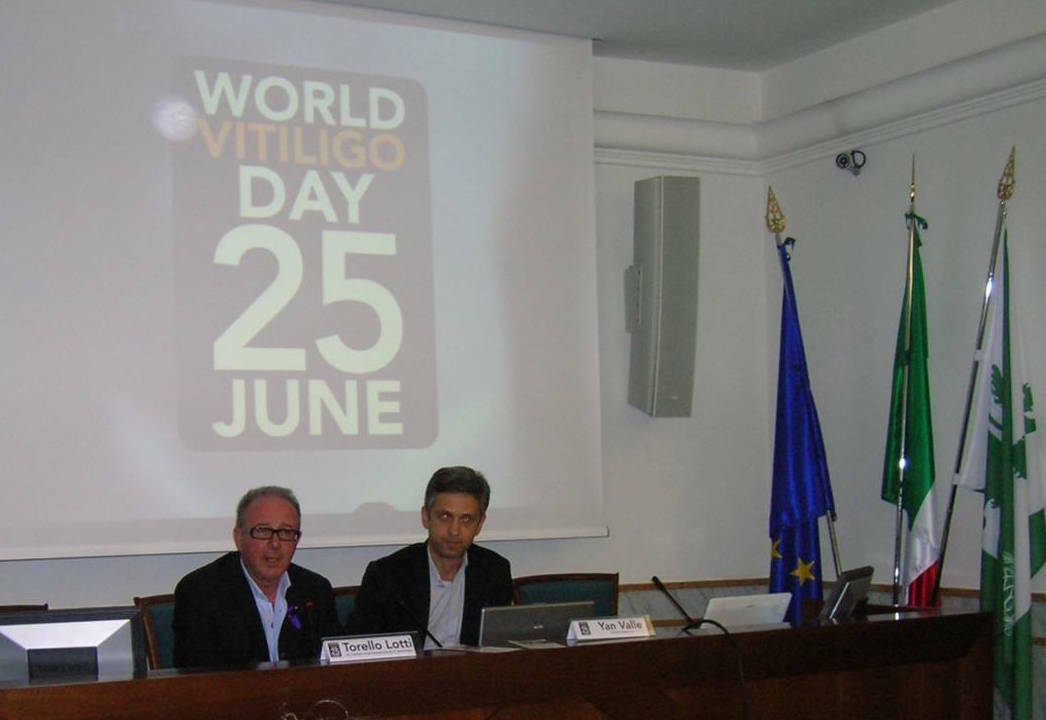
Image: Prof. Torello Lotti and Yan Valle at the World Vitiligo Day press conference in Rome on June 23, 2012. Copyright: VR Foundation.
The movement’s momentum continued to build. In December, a Winter Consensus Conference organized by VRF in the picturesque town of Kitzbühel, Austria, brought together three Nobel Laureates and 200 other leading scientists. This gathering had three ambitious objectives: to focus academic attention on the overlooked realm of vitiligo research, to engage Big Pharma executives in brainstorming for vitiligo drugs, and to orchestrate WVD 2013 campaign activities. It was a bold attempt to bridge the gap between scientific research, pharmaceutical innovation, and community advocacy.
From this point, World Vitiligo Day embarked on a global odyssey. Each year, a new country would take center stage as the campaign’s headquarters, spreading awareness and fostering international collaboration like never before.
As the WVD movement gained traction, the VRF set an audacious goal: to collect at least 500,000 signatures for a petition seeking official recognition from the United Nations (UN). This was not merely about numbers; it was a strategy to catapult vitiligo onto the global stage, encouraging governments to tap into UN and World Health Organization (WHO) resources to boost research. The campaign drew inspiration from the World Psoriasis Day movement, which had successfully achieved WHO recognition in 2014 after a decade of tireless advocacy.
The petition effort began modestly. Ogo Maduewesi’s initial campaign on the popular website Petitions24 ultimately gathered 1,400 signatures before stalling. However, the tide turned when the VRF launched and promoted the dedicated campaign website, 25June.org, featuring a petition for UN recognition.
What happened next was nothing short of extraordinary. Michael Jackson’s fans, moved by the cause, became unexpected allies in the fight against vitiligo stigma. They rallied together, amassing nearly 270,000 signatures in less than a year. Comments like “Heal the World” and “Let’s do this for Michael” flooded in, infusing the campaign with the spirit of the late pop icon’s message of unity and change.
Support from Michael Jackson’s fans brought mixed reactions within the vitiligo community. Concerned about the campaign’s focus, some groups launched a separate initiative for National Vitiligo Awareness Day in the US on October 17. This effort persisted at least until 2023, with legislators reintroducing a resolution for the date. Despite its alignment with National Bullying Month, this initiative struggled to match the global momentum of World Vitiligo Day on June 25, which had already established a strong international presence.
By the close of 2013, the WVD petition had garnered over 475,000 signatures, surpassing the target mark of 500,000 by July 2015. Armed with this groundswell of support, the VRF sought and obtained United Nations Economic and Social Council (UN ECOSOC) Special Consultative Status. This prestigious position allowed for direct advocacy of WVD’s recognition to the UN committee.
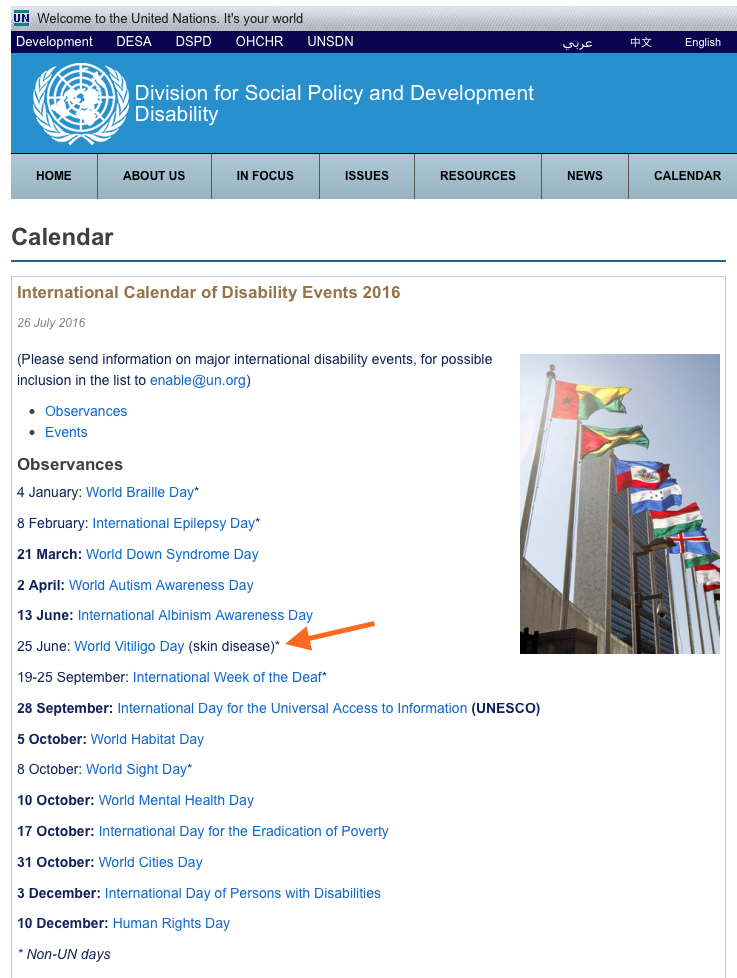
Image: Screenshot of UN website.
The efforts bore fruit when WVD was included in the UN Calendar of Disability Events in late 2016. However, in 2019, the UN revised its criteria for the calendar to include only high-level events organized directly by UN agencies. Since WVD is organized independently by non-governmental actors, it was removed from the calendar. Plans to reinstate WVD’s position on the UN calendar were then derailed by the unforeseen global disruptions of the early 2020s, including the COVID-19 pandemic.
For much of its early history, World Vitiligo Day was engaged in a struggle for visibility. Patients battled misconceptions, healthcare systems often overlooked the condition, and pharmaceutical companies showed little interest in developing dedicated treatments. The petition campaigns, public events, media outreach, and advocacy efforts of thousands of volunteers helped change that reality.
By the early 2020s, the conversation began to shift. Awareness was no longer the only objective. Researchers, regulators, industry leaders, and patient organizations increasingly focused on a new challenge: ensuring that scientific breakthroughs could reach people living with vitiligo. This transition marked an important turning point. World Vitiligo Day evolved from a campaign seeking recognition into a platform helping patients navigate a rapidly changing landscape of treatments, technologies, research opportunities, and support services.
The mission expanded, but the original goal remained unchanged: improving the lives of people affected by vitiligo worldwide.
World Vitiligo Day’s unique approach sets it apart from traditional health days. Like a well-orchestrated symphony, WVD adopts a network-centric management model, fostering harmony through the collaboration of agile, independent teams. This innovative strategy has given birth to a diverse array of initiatives, from intimate backyard gatherings for parents to expansive three-day conferences for healthcare professionals.
Since its inception, WVD has embarked on a global journey, with the international campaign’s headquarters migrating to a new country each year. At the national level, the movement adapts to local customs: in the USA and France, events dance between states or cities annually, while in China and India, they maintain a steady rhythm in familiar locations.
The WVD story is punctuated by remarkable moments that have shaped its journey:
Regional support groups like VITFriends in the USA, VIPOC members in the EU, the Vitiligo Society in the UK, and SHWETA in India have amplified WVD’s reach, effectively influencing policies and perceptions over the years.
Against all odds, WVD has emerged as a mighty force in global health advocacy, its impact resonating louder than similar events according to ever-watchful Google Trends.
World Vitiligo Day’s media journey mirrors the transformation of vitiligo itself — from a rarely discussed condition to a topic regularly covered by mainstream media, policymakers, and the healthcare industry.
The earliest coverage came through local television interviews, newspaper articles, and grassroots awareness campaigns. A major milestone arrived in 2013 when award-winning television journalist Lee Thomas used his platform in Detroit to bring vitiligo into millions of American homes.
The movement received additional momentum from the enduring legacy of Michael Jackson, whose highly publicized struggle with vitiligo sparked global conversations about skin difference, stigma, and identity. In later years, public figures such as Winnie Harlow helped introduce a new generation to vitiligo through fashion, entertainment, and social media. For details, check The Jackson-Thomas-Harlow Effect.
As digital platforms expanded, World Vitiligo Day evolved beyond traditional media. Livestreams, podcasts, online conferences, social campaigns, and AI-powered educational tools allowed the movement to reach audiences previously inaccessible through conventional channels.
By June 25, 2025, World Vitiligo Day content appeared on approximately 60 million screens within a single day, with cumulative global reach approaching 200 million people across television, print, online media, podcasts, and social networks.
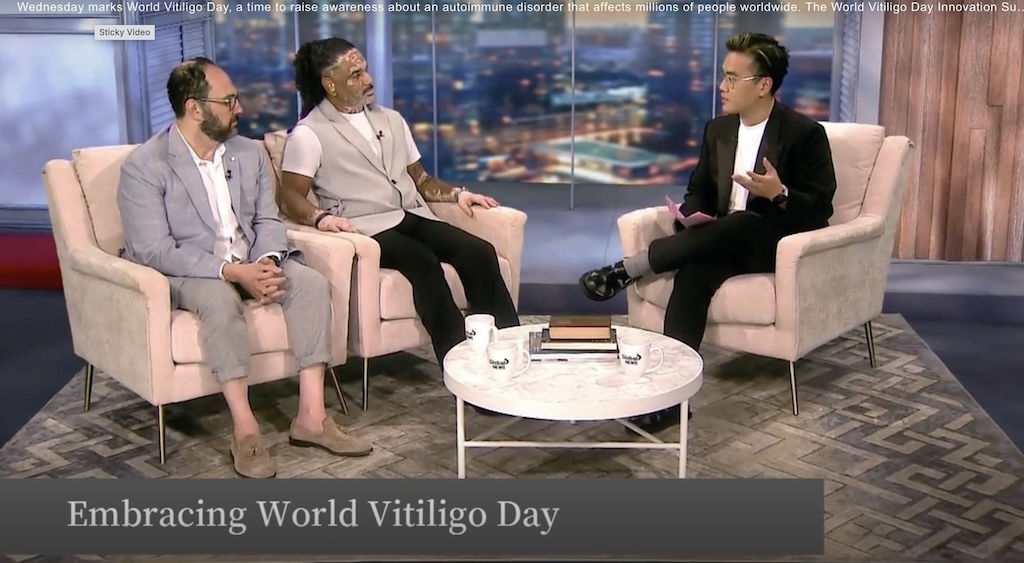
Image: Dr. Sam Hanna and Omar Sharife at Global News Toronto morning show with Liem Vu on June 25, 2025.
One of the less visible ambitions of World Vitiligo Day was to encourage greater scientific and commercial interest in vitiligo. For decades, the condition occupied an uncomfortable middle ground: too common to qualify as a rare disease, yet too neglected to attract significant pharmaceutical investment. That landscape has changed dramatically.
When the movement began, very few companies maintained dedicated vitiligo development programs. Today, dozens of pharmaceutical and biotechnology organizations are actively pursuing new treatments, including topical therapies, oral medications, biologics, cell-based approaches, and regenerative technologies.
The approval of the first medication specifically indicated for vitiligo in 2022 marked a historic turning point. What was once considered an overlooked condition has become one of the fastest-evolving fields in medical dermatology.
No individual has influenced the history of World Vitiligo Day more indirectly than Michael Jackson.
Although the King of Pop never publicly advocated for the condition beyond acknowledging his diagnosis, his experience with vitiligo helped introduce the disease to a global audience. Following his death in 2009, discussions about his skin changes brought unprecedented attention to a condition that many people had never heard of before.
The decision to observe World Vitiligo Day on June 25 was made in his memory. Michael Jackson’s fans later became one of the campaign’s most powerful allies, contributing hundreds of thousands of petition signatures and helping spread awareness across continents.
While World Vitiligo Day has grown far beyond any single individual, the movement’s origins remain inseparable from the cultural impact of the world’s most famous vitiligo patient.
2026: 🇮🇳 Chandigarh, India
2025: 🇨🇦 Toronto, Canada
2024: 🇨🇴 Cali, Colombia
2023: 🇰🇿 Almaty, Kazakhstan
2022: 🇲🇽 Mexico City, Mexico
2021: 🇮🇩 Jakarta, Indonesia (semi-virtual)
2020: 🇷🇸 Serbia (virtual due to COVID-19)
2019: 🇻🇳 Hanoi, Vietnam
2018: 🇺🇸 Boston, USA
2017: 🇧🇷 Sao Paulo, Brazil
2016: 🇨🇿 Prague, the Czech Republic
2015: 🇨🇳 Shenyang, China
2014: 🇮🇳 Chandigarh, India
2013: 🇺🇸 Detroit, USA
2012: 🇮🇹 Rome, Italy
2011: 🇳🇬 Lagos, Nigeria (honorary)
2026: From Stigma To Strength
2025: Innovation for Every Skin, Powered by AI
2024: United by the Skin
2023: Vitiligo: Looking into the Future
2022: Learning To Live With Vitiligo
2021: Embracing Life With Vitiligo
2020: SELF: Awareness, Love, Respect, Care
2019: The Quality of Life of Vitiligo Patients
2018: Children, Research, and Hope for the Future
2017: Step Up for Vitiligo: A Call for Truth, Hope and Change!
2014: Holistic Management For Vitiligo
Led by the WVD Presidential Committee, this global movement orchestrates diverse events worldwide, with healthcare providers offering free services and media attention swelling across all platforms. This symphony of change, honoring countless unsung heroes, has illuminated a path of hope, transforming lives and perceptions of vitiligo. As it continues, World Vitiligo Day stands as a powerful testament to unity, perseverance, and hope.
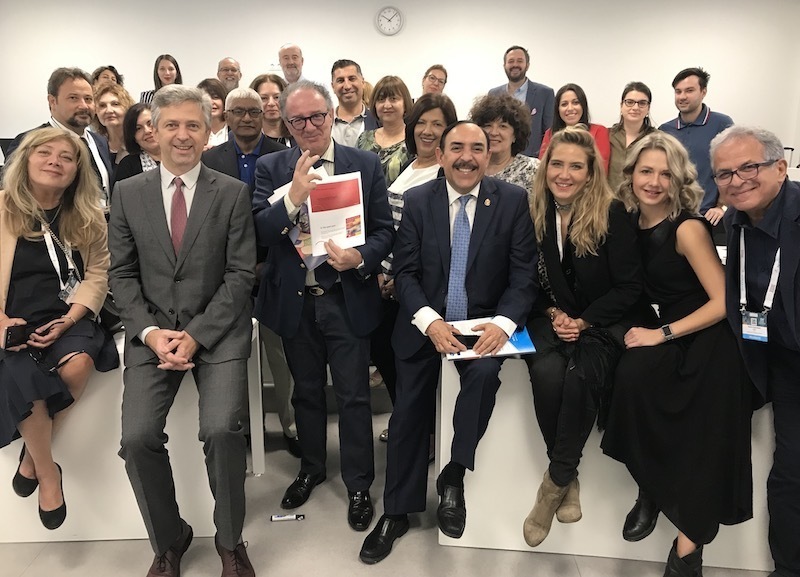
Image: World Vitiligo Day Org Committee meeting in 2020. Copyright: VR Foundation.
This chronology is maintained by the Vitiligo Research Foundation (VRF) as an evolving historical archive of the global vitiligo movement. As new evidence emerges, our goal is to preserve the most accurate, comprehensive, and balanced account possible.
We welcome documented corrections, archival materials, photographs, publications, and first-hand accounts from the physicians, researchers, patient advocates, organizations, and volunteers who helped shape this remarkable journey.
If you believe we’ve overlooked an important event or perspective — or if you’d simply like to share your own memories of World Vitiligo Day — we would love to hear from you.
Together, let’s continue preserving — and shaping — the remarkable history of the global vitiligo movement. The history of World Vitiligo Day belongs to everyone who helped build it.
Continue exploring the people, stories, and milestones that shaped the global vitiligo movement.
How three public figures helped move vitiligo from silence and stigma into mainstream visibility.
Read article →A look at how art, storytelling, and creativity became powerful tools for visibility and pride.
Read article →A historic return to Chandigarh, India — one of the spiritual birthplaces of the movement.
Read article →Global celebrations, media reach, and the growing role of AI in vitiligo education and advocacy.
Read article →Prefer listening? These podcast episodes explore the history, personalities, and cultural moments behind World Vitiligo Day.
A deeper audio journey through the origins, turning points, and global rise of WVD.
Listen →How Michael Jackson, Lee Thomas, and Winnie Harlow reshaped public understanding of vitiligo.
Listen →A look at global visibility, digital culture, and what a Google Doodle could mean for WVD.
Listen →VRF Frequently Asked Questions Vitiligo and Pregnancy Pregnancy, treatments, inheritance, fertility and the questions people usually remember to ask five minutes after leaving t...
Before starting vitiligo therapy, several tests may be recommended to ensure an accurate diagnosis and appropriate treatment plan: Physical Examination A thorough physical exami...
Right now, there is no universal "cure," but we have entered a new era of treatment. Today, managing vitiligo isn’t just about "hiding" it; it’s about sophisticated science that...
Though it is not always easy to treat vitiligo, there is much to be gained by clearly understanding the diagnosis, the future implications, treatment options and their outcomes.
Many people deal with vitiligo while remaining in the public eye, maintaining a positive outlook, and having a successful career.
Copyright (C) Bodolóczki JúliaBy taking a little time to fill in the anonymous questionnaire, you can help researchers better understand and fight vitiligo.