New

Vitiligo camouflage: the practical guide to covering patches when you just don’t feel like explaining
Sometimes you’re totally fine with your vitiligo. Sometimes you even like it.
And sometimes you’re walking into a job interview, a formal event, a family gathering, or a passport photo appointment, and you’d rather not turn your skin into the conversation starter.
That’s where camouflage belongs.
Not as a statement about shame. Not as a replacement for self-acceptance. Just a tool you can reach for on the days when you want less attention, not more.
Like an umbrella: you can love the rain and still choose to stay dry.
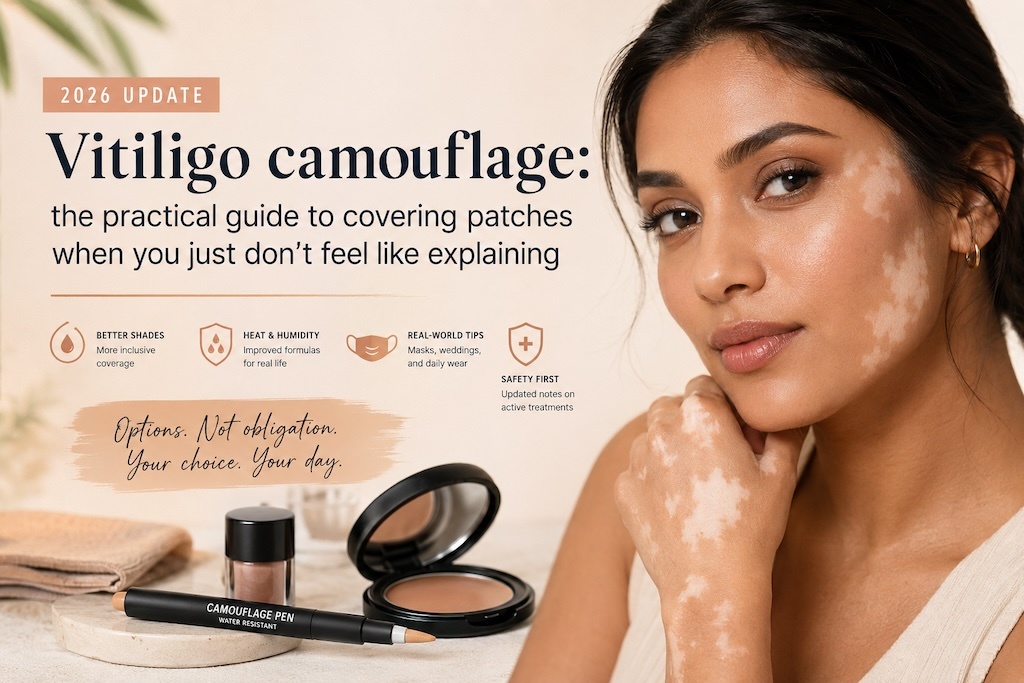
This post from January 2026 was refreshed today with newer product notes, better global shade-range context, heat and humidity considerations, and practical reminders about masks, weddings, and active vitiligo treatments.
In Brief
Vitiligo camouflage is not treatment. It does not change the biology of the disease. But it can change your day.
The best option depends on your goal: quick coverage, low transfer, wedding-day durability, face-friendly blending, hand coverage, or longer-term camouflage.
In 2026, the most useful shift is not magic technology. It is better shade matching, better attention to darker and warmer skin tones, and more realistic claims around heat, sweat, masks, and real life.
What's Inside This Story
Full disclosure: the Vitiligo Research Foundation doesn’t sell products, earn commissions, or get any financial benefit from any recommendation in this guide. We’re simply highlighting practical options when we see them. We’ve partnered with Zanderm before on community projects — camouflage giveaways, training camps and demos, that sort of thing — so we’re using them here as one real-world example of the DHA-based approach.
1. Why camouflage matters
Vitiligo is common worldwide, and it can show up anywhere: face, hands, neck, arms, trunk, feet.
The medical side matters, but so does the “walking around in public with a face people feel entitled to comment on” side.
Treatment takes time. Even when things are going well, it’s usually measured in many months, not days and weeks.
Camouflage fills the gap. It’s immediate. It’s optional. And for some people, it’s the difference between “I’m staying home” and “I’m going to live my life.”
You can accept yourself and still choose convenience. Those two things are not enemies.
2. The 10-minute quick start
- If you need coverage soon, start with the lowest-commitment option.
- If you need a fast solution with minimal skill, look at a vitiligo-friendly DHA-based product or a high-coverage camouflage makeup system.
- If you’re covering face or neck for an interview or formal event, most people prefer a makeup-style finish because it blends like skin and can be adjusted in real time.
- If you’re covering hands or body for events, transfer resistance matters more than perfect matching.
3. Three main approaches
You can think of camouflage as a spectrum. On one end: daily, reversible. On the other end: longer-lasting, more commitment.
Makeup-based camouflage
This is the classic approach: high-pigment foundations and concealers designed for coverage, often paired with setting powder and fixing spray.
What it’s good for: it can match surrounding skin more precisely than many self-tanners. It’s adjustable. If you hate it, you wash it off.
What tends to frustrate people: the learning curve, the time, and the occasional fear that your shirt collar is now part of the makeup routine too.
DHA-based camouflage
DHA (dihydroxyacetone) is the ingredient used in many self-tanners. It reacts with proteins in the outermost layer of skin and creates a temporary color. Some vitiligo-specific products use DHA in a way that’s closer to “stain the white patch” than “tan the whole body.”
What it’s good for: Low transfer once it sets. Useful for hands and body in everyday activities. Often faster and far simpler than full makeup routines, especially with pen-style applicators. Lasts for 2-3 days easily.
What tends to frustrate people: Shade matching can be imperfect. Some DHA products lean warm (orange/rust) on certain skin tones. Fading can be uneven. And some self-tanners take time to develop, so they’re not ideal if you need results in the next 30 minutes and you can't wash it off right away.
A realistic expectation: DHA rarely creates a perfect match. The goal is often reducing contrast so your patch doesn’t “flash” at first glance.
Micropigmentation
It’s sometimes called medical tattooing or cosmetic tattooing. The goal is not decoration. It’s tone correction.
What it’s good for: When done well, it can be life-changing for stable, localized vitiligo in appropriate areas. No daily routine. No transfer. No “did it rub off.” Lasts for months.
What tends to frustrate people: Cost, time, healing, and the fact that it’s not truly permanent in the way people imagine. It typically fades over time and may require maintenance. It is not recommended for everyone, and it’s not ideal for every body area.
A realistic expectation: This is the highest commitment option and should be approached carefully, with a serious practitioner and realistic goals.
4. Zanderm as a fast-cover case study
Zanderm is one of the better-known vitiligo-focused camouflage systems built around quick application and reduced transfer, rather than adapted from general cosmetics.
As a family-owned, New York–based brand, Zanderm has remained closely responsive to community feedback and real-life vitiligo needs. Compared with many specialty or high-end cosmetic options from major cosmetic brands, Zanderm is positioned to be more accessible.
The appeal is speed and simplicity. Rather than building a full makeup routine with powders, brushes, and blending tutorials that start to resemble Renaissance painting lessons, the product focuses on reducing visible contrast quickly.
For the spring 2026 update, Zanderm remains relevant mainly because it keeps improving the practical details: shade sampling, wide and precision applicators, quick-drying use, and troubleshooting guidance.
Their current starter kit lists 11 shades to allow shade testing at home, and their newer support content includes applicator-care instructions for clogged tips. Which sounds tiny until your pen dies three days before a wedding.
As with all camouflage systems, the biggest challenge remains color matching. Most frustration comes not from the product itself but from undertones, edges, and expectations, though application often becomes much easier once a good match is identified.
5. What people buy from China
The Chinese market has a huge number of camouflage products available through global e-commerce platforms, especially waterproof concealer pens and tattoo-style camouflage systems.
The upside is affordability and accessibility.
The caution is consistency. Ingredient transparency, quality control, and shade reliability can vary widely. Patch testing matters.
6. What’s happening in India
India has a massive vitiligo community, and the camouflage landscape there is evolving quickly.
One noticeable 2025–2026 shift is better attention to deeper, warmer, olive, and golden undertones.
This matters especially across India and Asia, where older “fair-to-medium” shade systems often missed the real spectrum of skin tones.
Brands now speak much more openly about humidity resistance, wedding use, and long outdoor wear — which is exactly where camouflage either succeeds or quietly melts into existential disappointment.
Mimiq
Mimiq has drawn attention in India for framing camouflage as choice, not shame. That messaging matters in places where stigma can still be intense. It’s also built around the practical need for products that can handle heat, humidity, and long days.
Microskin India
Microskin has been present in India and is often described as giving a natural look, especially for face, with multi-day wear when applied correctly. Some people use different tools for different areas: a makeup-style finish for the face and a stain-style approach for hands.
International brands like Kryolan Dermacolor and Coverderm are also commonly discussed and used, depending on availability and budget.
Practical note for hot climates: if you live somewhere humid, test camouflage the way you actually live. Walk outside. Wear the clothes. Try the mask. Sweat a little. A product that only works in air-conditioning is not the same thing as “wedding in June” reliable.
7. How to get better results
Undertone matters more than shade
If the color is the right depth but the wrong undertone, it will still look off. This is why some products look too orange, too grey, or too flat. When testing, look at it in daylight, not bathroom lighting that lies to you.
Edges matter
The eye notices borders. A softer edge with a slightly imperfect match usually looks more natural than a perfect match with a harsh edge.
Transfer is its own problem
If you’re using makeup-based camouflage, setting color matters. If you’re using DHA-based staining products, setting time matters. If you’re using either one and wearing white collars, you may want to do a test run before the big day. It’s annoying, but it’s better than discovering the problem in public.
And yes — masks are part of the conversation again.
8. 2026 reality check: masks, weddings, heat, and real life
Recent user conversations around camouflage have become extremely practical.
Less “will this change my identity?” and more “will this survive a wedding, a commute, a mask, and a humid train platform?”
Three themes keep coming up:
- Transfer resistance matters again because masks are back in some settings.
- Wedding-season use is huge, especially for hands, neck, and face.
- Heat and humidity separate “looks good indoors” from “actually useful.”
The practical answer is simple: test products in real life before trusting them during important events.
Real life is the lab.
9. Skin safety and common-sense precautions
Patch test everything
Especially if your skin is sensitive or medically active.
Be careful with active treatments
If you are using topical steroids, calcineurin inhibitors, retinoids, phototherapy, or topical JAK inhibitors such as ruxolitinib cream, do not treat camouflage like harmless paint.
Your skin barrier may already be irritated or medically stressed.
Allow treatment products to absorb fully before applying camouflage and avoid layering products over broken or inflamed skin.
Current JAK inhibitor prescribing information also continues warning against use during active serious infection and discourages casual combination with biologics or other strong immunosuppressants.
Camouflage is not sunscreen
Depigmented skin is often more sensitive to UV exposure. Camouflage products do not replace sun protection.
10. Practical recommendations
If your goal is:
- quick occasional coverage, start with low-commitment solutions
- durability through events, prioritize transfer resistance and setting over perfection
- surviving summer in a humid climate, test outdoors before trusting your dignity to the product
- long-term camouflage and your vitiligo has been stable, micropigmentation may be worth exploring with a reputable specialist.
And if your goal is doing absolutely nothing — that’s also completely valid.
Camouflage is not a lifestyle. It’s an option you keep nearby.
Suggested reading
- Vitiligo Patient Journey Map
- Tattoo Ink and Vitiligo: A Cautionary Case of Systemic Reaction to Red Ink
- The Hidden Danger of Cosmetics
- Phototherapy: How Long Does the Color Stay?
By Yan Valle, Prof. h.c., CEO, Vitiligo Research Foundation
FAQOther Questions
- Why Does the IRS Still Show an Old Revocation for VR Foundation?
IRS Status · A Short FAQ The old entry records the past. Publication 78 shows where VR Foundation stands today. Updated August 2026 · EIN 45-2498489 Tax records are rarely elega...
- Shall I try low-fat diet for my vitiligo?
The link between dietary fat and autoimmune diseases like vitiligo is a compelling yet complex puzzle that continues to intrigue scientists. While the conversation is ongoing, o...
- What joining a clinical trial actually looks like?
Pediatric vitiligo trials · Taking part Cream twice a day, scheduled visits and the practical questions every mother asks before committing the family calendar. The studies disc...
Though it is not always easy to treat vitiligo, there is much to be gained by clearly understanding the diagnosis, the future implications, treatment options and their outcomes.
Many people deal with vitiligo while remaining in the public eye, maintaining a positive outlook, and having a successful career.
Copyright (C) Bodolóczki JúliaBy taking a little time to fill in the anonymous questionnaire, you can help researchers better understand and fight vitiligo.